
No one set out to invent a ceramic fiber braiding machine. The machine that braids your gland packing today began life in the textile and wire-and-cable industries as a maypole braider, and it changed only when the yarn changed. That single fact explains almost everything a buyer finds strange about these machines: why a braider that costs as much as a machining centre turns its spindles at sixteen revolutions a minute, why the carriers hang upside down behind tempered glass, and why a broken end stops the whole machine instead of merely leaving one yarn missing.
This page walks the five engineering generations in order — borrowed textile braider, brittle-yarn retrofit, enclosure and inversion, inverter control with break-stop, and in-braid impregnation with automatic lubrication — and then gives you a spec-sheet reading guide so you can place any machine you are offered into one of them. It is the machine-side companion to our material history, which covers the fiber itself from 1941 onward.
A Note on Dates Before the First Generation
One honesty rule first, because it shapes everything below: the public record does not carry reliable dates for these generations. We can date companies — a Chinese braider maker registered in June 2001, a refractory fiber producer founded in 2002, which together place the industrialisation of this equipment in China around the turn of the century (industry reference) — but not the machine stages. So the five generations here are ordered by engineering logic: each one exists because the previous one hit a wall that only a design change could clear. Where a claim has a source we label it; where it is reasoning from physics we say so. A supplier who offers you exact founding dates for braider generations is guessing as hard as anyone else.
Generation 1: A Textile Braider With a Different Yarn
Gland packing became its own product category long before ceramic fiber existed, and the equipment that made it was the equipment the textile industry already had: maypole braiders with horn gears, carriers and a braiding point, shared with rope, lace and cable sleeving. Asbestos made that borrowing painless. Chrysotile and its relatives are hydrated silicate minerals whose fibers are flexible, splittable and carry some elongation — spin-friendly in every sense — so a conventional braider could run them at conventional speeds with conventional tension. Chinese maker catalogues from the packing era list asbestos and gland packing on the same machine family, which is the cleanest public evidence that the two products shared one equipment pool (industry reference).
The consequence for a buyer reading old literature: specifications from the asbestos era describe a machine that never had to protect its yarn. Every adaptation that defines a modern ceramic fiber braider is absent from them, which is why an old datasheet can look impressively fast and be completely unusable for ceramic fiber.
The yarn change that forced every later generation
| Property | Asbestos-era yarn | Ceramic fiber yarn |
|---|---|---|
| Elongation before break | Some; the yarn absorbs let-off shocks | Almost none; a tension spike is a break |
| Flexibility | Flexible, splittable, forgiving in the guide path | Stiff and brittle; abrasion cuts filaments |
| Surface | Relatively clean | Shot particles and hard filaments abrade every eyelet it touches |
| Dust when handled | Present but the fiber is long and cohesive | Respirable, abrasive dust at every transfer point |
Generation 2: The Brittle-Yarn Retrofit
When asbestos was restricted on health grounds and ceramic fiber took its place as the high-temperature packing material, the machine met a yarn that cannot be pulled. Four adaptations followed, and together they are the definition of this generation.
What brittle ceramic fiber forced onto the braider
| Yarn property | Machine response | Evidence |
|---|---|---|
| Brittle, near-zero elongation | Lower let-off tension per spindle; tension drop-weights added to lengthen the yarn path and absorb shocks; eyelets polished hard | Reasoning from fiber physics, supported by a published patent (patent example CN215404862U) |
| Shot and hard filaments abrade guides | Alumina (Al2O3) ceramic rings at the wear points; harder rotor materials | Published patents (patent example CN215404862U, CN222390022U) |
| Respirable abrasive dust | Enclosed doors; dust routed downward toward the braiding point and collection | Published machine specifications (industry reference) |
| Speed breaks the yarn | Low spindle speed, high torque as a design direction; square packing braiders at 10–25 min-1 | Published parameter tables (industry reference) |
The spindle-speed number deserves a defence, because it is the one specification that gets misread as backwardness. Square packing braiders run at 16 min-1 on one published 32-carrier model and 25 r/min on our own 336 series (field practice). At those speeds the inertial let-off from a spinning carrier stays inside what a brittle yarn can absorb. Raise the speed and the carrier pays out faster than the braiding point consumes; the slack whips, the yarn snaps, and — with metal-wire reinforcement in the carrier — the heavy wire keeps coasting and flings its yarn into a tangle across the neighbouring carriers. A published patent states the failure exactly this way: after a sudden power cut every loaded carrier coasts while braiding and tension stop, and the inertia of the heavy carriers throws yarn into knots that surface at the next start as a wavy, slack braid (patent example CN103173928B). The industry's answer is a brake that acts at the moment of stop, with the shortest possible inertial let-off and the smallest possible tension swing across the stop.
Generation 3: Enclosure, and the Machine Turns Upside Down
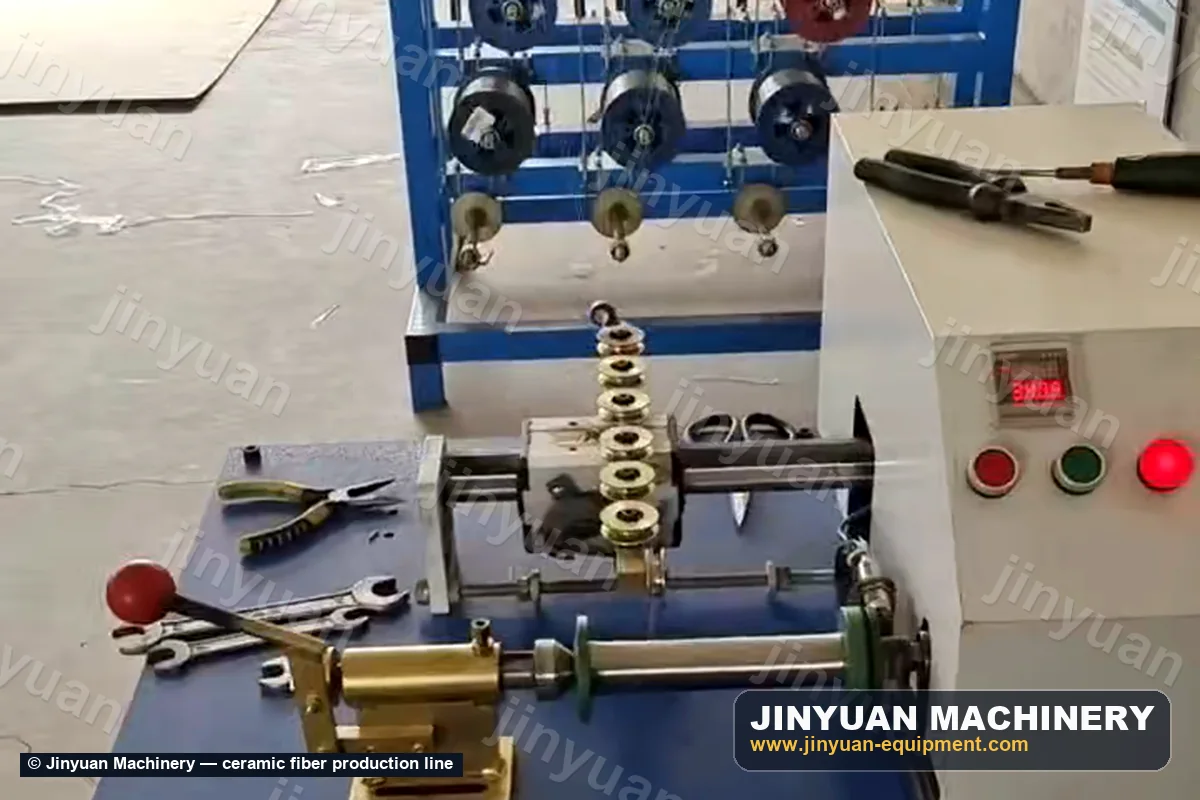
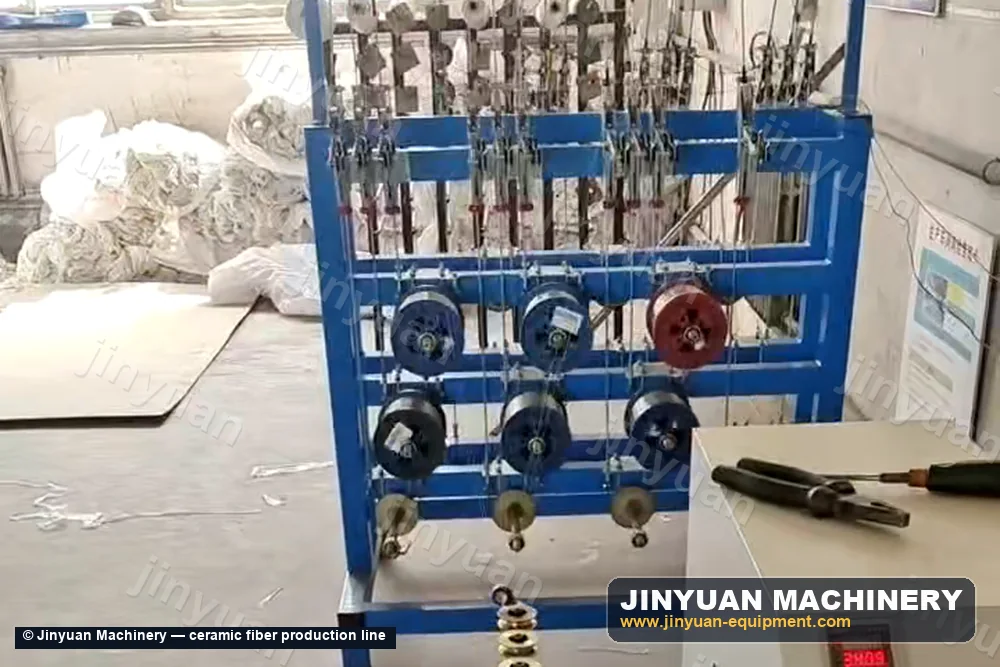
Early ceramic fiber braiders kept the textile layout: carriers standing upright on an open deck. That layout puts the dust source at chest height, in the operator's breathing zone, with nothing between it and the shop. The modern mainstream answer inverts the machine — carriers mounted above, braiding point below — and closes it in an aluminium-profile frame with tempered-glass doors and a door-open stop interlock (industry reference).
How settled is this? About as settled as a machine layout gets: at least one braider manufacturer states in its own product line that open-frame models are fully discontinued, with spare parts supplied only to existing customers (manufacturer statement). When a maker stops selling the old layout rather than discounting it, the layout question is closed.
- Braid quality — the enclosed inverted deck braids tighter with a more even pattern; our 336 series lists exactly this as a machine characteristic (field practice).
- Noise and dust — the doors contain both at speed, which is what makes an eight-hour shift beside the machine tolerable.
- Safety — the door-open stop is the interlock that makes an enclosure safe to reach into; it is standard on inverted high-speed models (industry reference).
- Dust direction (reasoning, not a published claim) — with carriers above and the braiding point below, gravity carries fiber dust toward the braiding zone and collection rather than into the breathing zone; this is our engineering reading of the layout, not a quoted specification.
- A cost you should plan for — inversion moves bobbin loading to the top of the machine, so carrier changeover needs its own procedure and tooling; see the changeover guide.
Generation 4: The Inverter Replaces the Gearbox, and the Machine Learns to Stop Itself
Speed control on these machines moved through four regimes, and the regime a machine uses is the fastest way to date it.
Speed-control regimes, oldest to newest (industry reference)
| Regime | Speed set by | Density set by |
|---|---|---|
| Change gears | Swap gear pairs, machine stopped | Swap gear pairs |
| Mechanical CVT | Mechanical variable-speed drive | Mechanical variator |
| Inverter | Synchronous stepless plus inverter stepless | Synchronous stepless plus inverter stepless |
| Servo | Servo motors in closed loop | Programmed |
Our 336 series sits in the inverter regime in its mature form: the main drive holds a constant rated 25 r/min while the take-up has its own independent stepless drive, so braid density is adjusted at the take-up without touching the braiding point (field practice). That split — constant braiding speed, independent take-up — is what separates a real inverter-generation machine from an old gearbox machine with a frequency controller bolted onto the main motor.
The second half of this generation is stopping. On a textile braider a broken end costs one yarn and a knot. On a ceramic fiber braider the carrier keeps paying out after the break, because nothing about the break stops the deck; the brittle yarn whips loose and wraps adjacent carriers, turning a single break into a mass tangle and sometimes into mechanical damage. Break-stop is therefore not a convenience feature but a fault-prevention requirement, and published manuals go one step further: on at least one 16-carrier model the stop must be accompanied by a spring plate and break detector that clamp the broken end, so the loose tail cannot wander (industry reference, manual transcript). Door-open stop belongs to the same idea: the machine treats any opening of its envelope as a stop condition.
Generation 5: Impregnation Moves Inside the Braid, and Lubrication Stops Depending on Memory
Impregnation — loading the braid with lubricant, PTFE dispersion or graphite depending on the packing recipe — used to be a separate station: braid off the machine, dip or impregnate, dry, rewind. Modern inverted high-speed models instead carry a central emulsion impregnation unit with a heated plate at the braiding point, electrically lifted, so the yarn is impregnated and set in the same pass that forms the braid (industry reference). That removes a dip tank, a drying step and two handling operations of half-finished product.
Two cautions belong with that claim. First, the impregnation plate is a product positioning choice, not a generation badge: semi-automatic round inverted models are sold without an impregnation tray, with adjustable braid density, for ceramic fiber square and round rope (manufacturer statement). If you do not need impregnated packing, paying for the plate is paying for a process you will not run. Second, in-braid impregnation only pays when the recipe and the heating are matched to the yarn; a heated plate running the wrong dispersion is a very expensive way to make sticky braid.
Automatic lubrication is the quieter half of this generation and the easier one to justify. Ceramic fiber dust is hard, abrasive dust; whatever escapes into grease turns the grease into lapping compound on gears and ways. Manual greasing depends on shift discipline — missed intervals wear the drive, excess grease migrates onto yarn and stains product — while an automatic pump with a settable interval turns lubrication from a habit into a machine setting (industry reference).
Where the high end is heading: wire-braider maintenance tiers (industry reference)
| Interval | Work |
|---|---|
| Daily | Clean-down; belt tension check |
| Weekly | Tension sensor verification; guide-rail clearance; replace ceramic guide wheels |
| Monthly | Strip and clean gearboxes; check servo encoders; calibrate temperature compensation |
| Quarterly | Replace main drive chains; check hydraulic seals; re-level the machine |
| Yearly | Full strip-down; replace bearing sets; re-calibrate sensors; software upgrade |
Reading a Braider's Generation From Its Spec Sheet
Generations are not marketing; they are visible in seven specification lines. Read them in this order and a datasheet tells you what decade of thinking the machine was built with, whatever the brochure claims.
Seven spec lines that place a machine in its generation
| Spec line | What it reveals | Ask this |
|---|---|---|
| Spindle speed and how it is set | Gear pairs = generation 1–2; inverter with independent take-up = generation 4 | “Is take-up speed independent of main speed, and over what range?” |
| Frame and enclosure | Open deck = pre-generation 3; aluminium frame, tempered glass, door interlock = generation 3 onward | “Door-open stop: interlocked or advisory?” |
| Break detection | None = pre-generation 4; stop plus end-clamping = mature generation 4 | “What holds the broken end after the stop?” |
| Impregnation | Absent, dip tank, or heated plate at the braiding point | “Is the plate heated and lifted, and which dispersions are proven on it?” |
| Lubrication | Manual points versus automatic pump with settable interval | “What is the factory interval, and what grease is specified?” |
| Guide materials | Steel eyelets = pre-generation 2; alumina ceramic rings = generation 2 onward | “Which wear parts are ceramic, and are they standard sizes?” |
| Carrier layout and count | Vertical open versus inverted enclosed; carrier count sets the braid structure you can run | “Show me the carrier count against the packing sizes I sell.” |
Two of those lines connect directly to pages we have already written: the tension drop-weights and ceramic eyelets in line six are the subject of the yarn tension and threading guide, and carrier count in line seven is the whole story of the braid structure article. The twelve-station process page places the braider inside the line, and the machine page carries the current specification of what we build.
What We Deliberately Do Not Claim
Three things this page will not give you, on purpose. It will not give you years for the five generations, because the public record does not support them and invented dates are worse than none. It will not tell you that ceramic fiber is a harmless substitute for asbestos: refractory ceramic fibers sit in IARC group 2B, and fiber that has served above roughly 1,000 °C can partly convert to cristobalite, crystalline silica, which is IARC group 1 — the enclosure and dust routing of generation 3 exist precisely because substitution reduced a hazard without removing it. And it will not tell you that newer is automatically better for your product: a semi-automatic round inverted braider without an impregnation plate is the correct machine for square and round rope, and buying generation 5 features you will not use is how capital budgets die.
The Bottom Line
The ceramic fiber braiding machine is a textile machine that was rebuilt five times by a yarn that cannot stretch. Each generation closed one specific failure: brittleness closed with tension weights and slow spindles, dust closed with enclosure and inversion, uncontrolled stops closed with inverters and break-stop, and separate impregnation and hand greasing closed with in-braid plates and automatic pumps. Read a spec sheet against those five closures and you are not buying a brochure — you are buying a known position in a known engineering sequence.
Frequently Asked Questions
When were ceramic fiber braiding machines invented?
There is no reliable public date, and anyone quoting one is guessing. What can be dated is the industry around the machine: Chinese braider and refractory fiber makers were registered around 2001–2002, which places the equipment's industrialisation near the turn of the century. The machine itself evolved in five engineering generations — borrowed textile braider, brittle-yarn retrofit, enclosure and inversion, inverter control with break-stop, in-braid impregnation with automatic lubrication — ordered by design logic rather than by years.
Why do ceramic fiber braiding machines run so slowly?
Because ceramic fiber yarn has almost no elongation. Published square packing braiders run at 10–25 min⁻¹ — 16 min⁻¹ on one 32-carrier model, 25 r/min on our 336 series — because at higher speed the carrier's inertial let-off pays out faster than the braiding point consumes and the brittle yarn snaps. A published patent describes the same physics after a power cut: coasting carriers, especially heavy metal-wire ones, fling yarn into tangles. Slow is an adaptation, not a limitation.
What is an inverted braiding machine?
A layout in which the carriers are mounted above and the braiding point sits below, inside an enclosed aluminium-profile frame with tempered-glass doors and a door-open stop. The inversion routes fiber dust downward toward the braiding zone instead of into the operator's breathing zone, and the enclosure contains noise and dust at speed. The trade is that bobbin loading happens at the top of the machine, so changeover needs its own procedure.
Are open-frame braiding machines still being made?
Effectively no. At least one braider manufacturer states in its own product line that open-frame models are fully discontinued, with spares supplied only to existing customers. Enclosed inverted machines are the mainstream layout, and an open frame offered today should be treated as old stock or a special build — ask why the current layout was not used.
Why does a braider need break-stop when a textile braider does not?
On a textile braider a broken end leaves one yarn missing and is knotted back. On a ceramic fiber braider the carrier keeps paying out after the break, and the brittle yarn whips loose and wraps adjacent carriers, turning one break into a mass tangle and sometimes into mechanical damage. Published manuals go further and require the broken end to be clamped by a spring plate and detector at the moment of stop, so the tail cannot wander.
What does in-braid impregnation change?
It moves impregnation from a separate dip-and-dry station into the braiding point: a central emulsion impregnation unit with a heated plate, electrically lifted, impregnates and sets the yarn in the same pass that forms the braid, removing a dip tank and two handling steps. It is not universal — semi-automatic round inverted models are sold without an impregnation tray for square and round rope — so treat it as a process choice matched to your packing recipe, not as a mark of quality.
How can I tell an old braider from a new one on the spec sheet?
Check four lines. Speed set by change gears or a mechanical variator places the machine before the inverter generation; an inverter with an independent stepless take-up is the mature form. An open deck without a door interlock predates enclosure. No break detection, or stop without end-clamping, predates generation 4. Manual grease points instead of an automatic pump with a settable interval predate generation 5. Steel eyelets instead of alumina ceramic rings predate generation 2.
Is braiding ceramic fiber safer than braiding asbestos packing was?
Safer, not safe. Ceramic fiber replaced asbestos because it keeps high-temperature sealing capability with a less severe carcinogenicity classification — refractory ceramic fibers are IARC group 2B — but fiber that has served above roughly 1,000 °C can partly convert to cristobalite, crystalline silica, which is IARC group 1. That is exactly why the enclosed, dust-routing layout of the third generation exists: substitution reduced the hazard, it did not remove it, and the machine's enclosure is part of the exposure control.