
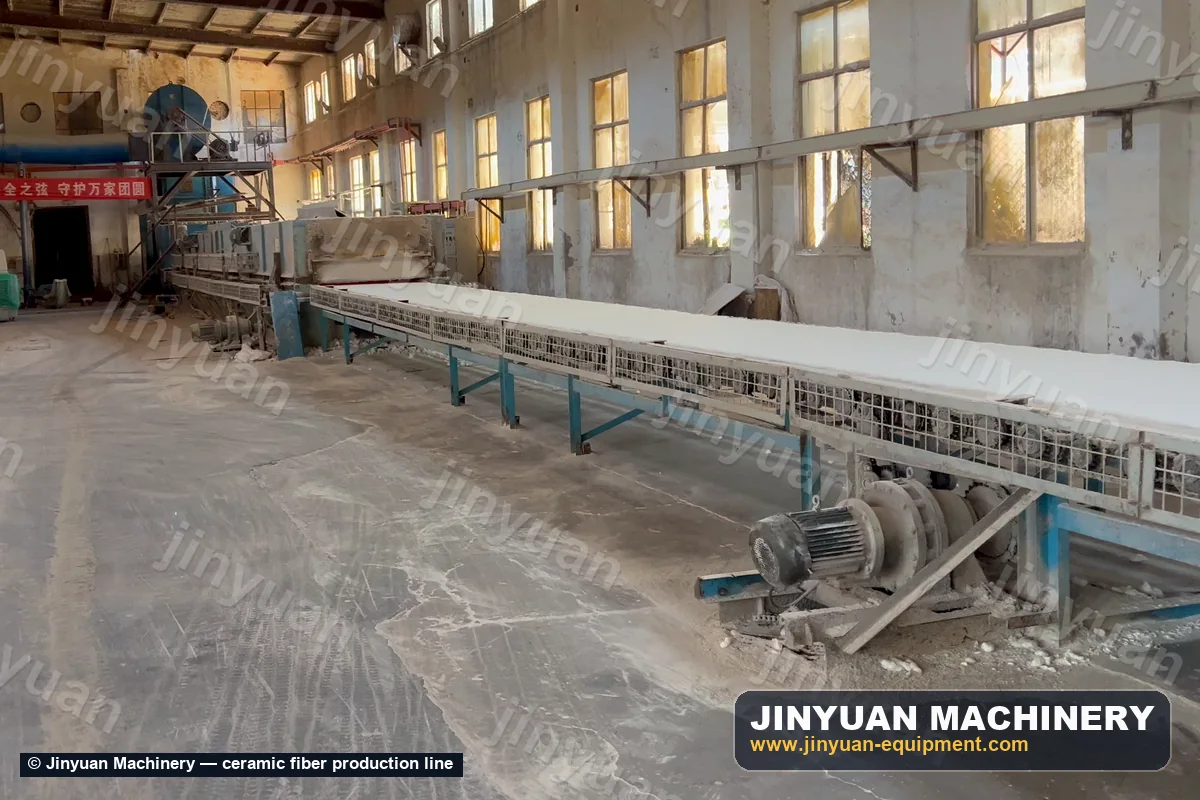
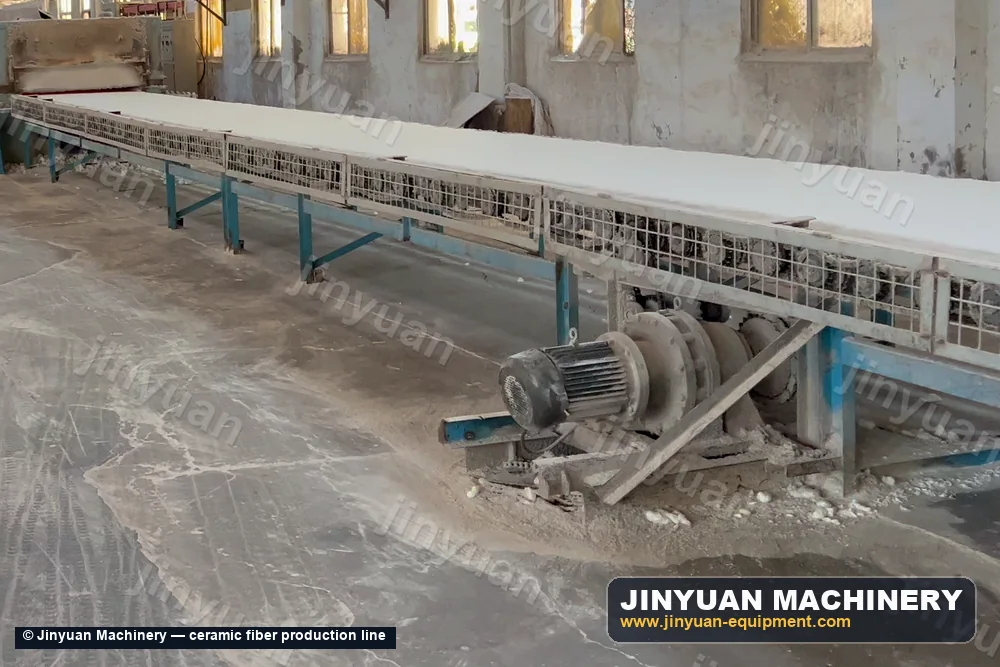
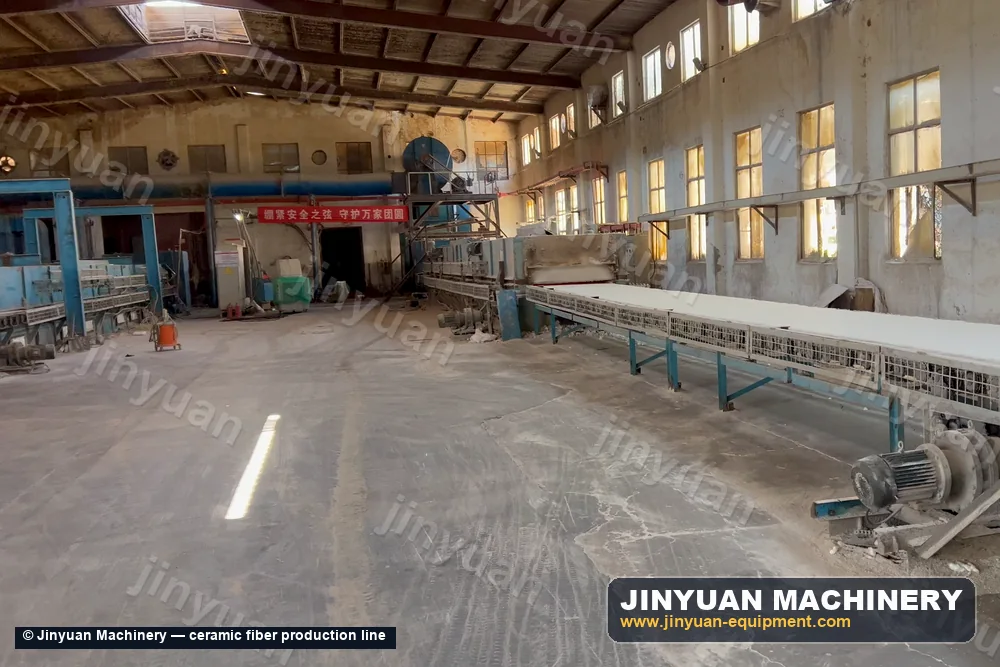
A ceramic fiber blanket line is usually presented as a list: eight host systems in process order, nine auxiliary systems beside them, each with a function in a table cell. That list is true and it is also useless for the two questions that actually decide a project — which configuration matches the product you sell, and which machine will cap the line once it is running. This page is the line read as a configuration and a constraint chain instead of as a catalog: the equipment sizing for your product mix, the two machines that govern speed, the five wear parts that govern uptime, and the four retrofits that pay in order. The hall photographed is our own, and the conveyor run crossing it is the line's spine.
Our equipment list catalogs the nine systems and prices the utilities, and our economics page owns money per tonne. What lives here is the engineering between them: the configuration sheet, the constraint map, and the upgrade ladder.
The Configuration Sheet You Actually Compare
On a needle-punched blanket line, specify the resistance furnace and centrifugal spinner against the same melt rate and product grades. Carry the same output target through the fiber collector, needle loom, curing oven and finishing stations. Ask the supplier to state the assumptions behind the blanket line specification.
The Bottleneck Chain: Two Machines Cap the Line
Every station on the line can be bought with headroom except two. Melting rate rises with power, collection rises with negative pressure and belt width, cutting and winding rise with drive size — but needling bond and curing residence cannot be bought with anything except machine size. Needling is a stroke process: the bond a blanket carries is punches per minute times pattern density, so speed bought without strokes arrives as an under-bonded web. Curing is a time process: the blanket must spend its minutes at temperature, and minutes are furnace length divided by line speed. Those two facts make the loom and the furnace the line's speed governors, and they are the two machines whose nameplate deserves the closest reading. The same two governors reappear one interface at a time on our line handoffs page, where every stage-to-stage handoff carries the indicator that proves it arrived in spec.
The two governors and how each one binds
| Governor | Why it caps speed | Signal when it binds |
|---|---|---|
| Needle loom | Bond is strokes per minute; density needs passes | Under-bond, delamination at speed |
| Curing furnace | Residence is length over speed; shrinkage needs minutes | Shrinkage returns; under-set core |
The practical reading is a question to put to any quotation: which of the two governors does the nameplate speed assume, and what happens to bond and shrinkage if the product mix moves thicker? The loom side is worked through on our stroke-rate page and the furnace side on our curing furnace page; the point here is that they are one chain, because a speed change at either end changes what the other one delivers without moving a single setpoint.
The Wear-Part Ledger: Five Items That Set Uptime
Five consumables carry most of a line's unplanned stops and most of its spare-part budget. They wear by five different mechanisms and each gives a different early signal, which is why the ledger below is written as mechanism and signal rather than as a replacement interval:
The five high-value wear parts, their mechanism and their early signal
| Part | What wears it | Signal before failure |
|---|---|---|
| Molybdenum electrodes | Erosion and oxidation at the melt line | Rising current for the same melt |
| Orifice / bushing | Erosion widens the flow path | Fiber diameter spread widens |
| Rollers and bearings | Thermal cycling and fine dust | Vibration and bearing temperature |
| Needles | Fatigue at the barb root | Breakage rate and bond drop |
| Silicon carbide rods | Resistance rises with service age | Zone needs more voltage monthly |
The ledger's real subject is procurement, not maintenance: these are the five items whose lead time can stop a line, so they are the five items whose stock policy is a production decision. The roller and bearing side is detailed on our roller maintenance page and our spare-parts list, the needle side on our needle breakage page, and the rod side on the curing furnace page — rods age into a voltage compensation schedule and end in group replacement, never one at a time.
The Retrofit Ladder: Four Upgrades in Payback Order
Public practice documents four retrofit directions on existing lines, and they are worth reading as a ladder rather than a menu, because the order is the payback:
Four retrofit directions and what each one buys
| Retrofit | What it buys | Where it hurts |
|---|---|---|
| Resistance furnace for arc | About half the melting power bill | Transformer and regulator scope |
| Two-roller for three-roller | Fewer bearings, longer roller life | Re-specified spinner drive |
| Cross needling | Isotropy across machine direction | Loom head and pattern work |
| Staged heat treatment | Lower linear shrinkage in service | Longer furnace or slower line |
Energy first, because it pays every hour the line runs and its saving is documented at roughly half the melting power bill when a resistance furnace replaces an arc furnace. Reliability second: the two-roller spinner drops a row of bearings and the faults that come with it, which is the argument worked through on our roller-count page. Product quality last, because it pays in claims avoided and grades unlocked rather than in kilowatt-hours: cross needling buys isotropy across the machine direction, and staged heat treatment buys service shrinkage — but staged treatment buys it with residence time, which is borrowed from the bottleneck chain above. That is why it sits at the top of the ladder: it is the upgrade that has to argue with the curing furnace first.
The Auxiliary Half, Read as Dependencies
The nine auxiliary systems are usually handed over as a shopping list. Read them instead as dependencies, each with a named host machine that fails in a named way when the utility sags:
- Nitrogen. Protects the orifice from high-temperature oxidation; without it the flow path erodes into a fiber-diameter problem, not a gas problem.
- Cooling water. Carries heat from the furnace shell, the orifice base, the electrode jackets and the spinner; a flow loss is a melt-end emergency within minutes.
- Compressed air. Feeds web-belt cleaning and the cross-cut cylinders; a pressure sag shows up first as a dirty belt and a hesitating cutter.
- Induced-draft negative pressure. Does double duty as collection transport and environmental capture, the pairing detailed on our dust collection page.
- Electrical and DCS. Holds the speed chain together; the regulator is a throttle only because the control layer treats it as one.
Framed this way the auxiliaries stop being the half of the line nobody prices and become what they are: the half that decides which host machine fails first. A line commissioned without its utilities is a line whose bottleneck is discovered by accident.
What We Deliberately Do Not Claim
Four boundaries. We publish no nameplate capacity, configuration price or payback figure for our own works on this page: those are contract-specific and a page of typical values would age into a lie. The retrofit payback order is structural — energy before reliability before quality — while the actual payback of any one retrofit is a function of your tariff and tonnage, which is the economics page's subject. And the bottleneck claim is structural too: on any given day a starved collection station or a faulted drive will cap a line, which is a fault, not a configuration.
The Bottom Line
A ceramic fiber blanket line is not eight machines in a row; it is one constraint chain wearing a catalog's clothes. The furnace and centrifugal spinner set the fiber feed to the rest of the line. Two machines decide how fast it may run, the loom and the furnace, because bond and residence are bought with size and not with speed. Five wear parts decide how often it stops, and their lead times decide whether a stop is an hour or a season. Four retrofits decide how the line ages, in payback order, with staged heat treatment last because it must argue with the furnace first. Read a configuration sheet that way — feed, bottlenecks, wear parts and upgrades — and the nine-system list finally means something.
Frequently Asked Questions
What are the main systems of a ceramic fiber blanket production line?
Eight host systems in process order: batching and feeding, the resistance melting furnace, centrifugal fiber formation, cotton collection and web laying, needling, heat setting in the curing furnace, lengthwise and cross cutting with measuring, and winding. Around them sit nine auxiliary systems, from raw-material grinding and mixing through compressed air, nitrogen, cooling water, dust extraction and the DCS control layer. The full catalog with each system's components is on our equipment list page.
How do I compare two blanket line configurations?
Use the same finished roll widths, thicknesses, densities and operating schedule. Compare the rated output and scope of melting, spinning, collection, needling, curing and finishing against that product mix.
Which machine limits the speed of a ceramic fiber blanket line?
Two machines, structurally: the needle loom and the curing furnace. Needling bond is strokes per minute times pattern density, so speed bought without strokes arrives as an under-bonded web that delaminates. Curing residence is furnace length divided by line speed, so speed bought without length arrives as returned shrinkage. Every other station can be bought with headroom; these two are bought with size.
What are the high-value wear parts on a ceramic fiber line?
Five carry most of the unplanned stops and the spare-part budget: molybdenum electrodes, the orifice or bushing, spinning rollers and their bearings, needles, and silicon carbide rods. Each wears by a different mechanism and gives a different early signal, from rising current for the same melt through widening fiber diameter spread to a zone that needs more voltage every month. Their lead times, not their prices, are what make them critical.
How is resistance furnace power controlled on a ceramic fiber line?
Through a dedicated transformer stepping 380 V down to roughly 10 to 180 V, with a single-phase magnetic regulator moving that secondary voltage continuously. Melt rate therefore tracks demand without switching elements, which is why furnace capacity is quoted in transformer kVA, in the 300 to 1050 kVA class, rather than in element wattage. The DCS layer above treats that regulator as a setpoint rather than a handwheel.
Which retrofits pay back first on an existing ceramic fiber line?
In payback order: replacing an arc furnace with a resistance furnace, documented at about half the melting power bill; replacing a three-roller spinner with a two-roller machine to drop a row of bearings and their faults; cross needling for isotropy across the machine direction; and staged heat treatment for lower service shrinkage. The last pays in claims avoided rather than kilowatt-hours, and it costs residence time, so it must be argued with the curing furnace first.
What utilities does a ceramic fiber line depend on?
Nitrogen for orifice oxidation protection, cooling water for the furnace shell, orifice base, electrode jackets and spinner, compressed air for web-belt cleaning and cross-cut cylinders, induced-draft negative pressure doing double duty as collection transport and environmental capture, and the electrical and DCS layer holding the speed chain together. Each is a named dependency of a named host machine, which is why utilities are commissioned with the line rather than after it.