
After the needle loom, a ceramic fiber blanket is still a promise: the right fiber, the right density, the right thickness — and a structure that has never been hot. The curing furnace is where the promise is kept. In one continuous pass it burns off what the upstream stages carried in, shrinks the felt to the thickness the order names, drives the phase change that decides the blanket's service temperature, and hands the rolling end a product that will not move again. This page is the machine itself: the four zones and each one's duty, the ramp curve that protects the lining and the binder, the six controls that keep the curve true, and the maintenance regime — rods, thermocouples, lining, conveyor, exhaust — that keeps the machine able to hold it.
Our process page covers heat setting as stage six of seven, our equipment list covers the parity between the setting furnace and the dryer, and our parameter reference carries the control windows. What lives here is the furnace's own engineering: zone by zone, degree per minute, rod by rod. The hall photographed is our own curing shop, and the line running along its left side is the tunnel this page walks through.
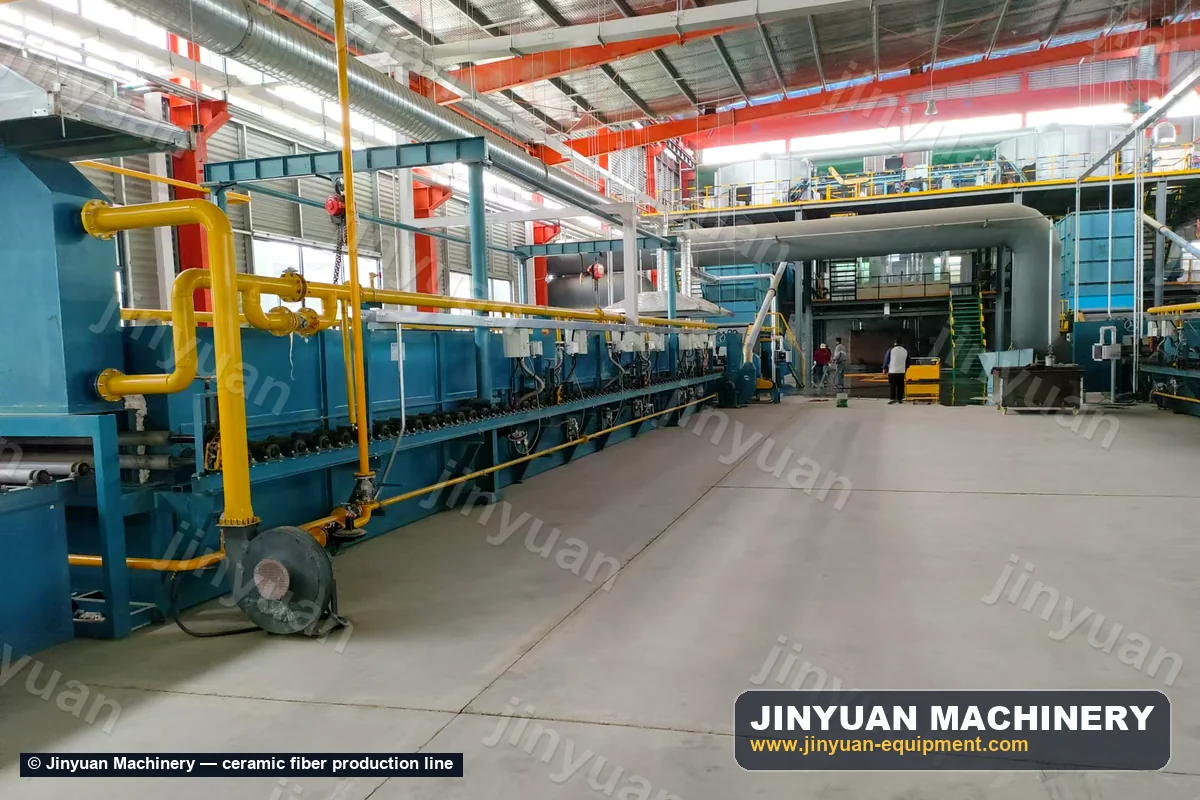
Four Zones, Four Duties: What Each Temperature Band Does to the Fiber
The tunnel is not one hot room; it is a ladder, and each rung has a different job on the fiber structure. Read the zones as a sequence of chemical and physical events and the setpoints stop being arbitrary:
The four zones, their duties and their failure signatures
| Zone | Duty on the blanket | When the zone misses |
|---|---|---|
| Preheat, 200-400 °C | Burn off lubricant and binder, relieve needling stress | Residue carries on; carbonized face |
| Setting, 600-800 °C | Uniform pre-shrink to ordered thickness | Uneven set; thickness out of tolerance |
| Phase change, 900-1200 °C | Crystal transition that lowers service shrinkage | Shrinkage returns in service |
| Cooling | Safe handling temperature for winding | Scorch marks; wound rolls deform |
The ladder is sequential logic, not four independent ovens. Binder that survives the preheat zone carbonizes in the phase-change zone, because the temperature that drives crystallization also bakes organics into stain. Shrinkage the setting zone did not finish becomes permanent linear change in the customer's lining, which is why the phase-change zone owns the shrinkage number on the test report. And cooling is a product-quality zone too: a blanket wound above its safe handling temperature deforms under its own roll weight, and that deformation is discovered at the customer's unpacking, not at yours. Each zone's controller holds a setpoint; the zone's duty is what makes the setpoint matter. What the fiber itself is doing inside those zones — the aids that must leave, the setting band that fixes dimensions and the phase-change band that repairs the damage the line already did — is the subject of our heat treatment page.
The Ramp Curve: Why Degrees per Minute Is a Controlled Variable
Zone setpoints say where the blanket ends up; ramp rate says whether it arrives intact. Two things break under a too-fast ramp. The lining, whose thermal mass lags the gas temperature, cracks under thermal shock when the gas outruns it. And the binder, whose volatiles must leave through the exhaust, can deflagrate instead of evaporating if it is released faster than the exhaust can carry it — which is why ramp rate and exhaust patency are one system, not two. A granted Chinese patent (CN120247400B) publishes one worked two-stage curve for high-temperature setting: a first stage at 1 °C per minute to 600 °C with a one-hour hold, then under nitrogen at 3 °C per minute to 1000 °C with a one-hour hold, followed by rapid air cooling.
Read as engineering rather than as a recipe, that curve is a statement of priorities: slow through the burn-off and stress-relief band where volatiles leave and the lining lags; faster once the volatiles are gone; protective atmosphere through the hottest climb where oxygen embrittles fiber; and cooling fast enough to protect the product's structure but never forced against a hot lining. The same logic governs shutdown, and here sits the rule with no exceptions: never open the doors of a hot furnace, and never force-cool a lining with fans or water. A lining cracked by thermal shock is not repaired by the next schedule; it is repaired by a reline, and every batch until then carries the dust of it.
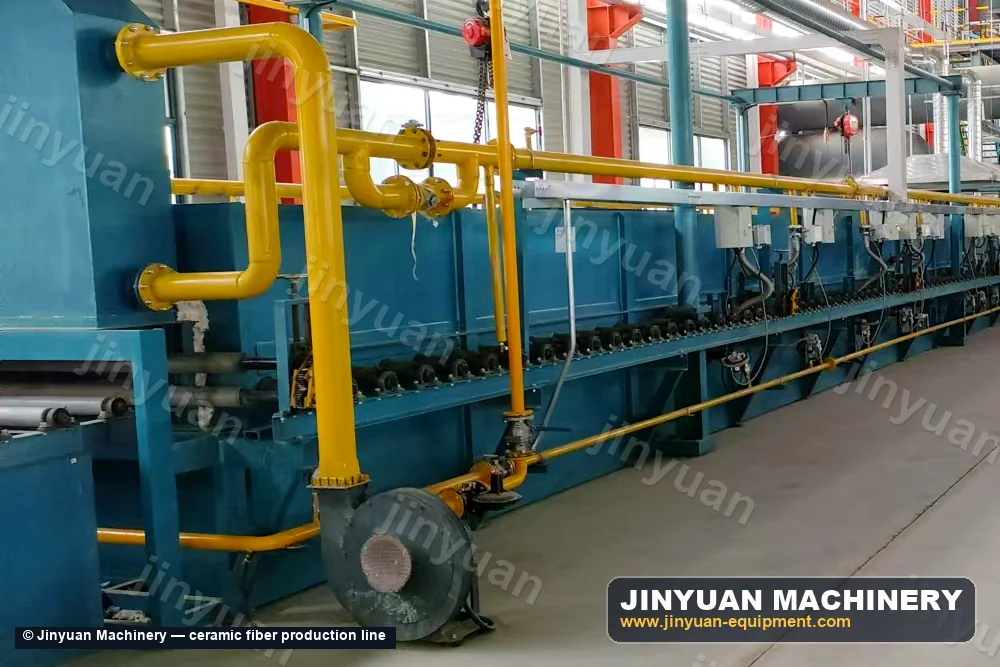
Six Controls That Keep the Curve True
The six control items, their targets and their drift signatures
| Control | Target | When it drifts |
|---|---|---|
| Zone temperatures | The process curve, zone by zone | Residue and high shrinkage when low |
| Ramp rate | Segmented, per the published curve | Lining shock and binder deflagration |
| Line speed and residence | Long enough for full phase change | Shrinkage returns when too fast |
| Conveying tension | Dimensional stability in the hot zone | Thickness out of tolerance |
| Furnace atmosphere | Air, or nitrogen where the recipe calls | Oxidation embrittlement of fiber |
| Exit temperature | Down to a safe handling value | Burns and wound rolls that deform |
Residence time is the integrator of the whole furnace, and line speed is its dial: speed sets how long each metre of blanket spends in each zone, so a speed change is a curve change even when no setpoint moves. That is why speed is interlocked with the zone profile on a commissioned line, and why the exit temperature probe sits on the panel permanently — under-set blanket re-expands or changes dimension after rolling, and the exit probe is the earliest place that debt becomes visible. Tension belongs on the same list because a hot blanket is at its most plastic: pull too hard and the thickness you set at the loom is not the thickness you wind.
Atmosphere: Air by Default, Nitrogen by Exception
Most of the tunnel runs in air, and for most grades that is correct: the oxygen helps burn off organics in the preheat zone and costs nothing. Nitrogen protection exists for one reason: at the top of the curve, oxygen embrittles the fiber surface, and a blanket whose surface embrittles sheds dust for the rest of its life — the dusting fault routed on our defect troubleshooting index lists oxidation embrittlement among its four causes. The decision is recipe- and grade-specific, and it is a cost decision: nitrogen through the hottest climb and hold buys surface integrity at the price of the gas and the sealing discipline. Where the recipe calls for it, the protective window covers exactly the band the published curve protects — the climb to and hold at the top temperature — not the whole tunnel.
Maintenance: Five Clocks Running Whether Anyone Winds Them or Not
A curing furnace ages in five places, each on its own clock, and none of them alarms at the controller:
- Silicon carbide rods. Resistance rises with service age, so the same voltage delivers less heat each month; the compensation is voltage, raised on a schedule, until the rods reach their limit and are replaced — as a group, never one at a time, because a new rod beside aged ones carries a share of current it was not sized for.
- Thermocouples. At these temperatures the platinum-rhodium wires of S and B types slowly volatilize and drift; a controller holding a drifted couple holds the wrong temperature with complete confidence, which is why calibration is calendared rather than event-driven.
- Lining. Cracking, powdering and spalling are inspected on a schedule; a spalled lining sheds onto the blanket and changes the zone's thermal mass, so the fault arrives as product dust and as a zone that no longer holds.
- Conveyor and rollers. Tracking and seizure checks; a blanket that stalls in a hot zone is scrap within minutes, and a tracking drift puts the blanket edge against the tunnel wall.
- Exhaust. Patency for binder volatiles; a restricted exhaust is one of the three routes to a carbonized face, and the cheapest of the three to fix.
The regime's logic is that every one of these failures is silent at the panel: aged rods read as a zone that needs more voltage, a drifted couple reads as perfect control at the wrong temperature, a restricted exhaust reads as a stain on the product three zones downstream. The furnace tells the truth only to a maintenance schedule, which is why the schedule is part of the machine and not paperwork beside it.
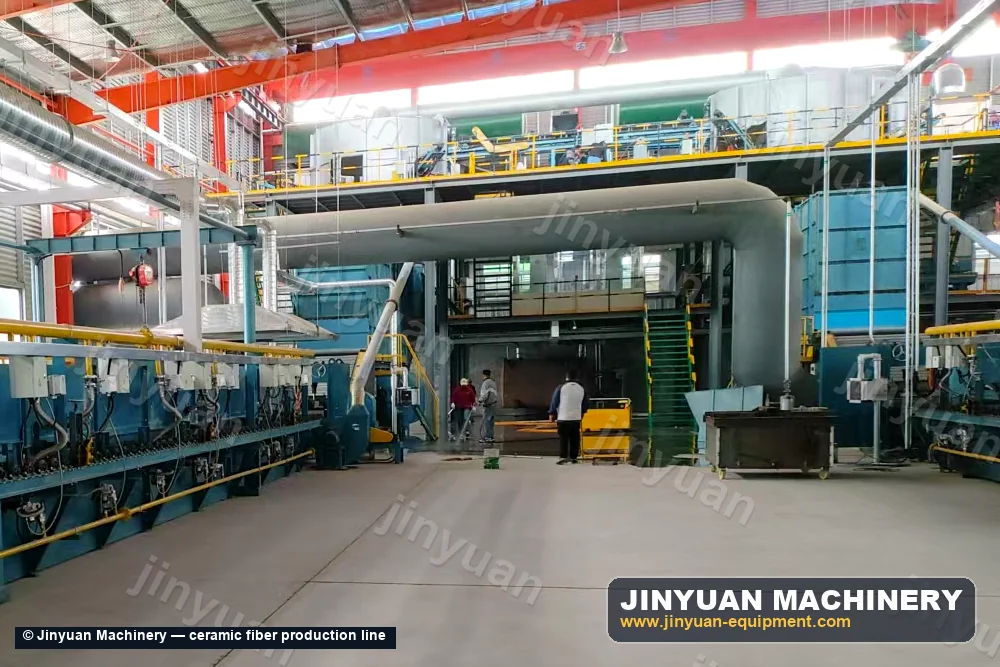
Five Faults and Where Each One Walks To
The curing furnace's own fault table, read against the defect index
| Fault | What you see | First moves |
|---|---|---|
| Temperature never reaches setpoint | Zone runs low at full output | Rod age, loose terminals, door seals |
| Poor temperature uniformity | One batch, uneven set | Door leakage, couple displacement, exhaust valve |
| Lining cracking | Spalling dust on the blanket | Review ramp and cool-down; patch or reline |
| Carbonized or blackened face | Brown to black stain | Preheat higher, clear the exhaust |
| Tension fluctuation | Dimensional wave along length | Drive and tension inspection |
Read this table against the defect index and the two become one instrument: a carbonized face is a product symptom whose owning process is this furnace, and the fault row here is the furnace-side half of that routing — symptom to owner on the index, owner to first moves here. The same pairing holds for shrinkage returned in service, which walks to the phase-change zone's residence time before it walks anywhere else, and for dusting, which walks to atmosphere and curing completion before it walks to the loom.
What We Deliberately Do Not Claim
Three boundaries. We publish no furnace geometry or setpoint table for our own works on this page: zone count, zone lengths, rod type and power, line speed, residence time and exit temperature are product- and contract-specific, confirmed per project, and a page of typical values would age into a lie. The patent curve is cited as one documented curve, not as our schedule, and the 800-1200 °C soak with its 4-6 hour residence quoted elsewhere on this site is industry reference whose governing text is the project's process specification. And we make no claim that nitrogen protection is universally required: it is a recipe decision with a price, and the honest answer is that some grades need it and some do not.
The Bottom Line
The curing furnace is where a blanket earns its service temperature, and it earns it four ways at once: a preheat zone that cleans and relaxes, a setting zone that shrinks to order, a phase-change zone that fixes the structure, and a cooling zone that lets the roll survive itself. Between them runs a curve measured in degrees per minute, because lining and binder break on rate before they break on temperature; six controls, of which line speed is the one nobody expects to be a curve variable; an atmosphere decision made by recipe; and five maintenance clocks — rods, couples, lining, conveyor, exhaust — that run whether anyone winds them or not. Buy a line and you buy this machine's schedule as much as its steel: the rods, the couples and the lining will age exactly as fast as the schedule says they may.
Frequently Asked Questions
What does a ceramic fiber curing furnace do?
Four duties in one continuous pass: it burns off the lubricant and binder carried in from the upstream stages, pre-shrinks the needled felt to its ordered thickness, drives the microcrystalline phase transition that lowers service shrinkage, and cools the blanket to a safe handling temperature before winding. The zones run roughly 200-400, 600-800 and 900-1200 degrees Celsius plus a cooling zone, each independently controlled, and each zone's failure shows up as a different product fault.
Why is ramp rate controlled in a curing furnace?
Because two things break on rate before they break on temperature: the lining, whose thermal mass lags the gas temperature and cracks under thermal shock when the gas outruns it, and the binder, whose volatiles can deflagrate instead of evaporating if they are released faster than the exhaust can carry them. Published curves ramp at about 1 degree per minute through the burn-off band and only then accelerate, which is why ramp rate and exhaust patency are one system.
What heating elements does a ceramic fiber curing furnace use?
Silicon carbide rods are the common choice, held by a computerized zoned temperature control system. The rods age: their resistance rises with service, so voltage is compensated upward on a schedule, and at end of life rods are replaced as a group rather than singly, because a new rod beside aged ones carries a share of current it was not sized for and the zone profile slowly stops matching the controller's assumption.
Why does a curing furnace sometimes run under nitrogen?
To stop oxidation embrittlement of the fiber at the top of the curve. Oxygen at those temperatures embrittles the fiber surface, and an embrittled blanket sheds dust for the rest of its life. The decision is recipe- and grade-specific: where the recipe calls for it, the protective window covers the hottest climb and hold rather than the whole tunnel, exactly as the published two-stage patent curve does.
How long does blanket stay in the curing furnace?
Residence time is set by line speed against the zone profile, and industry reference for the setting soak runs about 4 to 6 hours depending on thickness and density. Speed is therefore a curve variable: changing line speed changes every zone's dwell without moving a single setpoint, which is why speed is interlocked with the zone profile on a commissioned line and why the exit temperature probe sits on the panel permanently.
How is curing furnace temperature measured and kept accurate?
By thermocouples per zone, calibrated on a calendar rather than on failure: at these temperatures the platinum-rhodium wires of S and B types slowly volatilize and drift, and a controller holding a drifted couple holds the wrong temperature with complete confidence. Uniformity complaints usually start elsewhere — door seals leaking, a displaced couple, or an exhaust valve left too open — and are checked before the controllers are blamed.
What is the most important safety rule for a curing furnace?
Never open the doors of a hot furnace, and never force-cool a hot lining with fans or water. Thermal shock cracks the lining, and a cracked lining is not repaired by the next schedule but by a reline, with every batch until then carrying its dust. Cool-down follows the process curve exactly as heat-up does; the rule has no exceptions for production pressure.