
A defect on a ceramic fiber blanket line is not a mystery; it is a message with a return address. Every symptom a roll shows — grit under the palm, a peel along the thickness, a black stain on the face, a tear that runs cleanly across the machine but not along it — was created by one process at one moment, and the troubleshooting job is to read the symptom backwards to that moment. This page is the field index for that reading: twelve faults, each with the process that owns it, the first parameter to check, and the countermeasure family that closes it.
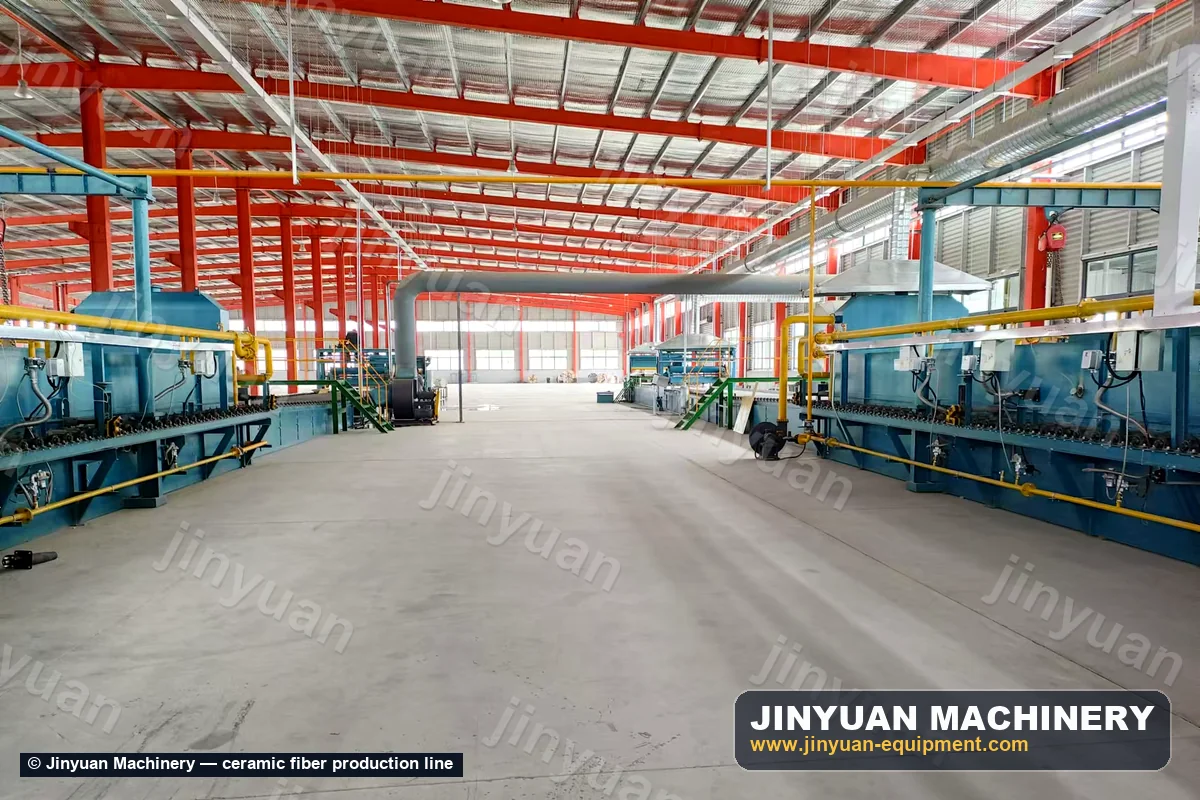
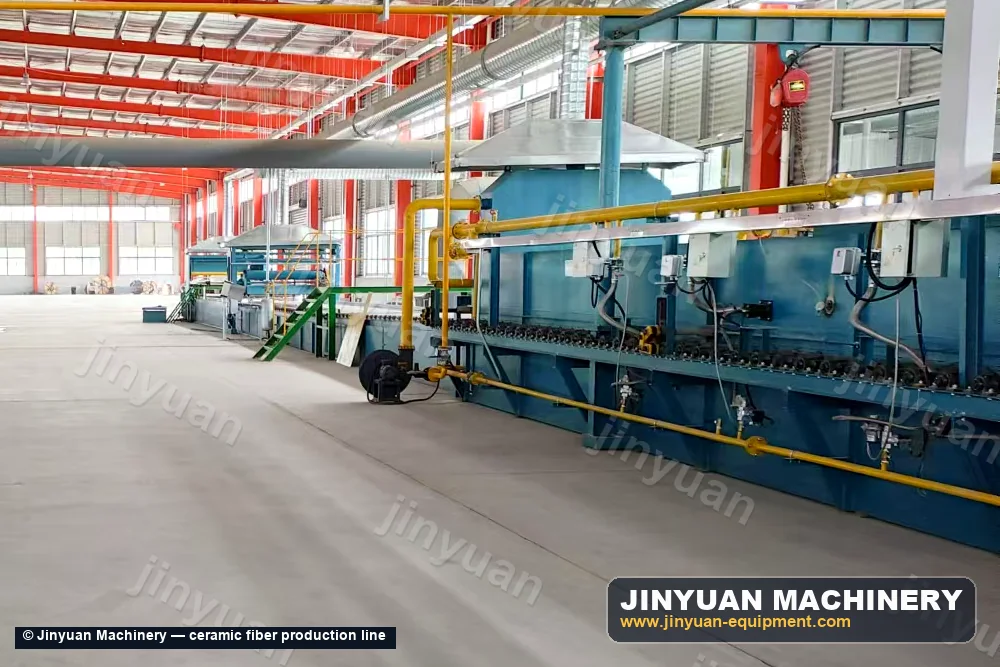
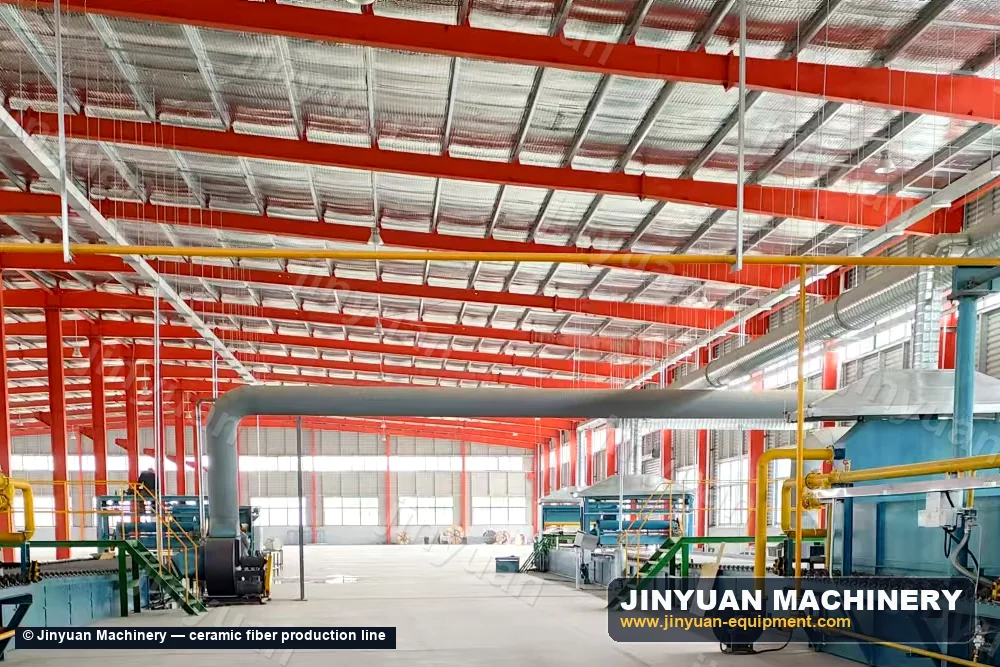
The seven faults that fail acceptance tests — shot, coarse fiber, wide diameter spread, short fiber, delamination, shrinkage and density variation — are covered mechanism-first on our defect guide, and the test methods that catch them live on our testing methods page. What lives here is the other half of the shift: the faults the acceptance panel does not catch because they appear late, in handling, in service or at the loom itself, plus the routing discipline that turns any symptom into a work order. The hall photographed is our curing shop, where three of the six late faults — shrinkage, dusting and carbonization — are decided.
The Routing Rule: One Symptom, One Owner, One First Check
Three rules govern the index. First, every defect has exactly one owning process: a defect with two owners has none, because two departments waiting on each other is how a fault survives three audits. Where two stages genuinely share a fault — shot is made at the spinner and sorted at the collection chamber — the owner is the stage whose parameter moves the number fastest, and the other stage is named in the countermeasure. Second, the symptom's shape precedes its cause: where a fault appears (face, edge, through-thickness, along the length) and when it appears (at the loom, after curing, at the customer's site) narrows the suspect list before any instrument is touched. Third, the first check is always the cheapest measurement that separates the two leading hypotheses — a hand feel, a peel by thumb, a caliper across the width — not the laboratory test that confirms the verdict a week later.
The table below is the index in one view. Read it as a dispatch board: the left column is what the operator reports, the middle column is who gets the call, and the right column is the first dial or record they open.
Twelve faults, routed: what you see, who owns it, what they check first
| What you see | Process that owns it | First check |
|---|---|---|
| Gritty hand, visible granules | Fiberizing, collection | Melt temperature and viscosity window |
| Shrinkage gaps in service | Heat setting | Curing temperature and soak time |
| Uneven hand, hard and soft zones | Melting, fiberizing | Melt temperature stability per shift |
| Peel along the thickness | Needling | Needle depth and punch density |
| Thickness waves across or along | Collection, needling, curing | Batt weight and feed sync |
| Tensile short in test | Fiberizing, needling | Punch density, depth, needle wear |
| Strong one way, weak across | Needling | Needle layout: parallel or cross |
| Dust and powder shedding | Needling, heat setting | Punch density and curing completion |
| Too stiff to conform on curves | Needling | Punch density and density grade |
| Black or brown stain on the face | Heat setting | Exhaust flow and zone oxygen |
| Width or length off specification | Cutting and rolling | Blade wear, guides, length gauge |
| Needle breakage at the loom | Fiberizing, needling | Fiber hardness, depth, needle gauge |
Two readings of the table matter more than its rows. The middle column is a dispatch list, not a blame list: naming the owning process is what converts a rejected roll into a work order, and a fault whose owner is “the line” will be rejected again next month. And the right column is deliberately narrow — one first check per fault — because a troubleshooting session that opens five dials at once closes none of them; the elimination gates in the third section are what widen the search, in order.
The Six the Acceptance Panel Misses
The acceptance panel catches faults that are already in the roll when it is sampled. Six faults escape it: three because they appear only in handling or in service, one because it is a direction the standard panel measures only on request, and two because they are line events rather than product properties at all. Each gets the same four lines the field uses: symptom, root cause, owning process, countermeasure.
Dusting and Powder Shedding: The Fault That Appears at the Customer's Site
The symptom is the face shedding fiber and fine powder during cutting, handling and first heat-up; the complaint arrives as dust in the customer's lining shop, not as a failed test, which is exactly why the panel never sees it. Four root causes, in the order they turn up on real lines: over-needling that bruises and cuts fiber instead of interlocking it; a weak interface between shot granules and the fiber matrix, so each granule pulls fiber out as it leaves; incomplete heat setting that leaves the structure unsettled and friable; and oxidation embrittlement where the curing zone runs without the protective atmosphere the recipe requires. The owning processes are needling first and heat setting second. The countermeasure follows the cause: pull punch density back into the window for the batt weight, finish the curing schedule with zoned temperature control and protective atmosphere where specified — and attack the granule source itself, because dust that is shot-driven is a fiberizing fault wearing a handling costume. The lot's sieve number tells you which of the two you are fighting before you touch the loom.
Stiffness: When the Blanket Will Not Conform
The symptom is a roll that tests within every limit and still fights the installer: hard to cut, springing off curved surfaces, leaving gaps at elbows and vessel heads where the gaps become hot spots. The root cause is needling past the density the application wants — punch density set too high, or a density grade chosen for compression resistance where conformability governs — so the blanket's own recovery works against the curve it must wrap. The owning process is needling, jointly with specification. The countermeasure has three moves: reduce punch density for the grade; use a density-gradient construction so the face carries strength while the body stays compliant; and specify the lower-density grade where the service is curved surfaces rather than flat walls. Stiffness is the one fault in this index whose fix can be a specification decision instead of a machine adjustment — which is why it is diagnosed on paper before the loom is touched.
Surface Carbonization: A Curing-Furnace Signature
The symptom is brown to black staining on the face or in patches, sometimes with a burnt smell at unpacking. Three root causes, all in the same hall: binder or organic additive not fully burned off because the preheat zone ran cool; a starved-oxygen zone in the curing furnace; and blocked exhaust letting combustion products recirculate onto the blanket instead of leaving the building. The owning process is heat setting. The countermeasure is the same three in reverse: raise the preheat zone temperature so volatiles leave early, clear the exhaust path, and hold an oxidizing atmosphere through the burn-off zone. Carbonization is cosmetic only until it is not: a stain is a record of a furnace zone that ran wrong, and the zone that left binder unburned may have left the structure unset — so a carbonized lot gets its shrinkage and dusting checked before release, not merely its appearance. The furnace-side half of that routing — zones, ramp curve and the five maintenance clocks — is on our curing furnace page.
The MD/CD Split: One Blanket, Two Tensile Numbers
The symptom is tensile results that pass in one direction and fail in the other, or a roll that tears cleanly across the machine while holding along it. The root cause is needle layout: parallel needling interlocks fiber in one family of directions, and the machine-direction versus cross-direction strength difference can exceed 30 %, while cross-laid multi-angle needling holds the two within about 5 %. The owning process is needling. The countermeasure is layout — cross-laid or multi-angle needling — verified by pulling tensile specimens in both directions on the next lot, because a single-direction tensile number cannot see this fault at all. For contracts on loaded linings and suspended wraps the direction pair belongs in the acceptance clause; the direction rule itself is on our testing methods page.
Dimensional Drift: Width, Length and the Cutting End
The symptom is width or length outside the contract tolerance, found at packing or at receipt, and usually periodic rather than random. Three root causes aging at three different rates: worn cutting blades, drifted edge guides or positioning, and a length gauge out of calibration — which is why the fault arrives slowly and is blamed on the wrong one first. The owning process is cutting and rolling. The countermeasure: replace blades on a measured wear schedule rather than at failure; recalibrate guides and the length gauge against a reference tape; and read the periodicity, because a width wave sharing a period with blade run-out names the blade before any measurement does. Tolerances themselves are standard-edition and contract-specific, and we publish no universal number here; the cutting end's own controls are on our cutting and rolling page.
Needle Breakage: The Defect That Stops the Line
The symptom is not a product property but a line event: broken needles at an abnormal rate, and behind them the residual-needle risk in every roll made since the last count. Three root causes: fiber too hard for the needle gauge, whether from chemistry or from shot; needle depth set beyond what the batt actually needs; and a needle gauge too fine for the batt weight. The owning processes are fiberizing and needling jointly, because hardness arrives from one and meets the needle at the other. The countermeasure: soften the batt where the recipe allows, pull depth back to the minimum that interlocks, and step to a heavier gauge when the batt outruns the fine one. Behind the mechanics sits one absolute rule: every broken needle is accounted for and removed before the roll moves, because a residual needle in a furnace lining is a foreign body in a wall and a residual needle in a customer's cutting shop is a lost contract. Breakage mechanics and stroke-rate economics are covered on our needle breakage and stroke rate pages.
Elimination Gates: Walking a Fault to Its Root, One Question at a Time
A routing table dispatches; an elimination tree concludes. The tree is a chain of binary gates ordered cheapest-first, and each gate's failing branch is a fix in itself — so the walk stops at the first gate that fails rather than at the laboratory. The worked example is the most common dispatch on a fiber line: shot over limit.
- Raw material fineness. Does the batch grind to the specified fineness, passing the 200-mesh screen? No — regrind; coarse grains that never melt become shot directly.
- Melt temperature. Is the furnace holding its setpoint band? No — restore temperature; under-melted melt tears into crescent shot.
- Viscosity window. Is the chemistry inside the alumina-silica window for the grade? No — adjust the ratio; a melt outside its window balls up at any temperature.
- Shot removal. Is the separation system running at setpoint — discharge, pump pressure, separator condition? No — repair it; shot the line already made otherwise returns to the roll.
- Recycle ratio. Is reclaimed material within its allowed share? No — cut the share; recycled fiber carries its history back into the batt.
Five gates, and each failing branch is a same-shift action. Only when all five pass does the investigation move to the fiberizing parameters themselves — roller speed, air pressure, spinner condition — which is where the defect guide's shot mechanisms take over. The same gate structure serves the second most common dispatch, thickness waves: is the batt weight stable, is the feed synchronized with stroke frequency, is the curing tension correct — in that order. The middle gate exists because continuous feed against a fixed stroke frequency is the classic cause of periodic thickness error; intermittent synchronous feed, feeding the batt in step with each change of stroke frequency, is precisely the remedy a Chinese patent (CN102978829A) was granted for.
Two properties make a gate chain worth writing down. It is ordered by measurement cost, so most walks end at gate one or two and never reach the bench. And every branch terminates in an action, so the tree cannot produce the two failure modes of unstructured troubleshooting: adjusting five dials at once, and concluding “raw material” without having opened a bag.
Three Rules That Keep a Fix Fixed
- One variable at a time. A change made alongside three other changes is not a fix, it is a new experiment with no control; the next batch teaches nothing and the fault keeps its seat.
- Fix upstream, not downstream. Dust compensated by a harder face, thickness compensated by calender pressure, strength compensated by density — each buys a passing sample and stores the fault deeper in the roll.
- Verify with the test that caught it, and write it back. A countermeasure is closed only when the original symptom's test reads clean on the next lot, and only when the new setpoint is written into the parameter record with the fault's name beside it: phenomenon, root cause, action, verification.
The record is the cheapest equipment on the line. A plant that verifies without recording pays for the same lesson twice, once per turnover of staff; a plant that records without verifying writes fiction into its own manual. The four-line entry — phenomenon, root cause, action, verification — is what turns a troubleshooting session into an asset the next shift inherits.
What We Deliberately Do Not Claim
Three boundaries. We publish no universal tolerance or acceptance number on this page: widths, lengths, shrinkage and strength limits are standard-edition and contract-specific, and the governing texts are the current edition of the product standard plus the purchase contract. We cite improvement cases as cases, not as promises: published material reports one plant's shot content falling from 8.2 % to 3.5 % — against a 5 % national limit — after raw material purification, fiberizing optimization, a shot-removal upgrade and refined heat treatment, and we repeat it as one documented walk through exactly the gates above, not as a guaranteed outcome of buying any machine. And we name no competitor's equipment as a cause: every root cause on this page is a process state, observable on any line of any make, including ours.
The Bottom Line
Troubleshooting is routing plus discipline. Twelve faults, one owner each and one first check each; six of them invisible to the acceptance panel until handling, service or the loom itself exposes them; gates ordered by cost so most walks end early; and three rules that keep a fix fixed once it is made. A line that routes defects this way stops arguing about blame and starts closing work orders — and a buyer who asks a supplier which process owns each fault on this table learns more about that supplier's plant in one question than a week of brochures will tell.
Frequently Asked Questions
What are the most common ceramic fiber blanket defects?
The acceptance panel's seven — excess shot, coarse fiber, wide diameter distribution, broken and short fiber, delamination, excessive linear shrinkage and density or thickness variation — plus six that appear later: dusting and powder shedding, stiffness that fights curved surfaces, surface carbonization, a machine-versus-cross tensile split, width or length drift, and needle breakage at the loom. Each has exactly one owning process, which is what makes it fixable rather than merely measurable.
Why does ceramic fiber blanket shed dust during handling?
Four causes, in the order they turn up on real lines: over-needling that bruises fiber instead of interlocking it, a weak interface between shot granules and the fiber matrix so granules pull fiber out as they leave, incomplete heat setting that leaves the structure unsettled, and oxidation embrittlement where the curing zone runs without the protective atmosphere the recipe requires. The lot's sieve number separates the shot-driven case from the needling-driven case before any machine is adjusted.
How do you fix delamination in needle punched blanket?
Delamination means the layers never interlocked, and the fix lives at the needle loom: increase penetration depth until punches fully cross the batt, move to double-side needling where the batt weight demands it, and raise punch density to the level the weight requires. A thickness profile across a peeled sample names the parent fault — uniform thickness with peeling points at the loom, thickness variation with peeling points upstream at batt formation.
Why is ceramic fiber blanket tensile strength different in two directions?
Because parallel needle layout interlocks fiber in one family of directions: machine-direction and cross-direction strength can differ by more than 30 percent with parallel layout, while cross-laid multi-angle needling holds the two within about 5 percent. A single-direction tensile number cannot see the fault at all, which is why contracts on loaded linings and suspended wraps should name both directions.
What causes black or brown stains on ceramic fiber blanket?
A curing-furnace signature, from three routes: binder or organic additive not fully burned off because the preheat zone ran cool, a starved-oxygen zone in the curing furnace, or blocked exhaust recirculating combustion products onto the blanket face. The countermeasure is preheat zone temperature, exhaust path and oxidizing atmosphere — and because a zone that left binder unburned may have left the structure unset, a stained lot gets shrinkage and dusting checked before release.
How is needle breakage on a needle loom reduced?
By matching the needle to the batt: softer fiber where the recipe allows, needle depth pulled back to the minimum that interlocks, and a heavier gauge when the batt weight or fiber hardness exceeds the fine gauge's limit. Behind the mechanics sits one absolute rule — every broken needle is accounted for and removed before the roll moves, because a residual needle in a furnace lining is a foreign body and in a customer's cutting shop a lost contract.
What is a defect elimination decision tree?
A chain of binary gates ordered by measurement cost, where each gate's failing branch is itself a same-shift fix, so the walk stops at the first gate that fails instead of at the laboratory. For shot over limit the gates are raw material fineness, melt temperature, the chemistry viscosity window, shot-removal system condition and recycle ratio; only five passes push the investigation into fiberizing parameters. Most walks end at gate one or two, which is the point.