
Every stage before this one makes blanket; this stage makes the product the customer ordered. Out of the heat-setting furnace the blanket is still a continuous ribbon with ragged edges and no length: the finishing end trims and slits it to the ordered width, cross-cuts it to the ordered length, verifies that length on a meter, and winds it into a roll that survives transport and unwinds straight on site. Nothing here is hot, fast or dramatic, and everything here is contractual — width, length, edge and roll are the four numbers on the packing list, and the finishing end is where they are either earned or faked.
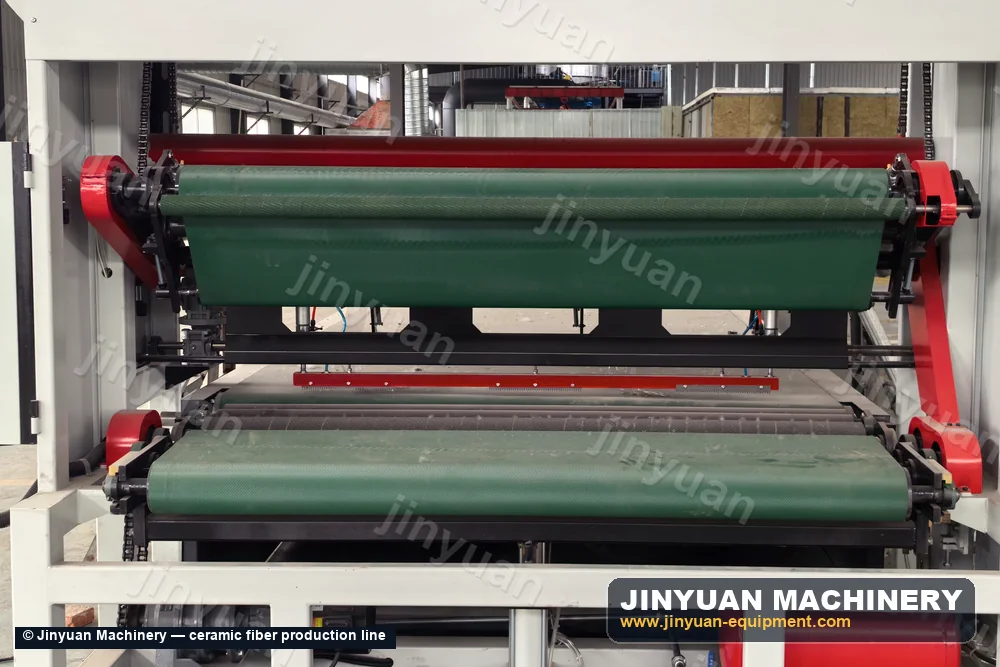
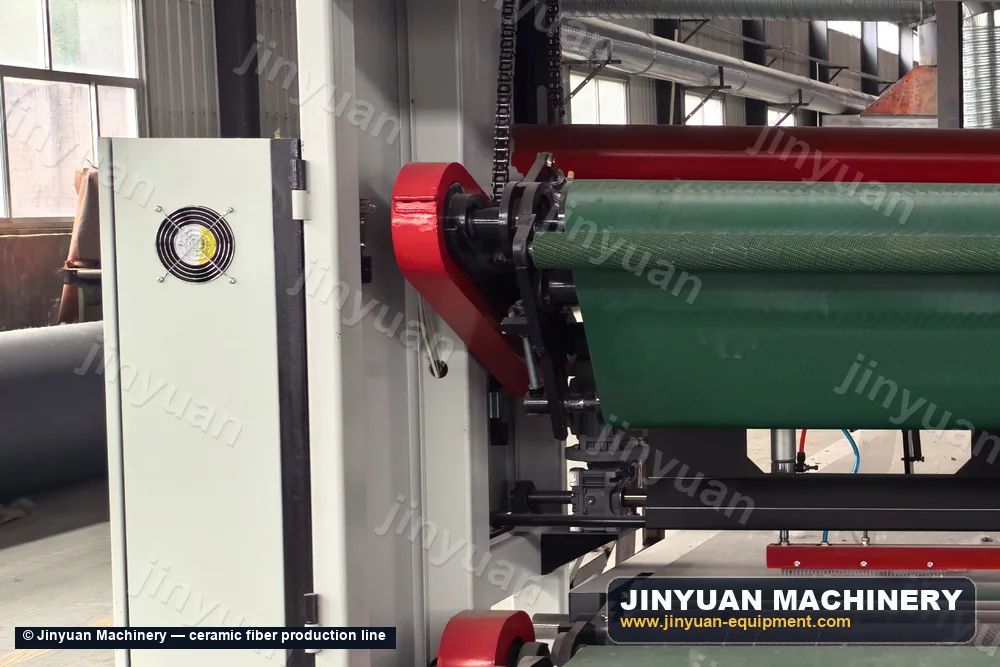
This page is the finishing end itself: the four operations in line order, the conventions they serve — including why 610 and 1220 mm rule the width column and why thick blanket ships in short lengths — and the tolerance discipline that separates a standard from a sales brochure. The stage summary lives on our production process page; the machine photographed here is a cross-cutting and rolling unit in our own works before delivery.
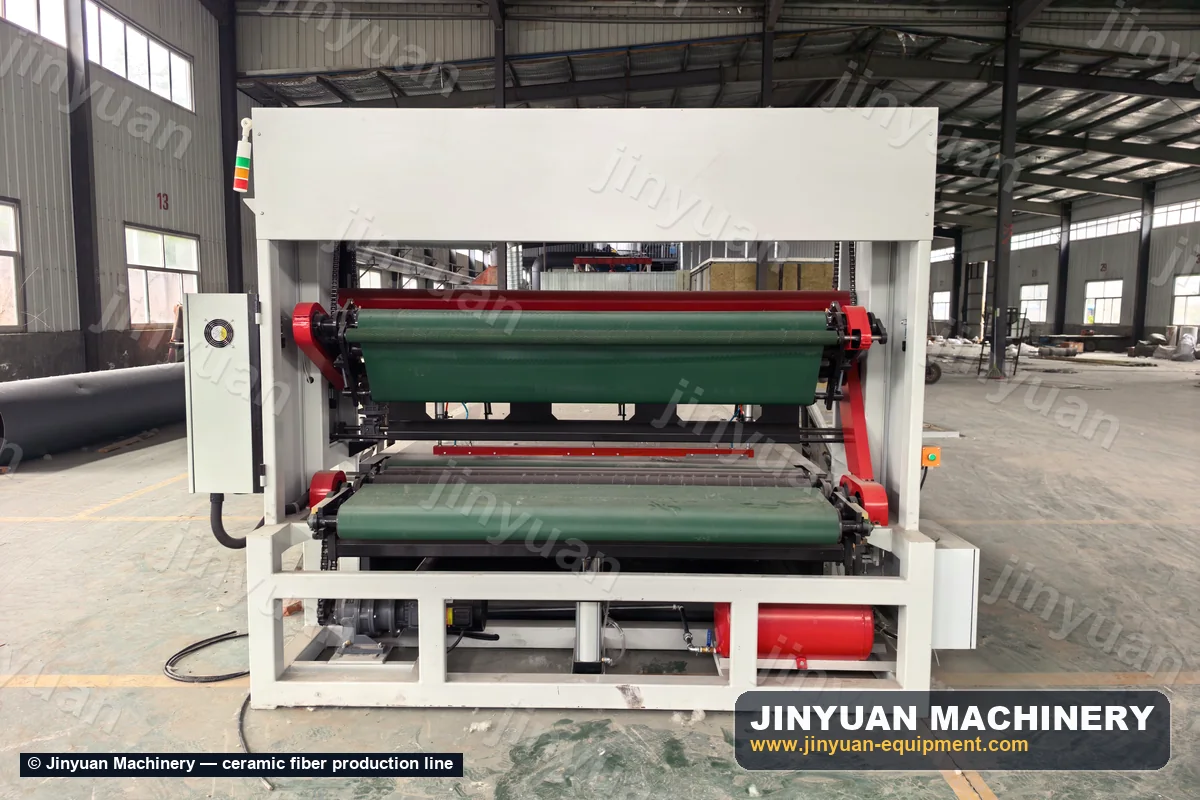
The Finishing End: Four Obligations Between Furnace and Packing
The task compresses to four obligations, and the packing list enforces every one:
- Correct width — both ragged edges trimmed away, then slit or left at the ordered width, straight and burr-free.
- Correct length — cross-cut to the ordered length and verified on a meter, roll by roll.
- Clean cut faces — cut edges square and closed, not frayed into loose fiber.
- A sound roll — even tightness across the width and along the roll, flush end faces, consistent inner diameter.
The asymmetry with earlier stages is worth naming: upstream faults arrive at the finishing end hidden inside the blanket, but finishing faults ship visibly, on the label and in the roll. A width error made here is a width error installed in a furnace lining, where blankets butt-joint and a few millimetres of missing width become a seam gap. That is why the finishing end is measured, not admired.
Longitudinal Cutting: Trim the Edges, Then Set the Width
The blanket's as-formed edges are its worst material: thinner, frayed and edge-effected, they are trimmed off both sides before anything else happens, and the trim is paid fiber leaving the line — which makes edge width a cost line, not just a quality line. What remains is either rolled at full width or slit into narrower strips on request. The width column of the trade is dominated by two numbers:
The standing width conventions (industry reference)
| Width | Where it comes from | Why it survives |
|---|---|---|
| 610 mm | The metric shadow of 24 inches | International order habit and lining layout |
| 1220 mm | The metric shadow of 48 inches | Double width, same habit, fewer joints |
The controls at this station are geometric: cut edges straight along the run, no burrs or stepped trim, and width held inside the contract tolerance. A blade that wanders does not merely lose millimetres; it produces an edge that will not butt, and the customer discovers it on a scaffold, not in your works.
Cross Cutting: A Knife, a Length Meter and a Calibration Discipline
Length is made in two moves: an air-cylinder-driven knife cross-cuts the moving blanket at the ordered length, and an online length meter counts the blanket past it so the cut falls where the order says. The knife is simple; the meter is the instrument of record, and it measures by contact with a soft, compressible surface — which is exactly the condition under which measuring wheels slip and drift. The discipline is therefore a calibration routine: check the meter against a tape on a marked run at a set interval and after every blanket grade change, because a meter that reads long ships every roll short, quietly, until a customer measures. Length tolerance itself is a contract value, written per order alongside width and thickness.
Why Thick Blanket Ships in Short Lengths: The Roll Arithmetic
Buyers new to the product often ask why a 6 mm roll is 15 m long while a 50 mm roll is 3 to 3.6 m. The answer is geometry: a wound roll's cross-sectional area is roughly its length times its thickness, so at a given roll-diameter ceiling the length must fall as thickness rises. The trade's conventional thickness-to-length pairings follow that arithmetic:
Conventional roll lengths by thickness, widths 610 / 1220 mm (industry reference)
| Thickness (mm) | Typical roll length (mm) | Widths (mm) |
|---|---|---|
| 6 | 15000 | 610 / 1220 |
| 10 / 12 | 14400 | 610 / 1220 |
| 20 | 7200 | 610 / 1220 |
| 30 | 5000 | 610 / 1220 |
| 40 | 5000 | 610 / 1220 |
| 50 | 3000 – 3600 | 610 / 1220 |
| 60 | Made to order | 610 / 1220 |
Read the table as diameters and it makes sense: 20 mm at 7.2 m and 50 mm at 3.6 m both wind to roughly a 430–480 mm roll, ignoring core and winding compression, while 6 mm at 15 m is a deliberately small roll whose floor is set by handling and packing rather than by diameter. Roll weight caps the same table from the other side, since one person must still lift it. The exact pairing therefore follows each plant's roll-diameter and roll-weight strategy and, ultimately, the order — which is why length per roll is confirmed per contract and printed on the roll label rather than argued from a catalogue.
Winding: Tension, End Faces and the Inner Diameter
The winder is the line's terminal machine and carries a quick-roll device so that cut rolls clear the station without holding up the cut. Its controls are three. Tension: even across the width and steady along the roll, because a loose roll shifts layers in transport, arrives oval and unwinds badly, while an over-tight roll compresses the blanket and falsifies the thickness the customer measures at opening. End faces: flush, with no telescoped layers stepping out of the face, which is an alignment fault of the guide rollers rather than a tension fault. Inner diameter: consistent roll to roll, because the customer's unwinding stand is built around one core size and discovers every exception. None of the three is visible in the blanket's test report; all three are visible in the customer's store.
Dimensional Tolerances: What the Standards Actually Govern
Three documents stand in a hierarchy, and confusing them is the commonest tolerance mistake in quotations. The product standard — the current version of GB/T 16400 for ceramic fiber blanket — sets what the product must be; the test method standard, GB/T 5480, sets how dimensions are measured so that two parties' numbers compare; and the contract technical agreement sets the values for this order, which may be tighter than the standard where the service demands it. Against that hierarchy, the figure sometimes seen in vendor marketing — a blanket dimensional tolerance of ±2 mm — is one manufacturer's promotional claim, not a standard provision, and we quote it as such: never as a norm. What we put in a technical agreement is width, length and thickness tolerance per grade, edge straightness, and roll condition on arrival — values both parties can measure by the same method.
Reading Finishing Defects Back to Their Cause
The five classic finishing faults and their corrections:
Finishing faults, symptoms and corrections
| Symptom | Cause | Correction |
|---|---|---|
| Width out of tolerance | Blade wear or guide shift | Replace blades; recalibrate guides |
| Roll length inconsistent | Length meter drift | Calibrate the meter against a tape |
| Ragged cut face, loose fiber at edges | Dull blade or over-hard blanket | Change blades; review needling and recipe |
| Roll loose, deformed in transport | Insufficient winding tension | Reset winding tension |
| Telescoped end faces | Misalignment at the guides | Square the guide rollers |
One discrimination rule keeps the table honest: finishing faults are geometric and begin at a moment — from this roll onward, after this blade change, after this meter drift — while faults born upstream arrive already inside the blanket, spread continuously across rolls. A width error is a finishing signature; a thickness band is not, and belongs to the collection and needling diagnoses on our defect guide.
The Finishing Section on a Quotation
The finishing end is cheap to specify well and expensive to retrofit. Five line items:
- Slitter with trim handling: edge trim cut clean and carried away or recycled, with width guides that hold tolerance at line speed.
- Cross cutter with length meter: air-driven knife plus an online meter with calibration access, so the routine actually happens.
- Winder with tension control and quick-roll: adjustable, even tension and a roll change that does not stall the cut.
- Blade stock and calibration routine: spare blades on site and a written meter-check interval, because both are consumables wearing tolerance.
- Discharge and packing interface: conveyor and table matched to the packing method, so a good roll is not damaged by its own exit.
Each item is ordinary steel and instrumentation at order time. Omitted, each becomes a manual workaround with a labour cost and a defect rate attached.
What We Deliberately Do Not Claim
Three boundaries. The thickness-to-length table and the 610 / 1220 width convention are public industry material, quoted as industry reference; individual plants and orders deviate, and the order governs. The ±2 mm tolerance figure circulating in vendor marketing is one manufacturer's claim, not a standard provision, and we will not quote it as a norm. And our own delivered tolerances are contract values: written per order against the current GB/T 16400 and measured by GB/T 5480 methods, because a tolerance nobody can measure is a wish, not a specification.
The Bottom Line
The finishing end is where a ceramic fiber line stops producing blanket and starts delivering orders: four cuts and one wind, each with a number attached. Trim and slit set the width the lining butts against; the knife and the meter set the length the label promises; the winder's tension and alignment set whether the roll arrives as it left; and the tolerance discipline sets whether those numbers mean anything in an argument. The roll-diameter arithmetic explains the trade's length conventions, the standards hierarchy explains what a tolerance actually is, and the defect table reads any bad roll back to the station that made it. Specify the finishing end with the same care as the furnace — it is the only stage the customer measures with his own tape. What protects those measured numbers between the dock and the customer's furnace — the wrap, the stack and the label — is the subject of our packing and warehousing page.
Frequently Asked Questions
What does the cutting and rolling stage of a blanket line do?
It converts continuous heat-set blanket into ordered rolls: both ragged edges are trimmed and the blanket is slit or left at the ordered width, cross-cut to the ordered length by an air-driven knife, verified on an online length meter, and wound under controlled tension into a roll with flush end faces and a consistent inner diameter. Width, length, edge and roll are the four numbers on the packing list.
Why are ceramic fiber blankets usually 610 or 1220 mm wide?
Because those are the metric shadows of 24 and 48 inches, the widths the international market orders by and furnace-lining layouts are drawn around. Other widths are slit on request, but 610 and 1220 mm dominate the width column of the trade, and the edge trim removed before slitting is paid fiber — which makes edge width a cost line as well as a quality line.
Why does thicker blanket come in shorter roll lengths?
Because a wound roll's cross-sectional area is roughly length times thickness, so at a given roll-diameter ceiling the length must fall as thickness rises: 20 mm at 7.2 m and 50 mm at about 3.6 m both wind to roughly a 430–480 mm roll, while roll weight caps the table from the other side. The exact pairing follows each plant's diameter and weight strategy and finally the order, which is why length per roll is confirmed per contract.
How is roll length kept accurate?
By an online length meter that counts the blanket past it and triggers the cross-cut knife, plus a calibration routine: the meter measures by contact with a soft compressible surface, so its wheel can slip and drift, and a meter that reads long ships every roll short. Checking it against a tape on a marked run at a set interval and after grade changes is what keeps the label honest.
What makes a wound blanket roll bad?
Three things, separately. Too little winding tension and the roll shifts layers in transport, arrives oval and unwinds badly; too much and it compresses the blanket, falsifying the thickness measured at opening. Misaligned guide rollers telescope the end faces into steps. And an inconsistent inner diameter fights the customer's unwinding stand. None appears in a test report; all appear in the customer's store.
Which standards govern blanket dimensions and tolerances?
A hierarchy of three: the product standard — the current version of GB/T 16400 for ceramic fiber blanket — sets what the product must be; the test method standard GB/T 5480 sets how dimensions are measured so two parties' numbers compare; and the contract technical agreement sets this order's values, which may be tighter than the standard. Marketing figures such as a flat ±2 mm tolerance are one vendor's claim, not a standard provision.
Can a ragged cut edge be repaired downstream?
No. The cut edge is finished the moment the blade passes: frayed edges and loose fiber at the cut face mean a dull blade or an over-hard blanket, and the corrections are blade change and a review of needling and recipe, not rework. This is why blade stock and a written change interval belong on the quotation, and why edge quality is checked at the machine rather than at the packing table.