
Every roll of ceramic fiber blanket is a printed record of the parameters that made it: the furnace temperature it was melted at, the roller speeds that drew it, the vacuum that laid it down, the needles that locked it and the curve that set it. This page collects those numbers in one place — the control window of every stage of a needled-blanket line, the linkages between stages, a worked recipe and a fault table — so a process engineer can check a shift against it and a buyer can write a tender against it.
One rule before any number. Values marked industry reference are the general industry working levels we use for design, acceptance and benchmarking; values marked machine example are placeholders from one line class we build and must be calibrated against the nameplate, the factory manual and the commissioning record of the actual machine before first production. Nothing here is a process file: the formal file is the parameter record sheet plus the shift log, and every change to it goes through the change procedure and into the debugging case archive.
The Line as One Chain, Held by Four Variables
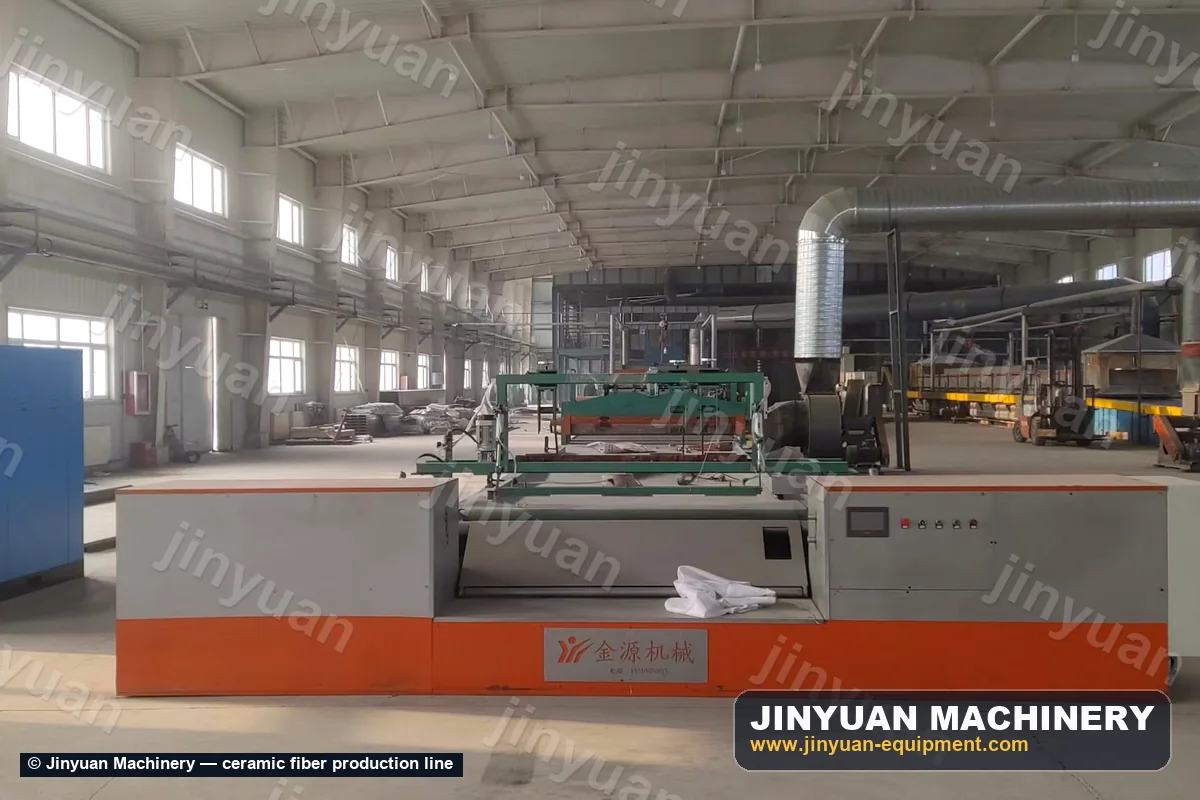
A needled-blanket line is nine stations in series, and material never waits between them: what the furnace does at two in the morning is in the roll by breakfast. The chain runs:
- Raw material inspection — chemistry of the incoming kaolin, alumina and silica against the grade target.
- Batching and mixing — the ratio that locks Al₂O₃/SiO₂ for the whole campaign.
- Resistance-furnace melting — solid batch to melt, with molybdenum electrodes on circulating water cooling.
- Flow guidance — the melt stream presented to the spinning machine at a stable rate.
- Spinning — distribution roller plus three spinning rollers throw the melt into fiber.
- Collection — the fiber settles onto the mesh belt under box vacuum into a uniform batt.
- Needle punching — boards of needles lock the batt into a blanket that holds together.
- Curing and setting — the zoned furnace sets dimension and shrinkage behaviour.
- Slitting, cutting and rolling — the blanket becomes the 7,200 × 610 mm roll that ships.
Across all nine, control reduces to four master variables and one derived one: temperature, viscosity, roller speed and collection vacuum. Furnace temperature sets melt viscosity; viscosity sets how easily the melt fibers; roller speed sets fiber fineness and its distribution; box vacuum sets how evenly the batt lays down. Every window in the tables below is a window on one of these four — which is why a line that trends them well makes boring blanket, and a line that does not makes surprises.
The Master Parameter Table
Two tables cover the chain. The attribute column is the one to read first: it tells you whether a number is a benchmark you can hold a supplier to, or a placeholder you must calibrate on your own machine.
Upstream windows: batching, melting and spinning
| Stage | Parameter | Control window | Attribute |
|---|---|---|---|
| Batching | Al₂O₃/SiO₂ target ratio | 45/55 to 50/50 by grade | Industry reference |
| Batching | High-purity grades: Al₂O₃ + SiO₂ total | 99% and above | Industry reference |
| Melting | Furnace temperature, resistance furnace | 1,900–2,200 °C | Industry reference |
| Melting | Temperature hold | within ±10–20 °C | Industry reference |
| Melting | Melt viscosity at the flow | 1–10 Pa·s | Industry reference |
| Spinning | Distribution roller surface speed | 20–30 m/s | Industry reference |
| Spinning | Roller 1 / 2 / 3 surface speed | 70–110 / 80–135 / 150–190 m/s | Industry reference |
| Spinning | Roller speed-ratio mismatch | keep under 5% | Industry reference |
| Spinning | Third-roller speed, this line class | 9,500–9,600 r/min | Machine example |
| Feeding | Charge rate, this line class | about 1,800 kg/h | Machine example |
Downstream windows: collection, needling, curing and the finished roll
| Stage | Parameter | Control window | Attribute |
|---|---|---|---|
| Collection | Collection box vacuum | −300 to −800 Pa by grade | Machine example |
| Collection | Batt laydown (forming) speed | 50–80 m/min | Industry reference |
| Needling | Stroke frequency | 800–1,200 strokes/min | Industry reference |
| Needling | Punch density | 200–300 punches/cm² | Industry reference |
| Needling | Needle penetration depth | 10–15 mm | Industry reference |
| Curing | Setting furnace temperature, zoned | 800–1,200 °C | Industry reference |
| Curing | Soak time at temperature | 2–4 h | Industry reference |
| Curing | Sol-gel low-temperature setting route | 550–680 °C × 40–50 min | Industry reference |
| Finished | Density range in regular production | 96 / 128 / 160 kg/m³ | Industry reference |
| Finished | Thickness range | 10–50 mm in six steps | Industry reference |
Read the spinning rows as one decision, not eight: what sets fiber diameter is the ratio between roller speeds — the draw ratio — which is why the mismatch limit matters more than any single speed. Our treatment of the mechanism sits on the fiber diameter control and shot content pages; the table here is the operating envelope those mechanisms live inside.
Why the Windows Are Windows: Six Linkages
A parameter window is not bureaucracy; it is the range inside which the next stage still works. Six linkages carry most of the cause-and-effect on a blanket line:
Stage-to-stage linkages and how they fail outside the window
| If this moves | Then this follows | Outside the window it shows as |
|---|---|---|
| Furnace temperature up, viscosity down | Fiber draws finer | Over-fine fiber, breakage, and if viscosity falls too far, more shot |
| Furnace temperature down, viscosity up | Fiber draws coarser, fiberizing harder | Coarse fiber, shot content over limit |
| Roller speed up | Centrifugal draw increases, diameter falls | Speed-ratio mismatch above 5% widens the diameter distribution |
| Box vacuum up | Batt settles and compacts faster | Too high: mesh blinding and batt blocking on the belt |
| Needling density up | Tensile strength rises — roughly 15% per 10 kg/m³ of density in industry test data | Too high: broken needles and pulled batt surfaces |
| Setting temperature up | Shrinkage behaviour sets more completely | Too high: embrittled fiber and density drift |
The strength figure is the one buyers quote back at us, so state its shape plainly: it is an industry test-result trend, not a guarantee on your line, and it holds only while the needling stays inside its own window. Push density for strength and you trade needle life and surface quality for it — the optimum is a recipe decision, not a maximum.
A Worked Route: 128 kg/m³ Standard Blanket
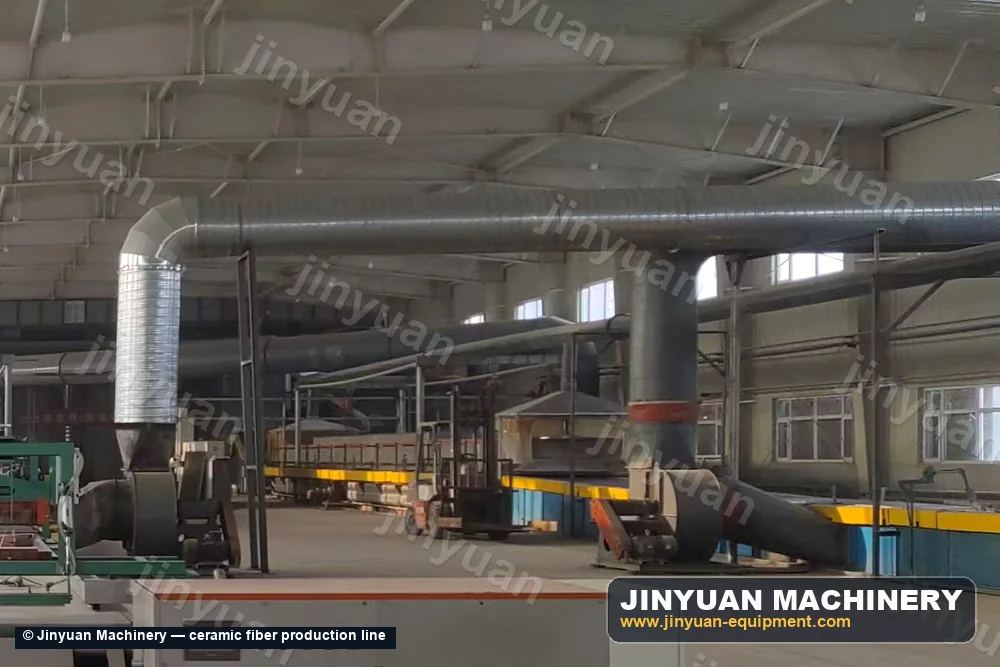
Tables argue; a recipe convinces. Here is one complete route for the most-ordered grade in the range, 128 kg/m³ standard blanket, in the order the line runs it:
Worked route for 128 kg/m³ standard blanket, 25 mm
| Stage | Setting | Attribute |
|---|---|---|
| Batching | Al₂O₃/SiO₂ ≈ 47/53 | Industry reference |
| Melting | 2,050 °C, hold within ±10–20 °C | Industry reference |
| Spinning | Third roller at 9,500–9,600 r/min | Machine example |
| Collection | Box vacuum −500 Pa for the grade | Machine example |
| Needling | 1,000 strokes/min, 250 punches/cm², 12 mm depth | Industry reference |
| Curing | 1,050 °C, 3 h soak, zoned ramp | Industry reference |
| Finished | 128 kg/m³, 25 mm, roll 7,200 × 610 × 25 mm | Industry reference |
Two disciplines make a recipe like this survivable in production. First, changeover is all-or-nothing: moving from 96 to 128 to 160 kg/m³ means switching the whole parameter set at once against the specification map — collection vacuum, laydown speed, needling set — because knob-by-knob trials waste a shift and produce rolls that belong to no grade. Second, the recipe is verified by record: four parameter recordings per shift, kept as the data source of process quality control and as the evidence base when a customer asks what made their roll.
When the Blanket Tells You a Parameter Moved
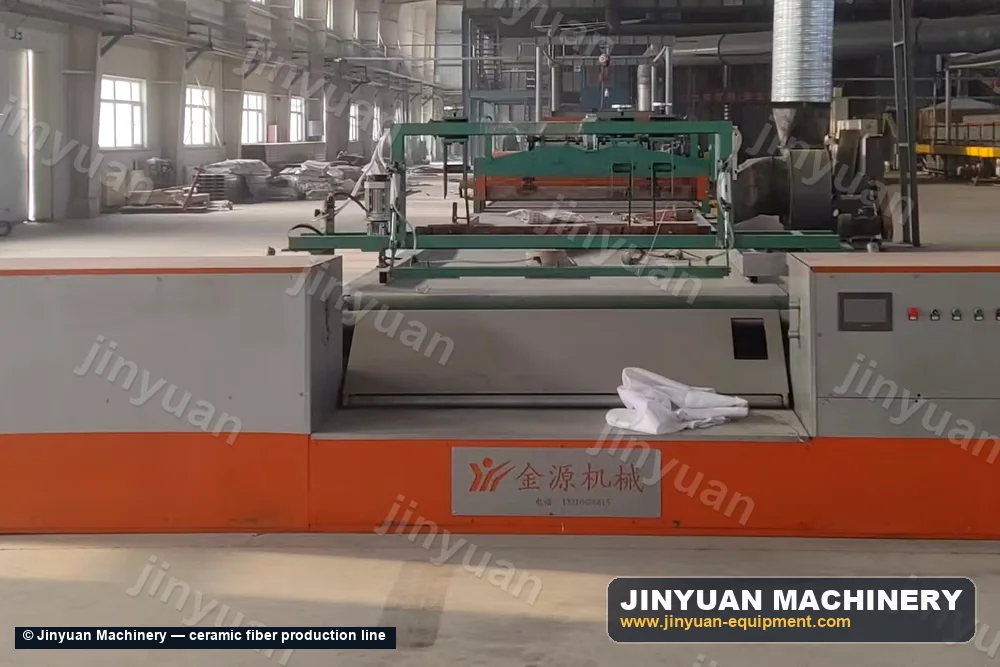
Defects are the line's alarm system, and they fire in a fixed order of likelihood. When a roll looks wrong, check in this sequence:
Symptom to first-check sequence
| Symptom on the blanket | Check first |
|---|---|
| Coarse fiber, high shot content | Furnace temperature low, roller speed low, viscosity high |
| Over-fine fiber, high breakage | Furnace temperature high, roller speed high |
| Batt thickness varying across or along the roll | Box vacuum fluctuation, mesh belt speed mismatch |
| Low tensile strength | Needling density insufficient, curing temperature insufficient |
| Density drifting off grade | Charge rate fluctuation, belt speed fluctuation |
The full defect taxonomy — what each fault looks like in service and not only on the line — is on the blanket quality defects page. The difference in emphasis matters: this table is for the operator standing at the line with thirty minutes to act, and its first-check order follows the four master variables, because they are the ones that move within a shift.
What This Means If You Are Buying a Line
Parameter windows are also contract language. Four clauses cost nothing to ask for and decide whether the numbers on this page will exist on your line:
- Windows in the technical agreement: the control ranges above, grade by grade, written into the purchase contract as acceptance values rather than left in a manual delivered at handover.
- Trending of the four masters: furnace temperature, roller speeds, box vacuum and belt speed recorded by the PLC with history long enough to audit a shipped roll — the scope question we treat on the electrical and automation system page.
- Zone metering from commissioning: melting, spinning, needling and curing metered separately, so a per-tonne figure can be decomposed when the energy bill or the standard asks.
- A commissioning trial at your recipe: the line proven on the grade and density you actually sell, with the parameter record sheet signed at the trial — not on a demonstration grade chosen for ease.
The design-side companion to this page — how the windows become zone parameters, layouts and headroom — is on the design and planning page; the commercial companion, what holding these windows costs per tonne, is on the unit economics page.
What We Deliberately Do Not Claim
Four refusals keep the tables honest. The machine-example values are placeholders from one line class, not promises: until they are calibrated against your machine's nameplate, manual and commissioning record they are engineering intent, and we say so on every row that carries them. The industry-reference values are working levels observed across the industry, not a standard text: your raw material, furnace age and product mix shift your own windows around them. A parameter table is not a process guarantee: the same numbers on a worn needle board or a damp batch make different blanket, which is why maintenance and material discipline sit beside this page rather than inside it. And no single recipe spans the grade range: the 128 route above is one point in a map, and the map — not the point — is what a line must be bought to hold.
The Bottom Line
A ceramic fiber blanket line is controlled by four variables — temperature, viscosity, roller speed and collection vacuum — expressed as a few dozen windows across nine stations. Hold them and the line makes boring, sellable blanket; let one drift and the roll tells on it within a shift, in fiber, in thickness, in strength or in density. That is why we publish the windows with their attributes, the linkages with their failure modes, and a worked recipe with its changeover discipline: the parameter table is the shortest distance between a line that runs and a line that is understood. Buy the line that can hold the windows, trend the four masters from day one, and calibrate every example value against your own machine before the first campaign — then the table stops being a document and becomes the way the plant talks.
Frequently Asked Questions
What are the master control variables of a ceramic fiber blanket line?
Four: furnace temperature, melt viscosity, roller speed and collection box vacuum. Temperature sets viscosity, viscosity sets how easily the melt fibers, roller speed sets fiber fineness and its distribution, and box vacuum sets how evenly the batt lays down. Every other window on the line is a window on one of these four, which is why they are the values worth trending from commissioning day.
What furnace temperature does a resistance-furnace blanket line run at?
1,900–2,200 °C as the general industry working range, held within ±10–20 °C, with melt viscosity at the flow between 1 and 10 Pa·s. The hold matters as much as the setpoint: viscosity moves with temperature, and viscosity is what the spinning machine actually sees.
How fast do the spinning rollers run on a blanket line?
As surface speeds: distribution roller 20–30 m/s, then roughly 70–110, 80–135 and 150–190 m/s across the three spinning rollers, with the speed-ratio mismatch kept under 5% because the draw ratio sets fiber diameter. Rotational speeds such as 9,500–9,600 r/min for the third roller are machine-class examples and must be calibrated against the actual machine.
Which needling parameters decide blanket tensile strength?
Stroke frequency 800–1,200 per minute, punch density 200–300 per cm² and penetration depth 10–15 mm. Industry test data show tensile strength rising roughly 15% per 10 kg/m³ of density, but the trade is needle life and surface quality: past the window you buy strength with broken needles and pulled batt surfaces.
What does the curing cycle look like for a needled blanket?
A zoned setting furnace at 800–1,200 °C with a 2–4 hour soak and a staged ramp, which sets dimension and shrinkage behaviour. A sol-gel low-temperature setting route runs cooler, around 550–680 °C for 40–50 minutes. Too hot embrittles the fiber and drifts the density; too cool leaves shrinkage unset.
How do you change a line from 96 to 128 kg/m³?
All at once, against the specification map: collection vacuum, laydown speed and the needling set switch together as one recipe, because knob-by-knob trials waste shifts and produce rolls that belong to no grade. The change goes through the change procedure into the debugging case archive, and four parameter recordings per shift verify the new recipe in production.
Can I use these parameter windows as my process file?
No. Industry-reference values are working levels for design, acceptance and benchmarking; machine-example values are placeholders that must be calibrated against the nameplate, factory manual and commissioning record of the actual machine. The formal process file is the parameter record sheet plus the shift log, and every change to it follows the change procedure.