
The furnace takes the credit and the blame in ceramic fiber production, but the first gate stands well before it: the batching house, where lump and powder raw materials become a blend the melt can trust. Everything the spinning machine later feels — viscosity, chemistry, shot, fiber diameter drift — is decided or damaged here, in crushing, weighing, mixing, drying and feeding. A batch that arrives at the furnace top with the right fineness, the right ratio, real uniformity and low moisture gives the melt a stable starting point; a batch that arrives wrong cannot be corrected at 2,000 °C, only inherited.
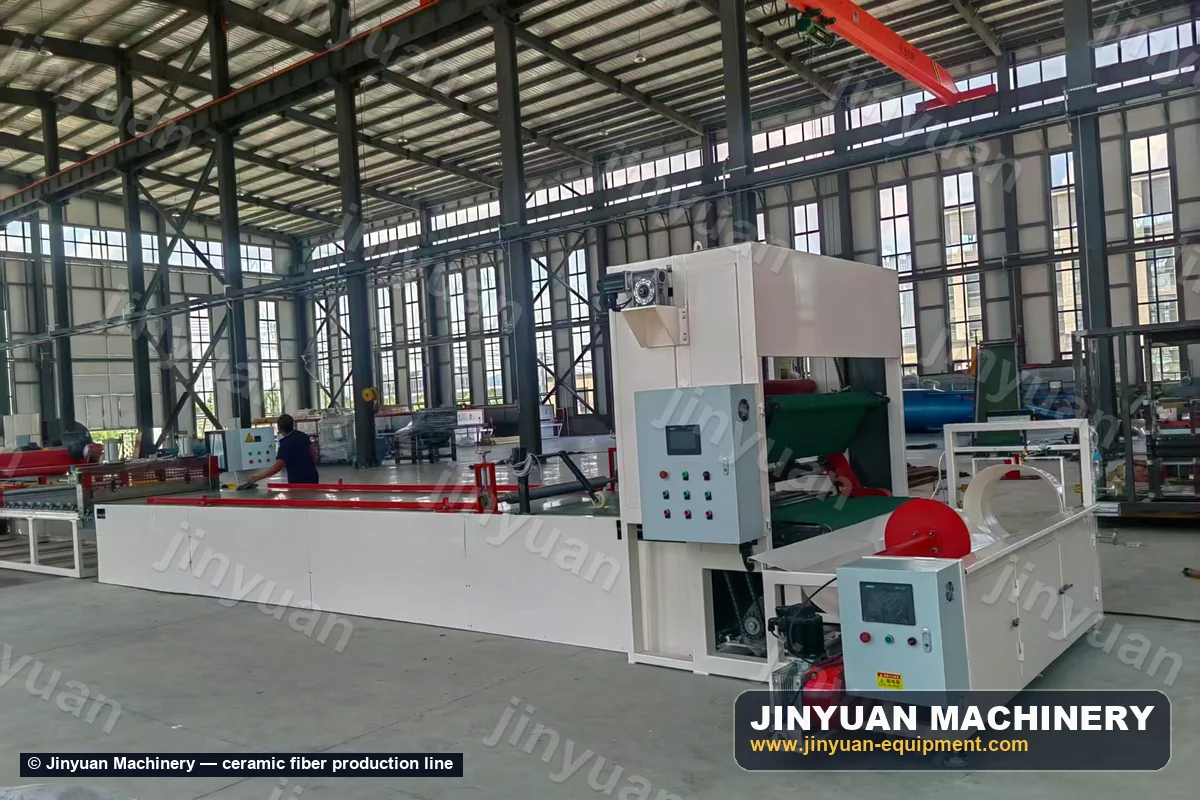
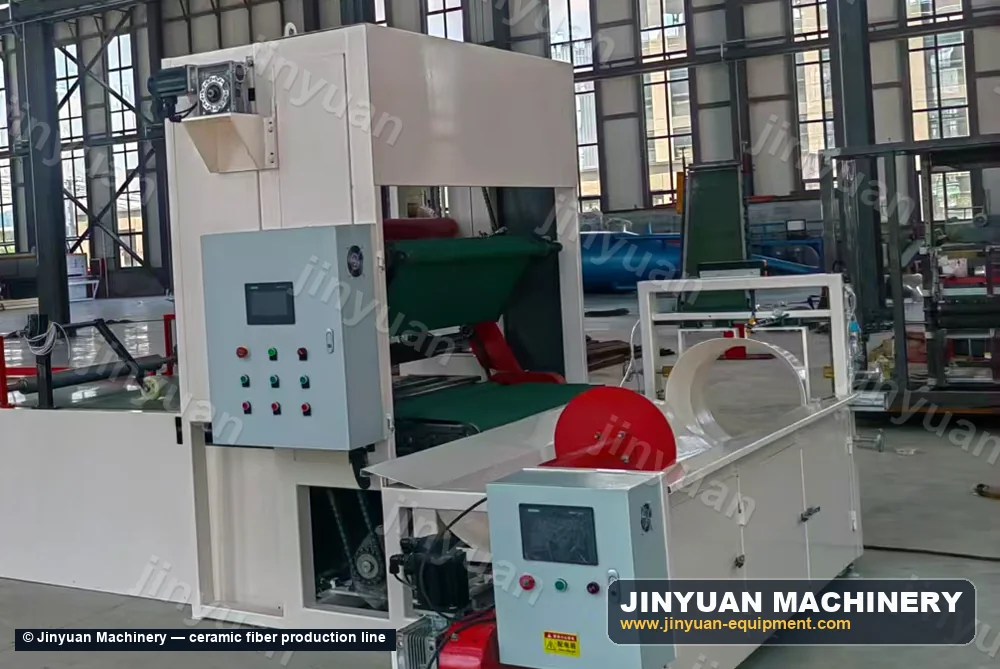
This page is the batching house itself: the five unit operations in line order, the control point and the cheap check for each, and the table that reads finished-fiber defects back to their batch cause. The raw-material routes and the chemistry targets they serve are covered on our production process page; the physics by which composition controls fiberization, on the formation physics page. The line photographed here is a commissioned Vietnam project — the kind of line whose melt stability is won or lost in the batching house behind it.
The First Gate: What the Batch Owes the Furnace
The task of the batching house compresses to four obligations, and the melt enforces every one of them:
- Qualified fineness — ground fine enough that the melt dissolves the batch completely and evenly.
- Accurate ratio — weighed to the recipe, because the weighbridge is where the finished chemistry is actually decided.
- Real uniformity — mixed evenly at both the shovel scale and the gram scale, because the melt sees grams.
- Low moisture — dried, because water entering a 2,000 °C melt does not dry out; it explodes into steam.
The reason the gate matters is inheritance. A wet or unevenly milled batch changes melt viscosity hour by hour, and the spinning machine feels it immediately as fiber diameter drift and shot spikes — symptoms that look like a furnace fault or a roller fault but are neither. Every downstream control window on our process parameter reference assumes a batch that met these four obligations.
Step 1 — Crushing and Grinding: The 200-Mesh Line
Lump raw material — calcined bauxite or chamotte, quartz sand, zircon sand where the grade calls for it — enters a crusher and leaves as powder behind a sieve. The common public industry requirement is a 200-mesh pass:
Crushing and grinding requirements (industry reference)
| Item | Requirement | Why it matters |
|---|---|---|
| Particle size | Pass a 200-mesh sieve | Fine particles melt faster and more uniformly |
| Impurities | Oversize and foreign matter removed | Avoids uneven melting and blocked melt orifices |
| Equipment | Jaw or roller crusher, then ball or Raymond mill | Two-stage size reduction to the sieve line |
Fineness is a melting-speed argument. A particle that survives to the melt surface unmelted becomes either shot in the fiber or a scab on the melt pool; both are expensive, and neither can be filtered out afterwards. The sieve residue check is therefore the cheapest insurance in the plant: a screen and a balance, run every lot.
Step 2 — Weighing the Recipe: Where Chemistry Is Decided
The recipe is a mass ratio, and weighing accuracy is the number that decides the finished Al₂O₃ / SiO₂ deviation — which decides melt viscosity — which decides fiber diameter and shot. No downstream control can recover a batch weighed wrong; the chemistry it carries is the chemistry the fiber gets. Two disciplines follow from this. Weighing records are kept per batch and reconciled against chemical analysis of the furnace feed, so a drift in either shows up as a difference between them. And when the recipe runs several components — alumina powder plus silica sand plus zircon sand for the zirconia grades — each is metered separately and only then mixed, because a pre-blended pile segregates by particle size in every subsequent transfer and delivers a ratio that no scale ever approved. The ratio targets per grade live on our grade recipe page; the impurity ceilings they sit inside, on the quality factors page. Which rung of the ladder a batch is aiming at — how much alumina the blend carries and whether zircon sand enters it at all — is the definition of the grade on our ceramic fiber grades page.
Step 3 — Mixing: Macro and Micro Uniformity
Weighing sets the average; mixing sets the variance. The blend must be uniform at both scales — across the batch and within a handful — because the melt dissolves grams at a time. An uneven mix delivers local chemistry differences to the melt: pockets richer in alumina melt stiffer, pockets richer in silica melt thinner, and the fiber alternates coarse with fine, soft with hard, while shot rises in the off-ratio pockets. The signature is worth memorising because it discriminates the cause: mixing faults produce variation within a run, across rolls of the same batch, whereas a weighing fault shifts the whole batch uniformly. The mixer is ordinary equipment — a ribbon or paddle mixer — but mixing time is a real process parameter, and shortening it to gain throughput is one of the quiet ways a plant buys defect rate.
Step 4 — Drying: The Moisture That Becomes Bubbles
Water in the batch does not evaporate gently on the way to the furnace; at 2,000 °C it flashes to steam inside the melt, churning the pool, destabilising the flowing stream and leaving gas pores in the fiber. The visible symptoms are a bubbling, jumping melt stream and pores in the finished fiber; the safety symptom is spitting at the furnace. Drying the blend before it climbs to the furnace-top bin removes the cause for a fraction of the energy cost of the melt itself, and the drying-loss test — weigh, dry, weigh again — is the check that keeps the dryer honest. Of the four obligations, moisture is the one most often skipped in dry seasons and most often blamed for faults in wet ones.
Step 5 — Feeding: The Rhythm That Matches Power
The finished blend climbs to the furnace-top bin and enters the melt through an automatic feeder, continuously and by weight. The feeder's only job is rhythm: feed faster than the furnace can melt and the pile accumulates, melting incompletely and scarring the pool; feed slower and the melt level falls, thinning the stream and unsteadying every fiberizing parameter downstream. The two tell-tales are the melt level and the furnace current, watched together — which is why feeding rate appears among the line's control parameters rather than among the batching house's, even though the equipment sits on the batching side of the wall. What the furnace does with that rhythm — the three balances that hold the level and the stream steady — is taken up on our melting process page.
The Five Control Points
Each operation carries one control point, and each control point carries a check cheap enough to run every shift:
Batching control points, checks and the cost of deviation
| Control point | Target | Check | Cost of deviation |
|---|---|---|---|
| Fineness | 200-mesh pass | Sieve residue | Incomplete melting, shot |
| Batch ratio | Matches the recipe | Weighing records against feed analysis | Chemistry drift, fiberizing faults |
| Mix uniformity | Uniform to eye and to sample | Sample analysis | Fiber quality fluctuation within the run |
| Moisture | As low as practical | Drying loss | Melt bubbles, stream jumping, spitting |
| Feed rhythm | Matched to melting power | Melt level and furnace current | Unstable stream |
The checks matter as much as the targets, because they are what turns a fault from a mystery into a row in a table. A plant that records sieve residue, weighing, sample analysis, drying loss and level-current together can name the cause of a bad roll within minutes; a plant that records nothing argues about it for a week.
Reading Fiber Defects Back to the Batch
The four classic batch faults and their signatures:
Batch faults, symptoms and corrections
| Symptom | Cause | Correction |
|---|---|---|
| Melting slow, pile scarring the pool | Coarse particles or overfeeding | Raise fineness; cut the feed rate |
| Bubbling, jumping stream, pores in fiber | Wet batch | Strengthen drying; check drying loss |
| Soft and hard bands in finished blanket | Uneven mixing | Longer mixing time; better mixer |
| Shot high, harsh hand | Ratio or fineness drift | Recheck recipe weighing; hold the sieve line |
Two discrimination rules save hours. Batch faults persist across every roll made from the batch and vanish when the batch changes, while roller-speed and cooling faults follow the machine, not the pile — the separation is worked through on our uniformity control page. And shot that arrives with unmelted cores in it is a batching or melting signature, not a spinning signature, as the shot content page details. Once the line is stable, defect handling in finished blanket is covered by our defect guide.
The Batching Section on a Quotation
Buyers compare furnaces and spinning machines and trim the batching house, because it looks like ordinary powder handling. It is the part of the line whose absence shows up in every roll, and the part that costs least at order time. The five line items:
- Crushing and milling with a sieve check: crusher, mill and sieve sized to the line's feed rate, with dust collection — the 200-mesh line is a system, not a screen.
- Weighing with records: per-component metering for multi-component recipes, with batch records retained and reconciled against feed analysis.
- Mixing sized to the line: mixer capacity matched to furnace feed rate with cleanout access, so mixing time survives production pressure.
- Drying capacity with a moisture check: dryer sized for the wet season, not the dry one, with drying loss as a routine test.
- Feeding interlocked with the furnace: automatic feeder holding rhythm against melt level and furnace current, because feed rate is a melting parameter wearing batching hardware.
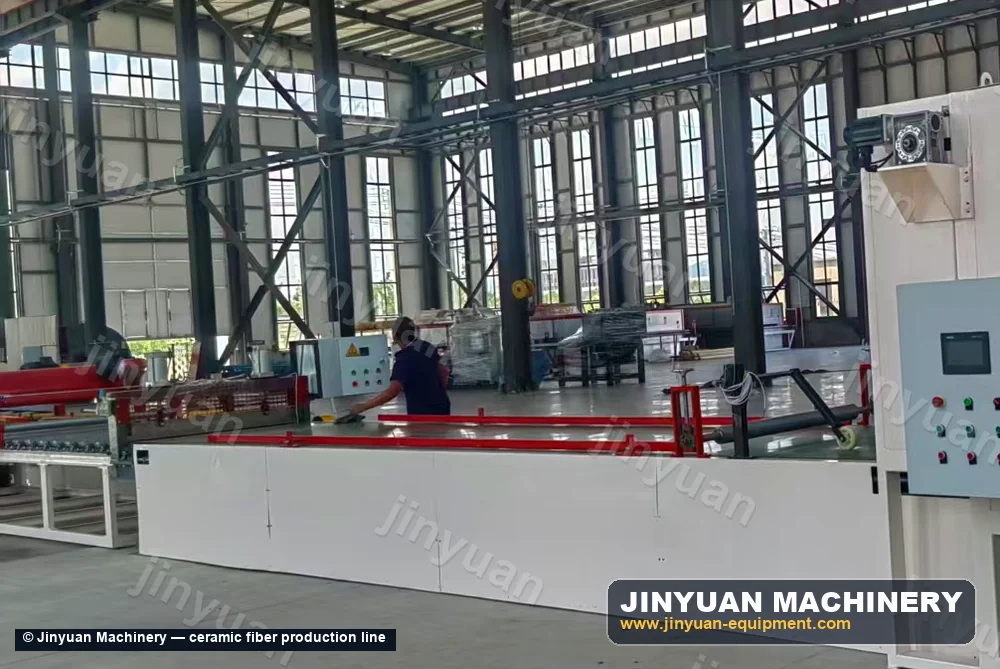
Each of these is cheap steel and instrumentation at order time and a retrofit with foundation work later. The line in these photographs runs because its batching house was bought with the same care as its furnace.
What We Deliberately Do Not Claim
Three boundaries. The 200-mesh figure is the common public industry requirement, quoted as such; individual plants run finer or coarser sieves by raw material and furnace, and the sieve line is a calibration value, not a law. Our own plant values for grinding fineness, weighing tolerance, mixing time and furnace-feed moisture are per-line calibration figures confirmed on site during commissioning — we publish the control points and their checks, not numbers that would pretend to be universal. And the defect table reads batch causes only: the same symptoms can have melting, fiberizing or cooling causes, and the discrimination rules linked above are part of using it.
The Bottom Line
Raw-material batching is not powder handling; it is the first quality gate of a ceramic fiber line, and the only one whose faults cannot be corrected downstream. Fineness decides whether the melt dissolves its feed, weighing decides the chemistry the fiber will carry, mixing decides the variance roll to roll, drying decides whether the melt runs calm or boils, and feeding rhythm decides whether the stream holds steady into the spinning machine. Five operations, five control points, five cheap checks — and a defect table that reads any bad roll back to the gate it came through. Build the batching house with the same care as the furnace, record the five checks every shift, and the melt starts every hour from the same place: which is all any spinning machine ever asks for.
Frequently Asked Questions
Why must ceramic fiber raw materials be ground fine before melting?
Because particle size sets melting speed and completeness. The common industry requirement is a 200-mesh sieve pass: fine particles dissolve into the melt quickly and uniformly, while coarse particles survive to the melt surface as unmelted cores that become shot in the fiber or scabs on the pool, and can block the melt orifice. Sieve residue per lot is the cheapest check in the plant.
What does batch weighing accuracy decide?
The finished chemistry, and through it the melt viscosity and the fiber. Weighing error moves the Al₂O₃ / SiO₂ ratio, which moves the viscosity window the spinning machine works in, which moves fiber diameter and shot content. No downstream control recovers a batch weighed wrong. Multi-component recipes — alumina powder, silica sand, zircon sand — are metered separately and only then mixed, because pre-blended piles segregate in transfer.
Why dry the batch before melting?
Because water entering a 2,000 °C melt flashes to steam inside it: the pool churns, the flowing stream jumps and bubbles, gas pores freeze into the fiber, and the furnace can spit. Drying the blend first removes the cause at a fraction of the melt's energy cost, and the drying-loss test keeps the dryer honest. Moisture is the obligation most often skipped in dry seasons and blamed for faults in wet ones.
What happens if the feed rate does not match melting power?
The melt tells you in both directions. Feeding faster than the furnace can melt accumulates a pile that melts incompletely and scars the pool; feeding slower lets the melt level fall, thinning and unsteadying the stream every fiberizing parameter depends on. Melt level and furnace current, watched together, are the tell-tales — which is why feed rate is a melting parameter even though the feeder stands in the batching house.
How does uneven mixing show up in finished blanket?
As variation within a run: coarse and fine fiber alternating, soft and hard bands, raised shot content, because off-ratio pockets of the blend melt stiffer or thinner than their neighbours. The discriminator is scale — a mixing fault varies roll to roll inside one batch, while a weighing fault shifts the whole batch uniformly — and the correction is mixing time and mixer quality, not furnace adjustment.
Which raw materials go into a ceramic fiber batch?
Two routes. The natural route uses calcined bauxite or chamotte and kaolin for the standard grades; the synthetic route uses alumina powder and silica flour for high-purity and high-alumina products, with zircon sand added for the zirconia grades. The ratio target sits between about 45/55 and 50/50 Al₂O₃ / SiO₂ for standard grades, inside impurity ceilings on iron and alkalis; the routes and their chemistry are covered on our production process page.
Can a batch fault be corrected after melting?
Not in any economic sense. Chemistry, uniformity, moisture and fineness are inherited by the melt and by every stage after it: the furnace can hold temperature but cannot re-weigh a batch, and the spinning machine can hold speed but cannot dry a wet melt. That inheritance is why batching is called the first quality gate — the control points and their cheap shift checks exist to catch faults where correction still costs nothing but a rejected lot.