
A ceramic fiber quotation opens with a designation — STD, RT, HP, HA, ZA, HZ — and everything else in the document, price first, follows from it. The designation is not a brand label; it is a promise about chemistry, and through chemistry a promise about temperature. Two packs can carry the same designation and behave differently, and two packs with different designations can be sold into the same duty — both failures trace back to reading the designation as a name instead of as a chemistry. This page is what the name promises, what it does not, and how the marking string on the pack encodes it.
Four neighbouring pages own the adjacent territory. Our grade recipes page owns the production side — the parameter set each grade runs under on one line and how a changeover proceeds; our applications page owns sector-by-sector selection; our thickness and density guide owns the two geometric numbers; and our performance indicators page owns what each measured value means. What lives here is the designation layer in between: the chemistry ladder, the temperature semantics and the marking string.
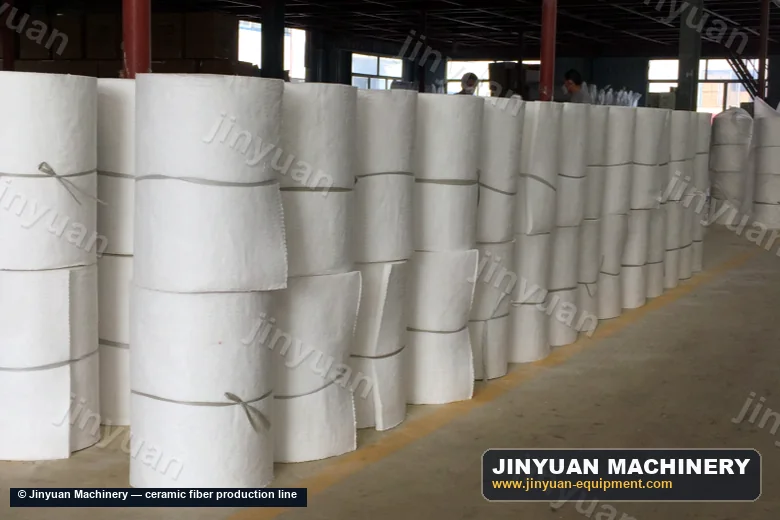
Six Designations, One Ladder: What the Chemistry Buys
The industry runs on six rungs. The first four climb by raising alumina and driving impurities out; the last two stop climbing that way and add zirconia instead, because above about 1400 °C of classification temperature the alumina route runs out of headroom. The table aggregates the ranges published across vendor datasheets; where vendors disagree, the range is shown as a range, and the contract governs.
The six common designations, their aggregated temperature rungs, the chemistry that sets each rung and the feedstock it is drawn from.
| Grade (code) | Classification / continuous use, °C | Chemistry that sets the rung | Feedstock |
|---|---|---|---|
| Common (STD / COM) | 1050 / ≤850–1000 | Al2O3 40–44 %, Al2O3+SiO2 ≥95–96 %, Fe2O3 ≤1.0–1.2 % | Calcined hard clay (pyrophyllite) |
| Standard (RT / ST) | 1260 / ≤1000 | Al2O3 44–46 %, sum ≥96–97 %, Fe2O3 ≤1.0 % | Upgraded calcined hard clay |
| High-purity (HP) | 1260 / ≤1100 | Al2O3 46–49 %, sum ≥97–99 %, Fe2O3 ≤0.2 % | Synthetic alumina–silica feed |
| High-alumina (HA) | 1360–1400 / ≤1200 | Al2O3 52–55 %, sum ≥99 %, Fe2O3 ≤0.2 % | High-alumina synthetic feed |
| Zirconia-alumina (ZA) | 1400 / ≤1200 | ZrO2 5–10 % on Al2O3 39–46 %, Fe2O3 ≤0.2 % | Synthetic feed plus zircon sand |
| Zirconia-bearing (HZ) | 1400–1430 / ≤1260–1300 | ZrO2 15–17 % on Al2O3 39–40 %, Fe2O3 ≤0.2 % | Synthetic feed plus zircon sand |
Read the ladder as two regimes. Rungs one to four buy temperature the expensive way: every point of iron oxide and every point of alkali removed raises the temperature at which the glassy fiber begins to devitrify and shrink, and every point of alumina added raises it further — which is why the feedstock changes from calcined local clay to synthetic feed between RT and HP, and why the price steps up with it. Rungs five and six buy temperature a different way: zirconia in the fiber raises resistance to crystallization, to shrinkage and to slag attack at once, so the alumina figure can fall while the temperature ceiling rises. A buyer comparing only alumina across the last two rungs will rank them backwards.
One warning before the table is used in a tender: vendors do not label the same designation identically. Public datasheets exist that call a standard-type product 1050 °C and others that call it 1260 °C, and the aggregated ranges above are exactly that — an aggregation of published samples, not a standard's table. The governing numbers are the current edition of the product standard and the technical agreement attached to the contract; anything else is marketing.
The Red Line: Classification Temperature Is Not Service Temperature
The single most expensive misreading in this family is treating the classification temperature as an operating temperature. It is not. The classification figure is a grade ceiling established by soak-and-shrink testing — the temperature at which the product's permanent linear change stays inside its limit — and it says nothing about holding that temperature hour after hour. The number a lining is designed against is the continuous service temperature, and it sits well below: roughly 850–1000 °C for a 1050 grade, 1000 for a 1260 standard, 1100 for high-purity, 1200 for high-alumina, and 1260–1300 for the zirconia-bearing rung.
Run a product above its continuous service temperature and the failure is not sudden; it is cumulative. The fiber sinters faster than the duty allows, shrinkage accelerates, thermal conductivity climbs as the mat densifies, and the structure powders at the hot face — the mechanism described in full on our performance indicators page, where permanent linear change is the grading number. The working rule is a margin: take the highest temperature the lining will actually hold in service, not the occasional peak, and leave 100–200 °C of headroom beneath the grade's continuous figure. A lining specified against peaks is a lining specified to shrink.
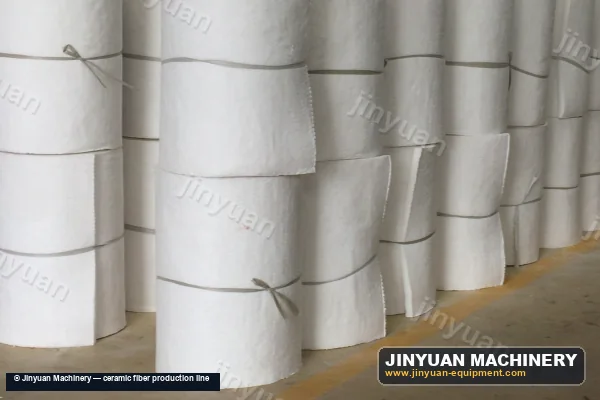
Reading the Marking String: Type Number, Process Letter, Density, Dimensions
The pack's marking is not a trade name; under the GB/T 16400 system it is a coded sentence in three parts — the product's full name, its technical characteristic values, and the standard number. A worked example in the standard's own format reads: a dry-process aluminium-silicate wool blanket of type 4, density 128 kg/m³, 7200 mm long, 610 mm wide and 30 mm thick is marked as type 4b blanket 128-7200×610×30, GB/T 16400.
- The digit is the type number: the class assigned by service temperature, so the temperature rung travels inside the marking itself.
- The letter is the process: a for wet-formed products, b for dry-formed products — the same wool, two different forming routes and two different product structures.
- The figures that follow are density, length, width and thickness, in that order — the geometric half of the specification, whose selection logic lives on our thickness and density page.
- The standard number at the end names the edition the marking is written under, which is what makes two packs' markings comparable.
One caveat a contract must respect: the type-number and a/b lettering above follow the standard's earlier editions. GB/T 16400 has been revised since — the 2003 and 2015 editions are published and a further revision has been in circulation — and the classification and marking details can move between editions. Before a marking string is written into a purchase order, check which edition the supplier's certificate cites, and cite the same one.
Where the Grades Sit in the Product Family — and Where the Family Ends
The designation ladder describes the wool, not the shape. The same chemistry is carried into a family of forms: loose wool as drawn; the needled blanket, dry-formed and binder-free, flexible; the felt, a flexible sheet carrying binder; the board, a rigid sheet; paper; pipe sections; and shaped parts and modules made to order. The grade sets the temperature semantics across all of them; the form sets the binder, the forming route and the mechanical behaviour, which is why a board and a blanket of the same designation are not substitutes any more than two blankets of different designation are.
Above the zirconia-bearing rung the melt-spun family ends. Polycrystalline mullite blanket — alumina above 70 %, continuous service into the 1500–1600 °C range, made by a colloidal polycrystalline route rather than by melting and spinning a glass — serves aerospace thermal hardware, special laboratory furnaces and single-crystal sintering. It is a different material family with a different price order, cited here only as the boundary: when a duty asks for the mullite rung, no designation in the table above is the answer.
Choosing a Rung: Work Down From the Duty, Not Up From the Catalogue
Selection is a short chain, and the order matters. Start from the temperature the lining will actually hold hour after hour, add the margin, and the rung chooses itself; then let the duty choose the form and the density on their own pages; then let the chemistry report confirm that the pack matches its designation, because the report — not the label — is the evidence. Sector-by-sector guidance for that last step lives on our applications page; the table below is only the temperature half of the chain.
The temperature half of grade selection: continuous duty ceiling to rung.
| Continuous duty ceiling | Rung | Where it typically sits |
|---|---|---|
| ≤1000 °C | STD / RT | Backing linings, general insulation, low-temperature kilns and ducts |
| ≤1100 °C | HP | Hot-face backing and mid-temperature kiln linings |
| ≤1200 °C | HA | Hot-face linings in metallurgical and petrochemical duty |
| ≤1300 °C | ZA / HZ | Hottest faces: tapping zones, reheat furnaces, kiln hot face |
| Above 1300 °C | Beyond this family | Polycrystalline mullite or non-fiber refractories |
What We Deliberately Do Not Claim
The temperature and chemistry ranges above are an aggregation of publicly published vendor datasheets and the standard family's published figures, cited as industry reference; they are not our specification and not a standard's table, and the vendor-scatter warning is part of the data rather than a footnote to it. We publish no lot chemistry of our own on this page: chemistry is batch-specific and travels on the contract report. Where a tender needs a governing number, the governing number is the current edition of the product standard plus the technical agreement — and a quotation from us carries both.
The Bottom Line
A designation is a chemistry promise, and the ladder has two regimes: alumina and purity for the first four rungs, zirconia for the last two. The classification temperature on the label is a soak-test ceiling, not an operating temperature, and the margin rule — continuous duty plus 100 to 200 degrees of headroom — is what keeps a lining out of cumulative shrinkage. The marking string carries the type, the process route and the geometry in one coded line, edition-stamped; and above the zirconia rung the family ends and polycrystalline mullite begins. Read the designation as chemistry, check it against the report, and the price difference between two packs with the same name stops being a mystery.
Frequently Asked Questions
What does the classification temperature of a ceramic fiber grade mean?
It is the grade's ceiling established by soak-and-shrink testing: the temperature at which the product's permanent linear change stays inside its limit after a long hold. It is not an operating temperature. The number a lining is designed against is the continuous service temperature, which sits well below it.
Can a 1260 grade ceramic fiber blanket run at 1260 °C?
No. 1260 °C is the classification ceiling, and the continuous service figure for that rung is around 1000 °C for the standard type and around 1100 °C for the high-purity type. Holding the classification temperature hour after hour accelerates sintering and shrinkage; the working rule is 100 to 200 °C of headroom above the real duty.
What is the difference between HP and HA ceramic fiber?
Both are synthetic-feed grades, but HA carries more alumina, about 52 to 55 percent against 46 to 49 for HP, and therefore sits one rung higher: roughly 1360 to 1400 °C classification and about 1200 °C continuous service, against 1260 and about 1100 for HP. The step also costs more, because the feed and the impurity control are tighter.
What does zirconia do in a ceramic fiber grade?
Zirconia in the fiber raises resistance to crystallization, to shrinkage and to slag attack at once, which is why the two top rungs add 5 to 17 percent ZrO2 instead of chasing alumina further. It also means alumina alone cannot rank those two rungs: a zirconia-bearing fiber can carry less alumina and hold a higher temperature.
How do I read the marking string on a ceramic fiber blanket pack?
As a coded sentence: the type number is the temperature class, the letter a or b is the forming route (wet or dry), the figures are density, length, width and thickness in that order, and the standard number at the end names the edition the marking follows. Check which edition the supplier's certificate cites before writing the string into an order.
Is polycrystalline mullite blanket the same family as ceramic fiber blanket?
No. It is a colloidal polycrystalline route, not melt-spun glass: alumina above 70 percent and continuous service into the 1500 to 1600 °C range, for aerospace thermal hardware and special furnaces. It is cited here only as the boundary above the zirconia-bearing rung, and it carries a different price order.