
Every ceramic fiber quotation arrives with a row of numbers: density, permanent linear change, thermal conductivity, strength, moisture, organics, shot, chemistry, fiber diameter. Buyers compare them line by line across suppliers, and most of those comparisons are quietly invalid — not because anyone is lying, but because the numbers mean less on their own than they appear to. Of the ten, exactly one decides the grade of the product: the heating permanent linear change. The other nine decide whether the product survives in your particular service. This page is about what each number actually answers, which misreading of it costs money, and how the numbers trade against each other.
Two neighbouring pages own the adjacent territory. Our testing methods page owns how each item is measured — guarded hot plate versus heat flow meter, the sieve aperture, the tensile direction — and our quality factors page owns the six production variables that set diameter, shot and strength. What lives here is the semantics layer in between: what a finished number means once it is on the datasheet, which one grades the product, how the numbers couple, and what a complete report must carry before it counts.
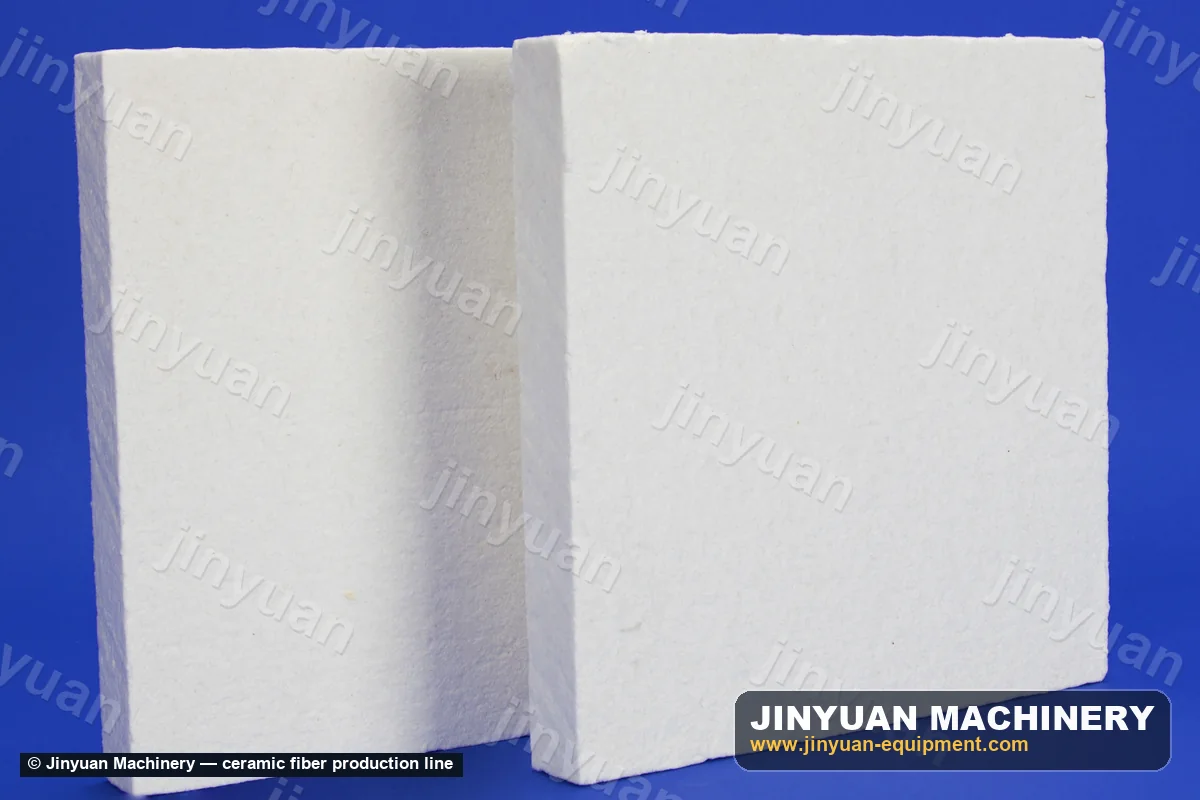
The Ten Indicators at a Glance: What Each Number Answers
Read the table as a map of responsibilities rather than a spec sheet. The third column is the one that saves money in a tender: it names the misreading we see most often when buyers compare reports.
The ten datasheet indicators, the question each one answers, and the misreading that costs money.
| Indicator | What it answers | Most common misreading |
|---|---|---|
| Bulk density, kg/m³ | How much solid skeleton sits in a cubic metre; sets load-bearing and the conductivity curve | “Denser is always better” — past the turning point it only adds solid conduction |
| Permanent linear change, % | Whether the product keeps its dimensions after a 24 h soak at temperature; the grading indicator | Read as thermal expansion — it is irreversible shrinkage, not expansion |
| Thermal conductivity, W/(m·K) | The heat flow the lining passes at a stated mean temperature | Quoting the room-temperature value for a hot-face calculation |
| Compressive strength, MPa | What the mat carries loaded through its thickness | Used interchangeably with flexural strength — they measure different things |
| Flexural strength, MPa | What a spanning panel carries in bending | Ignored because the compressive number looked fine |
| Moisture content, % | How much water ships inside the pack | Checked at ex-works only, ignoring re-absorption in transit |
| Organic content, % | How much binder burns out on first heat-up | The first-fire smoke is then reported as a defect |
| Shot content, % | How much unfiberized bead sits in the mat | Treated as cosmetic dirt rather than a conductivity and strength penalty |
| Chemical composition, % | Which chemistry the fiber was drawn from, and its alkali load Al₂O₃, SiO₂, Fe₂O₃, ZrO₂, Na₂O+K₂O, loss on ignition | Watching only the alumina figure while the alkalis set the real ceiling |
| Mean fiber diameter, μm | How fine the fiberizing ran, and where the product sits against respirable-dust definitions | Treated as a process curiosity with no health or handling consequence |
Permanent Linear Change: The Only Number That Sets the Grade
Permanent linear change — PLC, often called reheat or permanent shrinkage — is the length change that remains after a specimen has been soaked at a specified temperature for 24 hours and cooled to room temperature. It is irreversible by definition, and negative values mean shrinkage. The product standards cap it: the refractory-fiber products standard limits board to 3 %, while the insulation-systems standard writes the same family of requirement as not worse than −5.0 %. Different editions, different phrasing, one physical quantity.
It is the grading indicator because it is the visible end of crystallization. As-drawn fiber is a glass; held at temperature it devitrifies toward mullite and cristobalite, and that rearrangement shrinks the material. Shrink past the limit and the board or blanket loosens, cracks and pulls away from the shell it was meant to line — which is why the number that grades a product is the number that describes its skeleton rearranging.
The three levers behind permanent linear change, and the process answer to each.
| Lever | Mechanism | Process answer |
|---|---|---|
| Fiber chemistry | Higher alumina raises the crystallization temperature | Move up the chemistry ladder, or to zirconia-bearing wool for the hottest grades |
| Impurities | Soda, potash and iron oxide form low-melting phases that sinter the mat early | Control raw-material intake; wash the wool where the grade demands it |
| Binder alkali | Water-glass type binders carry sodium straight into the mat | Switch to silica or alumina sol binders on high-temperature grades |
This is where the recipe cost hides. Two boards can both be sold as the same classification temperature, look identical on the bench and differ by forty percent in price, because one was made from recovered wool with a water-glass binder and measured −4.5 % at a 24 h soak while the other, from high-purity wool with a sol binder, measured −1.8 %. Appearance cannot tell them apart; only the soak test can, which is precisely why PLC is the grading number and why a report without it is not a report.
Density and Conductivity: Two Numbers That Only Mean Something With Their Conditions
Bulk density is dry mass over geometric volume, open pores included. The product standard does not express its tolerance as a percentage: it publishes bands, and the bands are asymmetric. A board sold as nominal 260 kg/m³ is conforming anywhere from 200 to 280; a board sold as 300 is conforming from 281 to 320. A supplier quoting “±10 %” is not quoting the standard, and a buyer accepting that phrasing has accepted a wider gate than the one the standard writes.
Nominal bulk density and its conforming band for board, after the product standard: intervals, not percentages, and not symmetric.
| Nominal density, kg/m³ | Conforming band, kg/m³ |
|---|---|
| 260 | 200–280 |
| 280 | 240–300 |
| 300 | 281–320 |
| 320 | 301–340 |
| 360 | 341–380 |
| 400 | 381–460 |
Density also carries the most expensive misreading in the table above: the belief that more is better. Solid conduction rises with density, so the conductivity curve has a turning point somewhere around 280–320 kg/m³ for this family; beyond it, extra density buys load-bearing capacity and pays for it in insulation value. Load-bearing parts want the higher band; pure insulation wants the lower one. Specifying one density for both duties is how a lining ends up over-priced and under-performing at once.
Thermal conductivity has the same condition-dependence in a sharper form. A single board has many true conductivity values, one per mean temperature: 0.06 W/(m·K) near room temperature and 0.15 at a 500 °C mean are both honest numbers for the same product, and comparing suppliers across different mean temperatures compares nothing. The product standard therefore requires the value to be published with its mean temperature, its specimen density and its thickness or layer count. The insulation-systems standard's reference ceilings at a 500 °C mean run from about 0.19 W/(m·K) below 64 kg/m³ down to about 0.15 above 160 — note that the ceiling falls as density rises only up to the band where the turning point takes over.
Strength, Moisture, Organics and Shot: The Four Numbers Buyers Skim
Compressive and flexural strength are routinely collapsed into one “strength” column, and they should not be. Compression loads the mat through its thickness — the duty of a kiln-car deck or a bearing pad — while flexure bends a spanning panel, the duty of a large unsupported board or a suspended lid. They are set by different things: compression by the density of binder bridges, flexure by fiber aspect ratio. Short fiber with heavy binder gives a board that compresses well and snaps in bending; the two numbers can point in opposite directions on the same product.
The two strength figures, their loading direction and the duty each one governs.
| Figure | Loading direction | Duty it governs |
|---|---|---|
| Compressive strength | Through the thickness, at 10 % compression | Kiln-car decks, bearing pads, anything stacked under load |
| Flexural strength | Bending across the panel face | Large-span boards, suspended lids, panels handled on two edges |
Moisture is the quiet one. The standards cap it — 2 % for board in the products standard, 1.0 % for wet-process products in the insulation-systems standard — because residual water turns to steam on first heat-up and expands roughly sixteen-hundredfold, which is enough to crack a thick board from the inside. That is why thick sections are dried on a stepped curve rather than a straight ramp. The number also travels badly: an open-pore board in a sea container can re-absorb to 3–5 % in transit, so export contracts are better written against arrival moisture, with barrier film and desiccant named in the packing clause, than against ex-works moisture.
Organic content explains the complaint we hear most often after commissioning: white smoke and an odour on first fire-up. Starch, latex and PVA binders oxidize between roughly 200 and 400 °C, and the smoke is them leaving — normal, expected, and harmless to the finished properties, but only if the installation instructions said so beforehand. Unannounced, it reads as a defective product. The trade behind the number is real: more organic binder gives better cold strength and easier machining, and pays for it in first-fire smoke and weaker hot strength.
Shot content — the unfiberized beads retained on a 0.212 mm sieve — is skimmed as dirt and is not. Shot does three things at once: it raises conductivity, it interrupts the bonded crossings that give the mat its strength, and each hard bead is a nucleation site that accelerates the crystallization shrinkage described above. The insulation-systems standard sets a generous ceiling of 20 % for board; good practice sits in single digits, and the gap between the ceiling and the practice is exactly where fiberizing quality shows.
Chemistry and Fiber Diameter: The Two Numbers That Explain the Rest
The chemistry line is the authenticity check. The products standard asks for the data — alumina, silica, iron oxide, zirconia where relevant, the alkalis and loss on ignition — but sets no floor, so the report itself is the only evidence of what the wool was drawn from. The number to watch is not the headline alumina but the alkali sum: every additional half percent of Na₂O plus K₂O can drop the crystallization temperature by tens of degrees, and water-glass binders are the classic route by which alkali enters an otherwise clean chemistry. A board with a good alumina figure and a heavy alkali line is a board whose grade will not hold.
Mean fiber diameter, typically 3–6 μm across this family, carries two meanings. In process terms, finer fiber gives more surface per kilogram, which raises binder demand but yields a denser, flatter board. In regulatory terms, the diameter places the product against the respirable-fiber definition — diameter under 3 μm, length over 5 μm, aspect ratio over 3:1 — under which refractory ceramic fiber is classified as a suspected carcinogen and regulated in the European market. An export order into that market therefore needs biosolubility data or a documented substitute, and the diameter figure on the report is where that conversation starts.
Three Couplings: Strength, Low Conductivity and Price Are a Pick-Any-Two
Indicators do not move independently, and the couplings are the reason a “stronger, lower conductivity, cheaper” request cannot be met. Three dominate the rest.
The three dominant couplings between indicators, and what each gain costs.
| Coupling | What rises | What pays for it |
|---|---|---|
| Fiber aspect ratio | Wet-web strength and flexural strength | Harder dispersion: mottling, density spread and drying cracks |
| Bulk density | Compressive strength | Conductivity, once past the turning point around 300 kg/m³ |
| Alkali and organic binder load | Cold strength and machinability | Crystallization temperature falls, shrinkage rises, first-fire smoke rises |
Read the table against a tender and it becomes a negotiating instrument rather than a complaint: when a buyer asks for all three, the answer is not a refusal but a choice of which two the service actually needs. A kiln-car deck buys strength and pays in conductivity; a pure insulation lid buys conductivity and pays in compressive capacity; both pay in price when the chemistry ladder climbs.
What a Complete Test Report Must Carry
A report is not a list of numbers; it is a list of numbers with their provenance. Six items make it count in a technical review, and a report missing any one of them can be set aside without further argument:
- The product marking — type, grade, class, nominal density and dimensions per the standard's marking rule — not a trade name.
- The governing standard number with its edition year, so two reports compare like with like.
- The test conditions behind every value: soak temperature and time for shrinkage, mean temperature, specimen density and thickness for conductivity.
- Measured value and standard limit side by side, per item, so conformance is readable without arithmetic.
- The sampling basis and method: how many packs, drawn how, from which lot.
- The laboratory accreditation mark where the report is used for external quotation.
With those six present, the ten indicators above stop being advertising and become what they were measured to be: a description of a specific lot, made by a specific line, under conditions you can audit.
What We Deliberately Do Not Claim
We publish no measured values of our own on this page. Density bands, shrinkage limits, conductivity ceilings and shot ceilings quoted above are the product and insulation-systems standards' published figures, cited as the governing or reference gate; strength ranges are industry reference intervals, and the contract report governs. Our own lot values are batch-specific and travel with the batch, not on a public page that would age into a lie. Where a tender needs a number, the number arrives on the report, with its conditions and its limit beside it.
The Bottom Line
Ten indicators, one hierarchy. Permanent linear change grades the product because it is crystallization made visible; density and conductivity mean nothing without their bands and their mean temperature; the two strengths answer different questions and must not be collapsed; moisture, organics and shot each explain a complaint that arrives weeks after the line did its job; chemistry and diameter explain everything else, including whether the grade will hold and whether the product can travel into a regulated market. And above all of them sits the report itself: six provenance items that turn a row of numbers into evidence. Compare reports, not figures — the figures only mean what their conditions say they mean.
Frequently Asked Questions
Which ceramic fiber property decides the product grade?
The heating permanent linear change. It is the irreversible length change left after a 24 hour soak at temperature, and it is the visible end of crystallization: past its limit the product shrinks, cracks and pulls away from the lining. The other nine indicators describe fitness for a service, but this one sets the grade.
Why is ceramic fiber density tolerance a band and not a percentage?
Because the product standard publishes conforming intervals, and they are asymmetric: a nominal 260 kg/m3 board conforms from 200 to 280. A quotation written as plus or minus ten percent is not quoting the standard, and accepting that phrasing accepts a wider gate than the standard writes.
At what temperature should thermal conductivity be quoted?
At the mean temperature of the service, stated on the report together with specimen density and thickness. The same board reads about 0.06 W/(mK) near room temperature and about 0.15 at a 500 C mean; both are true, and comparing across mean temperatures compares nothing.
Is white smoke on first heat-up a defect?
No. Organic binders such as starch, latex and PVA oxidize between roughly 200 and 400 C and leave as smoke and odour on first fire-up. It is expected and harmless to the finished properties, which is exactly why the installation instructions must announce it before the first fire-up, not after the complaint.
Why can compressive and flexural strength point in different directions?
Because they are set by different things: compression by the density of binder bridges through the thickness, flexure by fiber aspect ratio in bending. Short fiber with heavy binder compresses well and snaps in bending, so one number cannot stand in for the other.
What makes a ceramic fiber test report trustworthy?
Six provenance items: the standard's product marking instead of a trade name, the standard number with edition year, the test conditions behind every value, measured value and limit side by side, the sampling basis and method, and the laboratory accreditation mark where the report supports a quotation. Missing any one, the report can be set aside.