
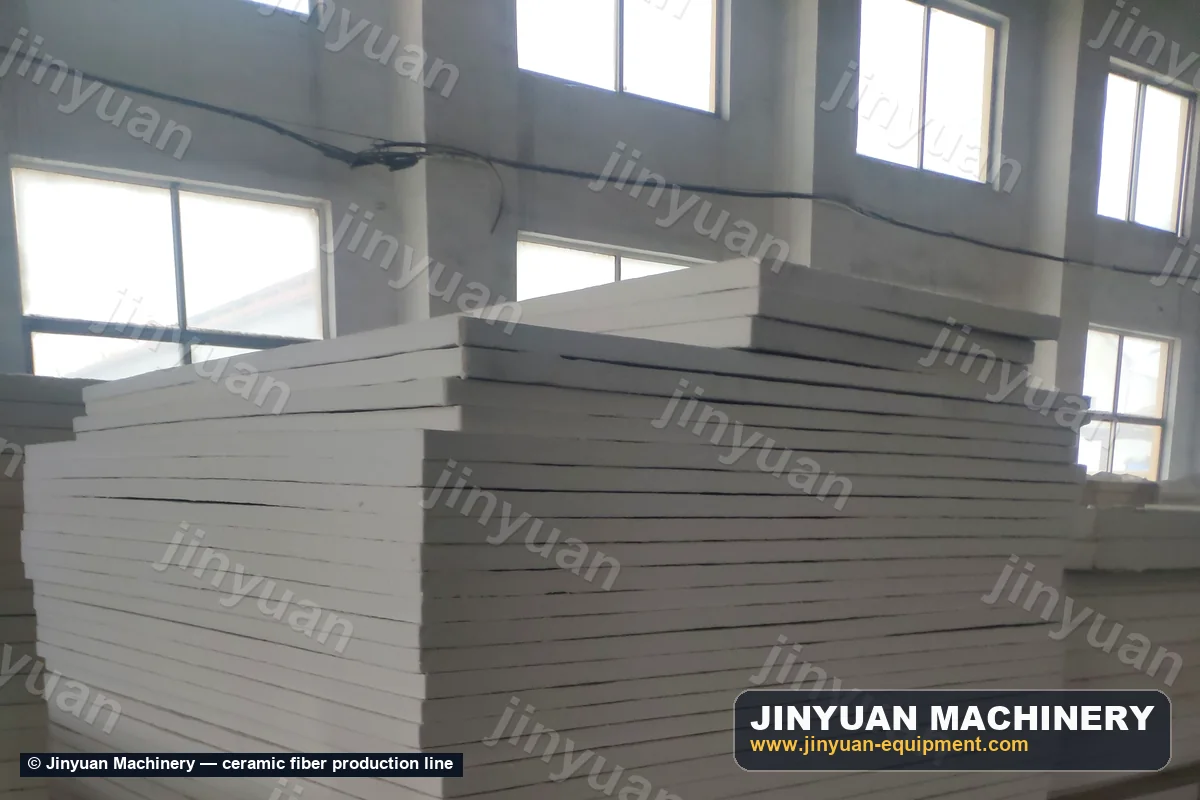
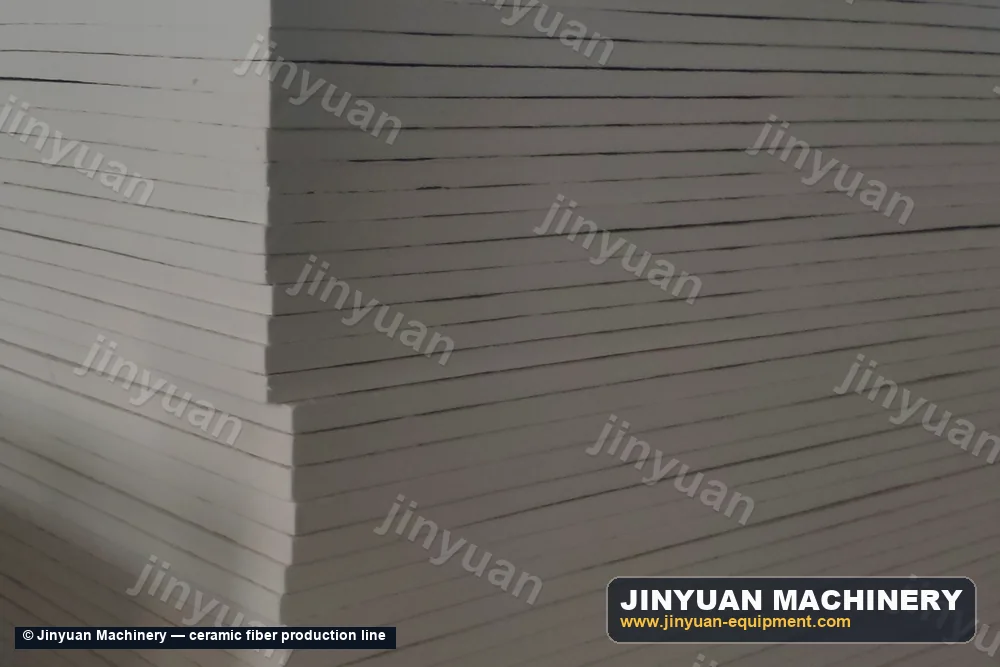
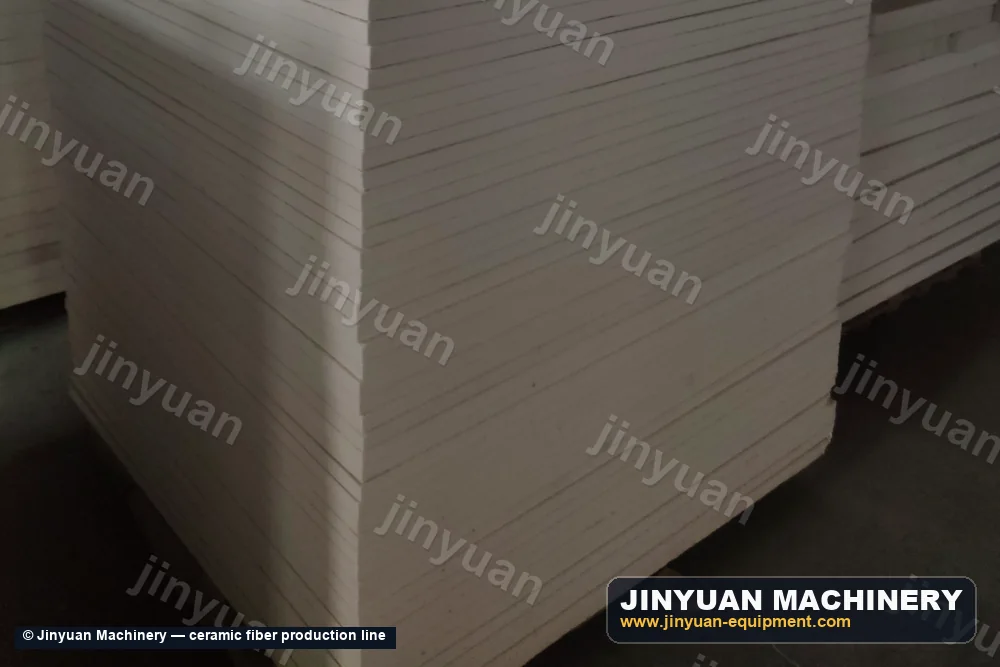
On this site the word board is already taken in one place, and it is not this page: in the needling articles a board is the needle loom's bed plate, the steel deck the web is punched against. Here board means the product — the rigid, flat, white insulation panel that stacks on a pallet and cannot be rolled. Getting that distinction out of the way first matters, because the two objects share a name and nothing else. This page is about the product: what a ceramic fiber board actually is, why the wet route makes it rigid, what the binder contributes at the fiber crossings, and, just as importantly, what a board is not.
One sentence carries the whole definition: a ceramic fiber board is not a blanket that has been pressed hard, it is a board that has been filtered. Aluminosilicate fiber wool is dispersed in water into a slurry, vacuum draws the water out through a forming screen, and the fiber settles onto that screen layer by layer into a wet mat; the mat is dried, bonded and machined into a rigid panel. Everything that follows — the density bands, the strength, the thickness ceiling, the difference from a blanket — is a consequence of that one forming step. Our blanket thickness and density guide owns the blanket side of selection, our production process page owns the dry blanket line, and our testing methods page owns how each property is measured; what lives here is the board product itself. The board-line water and fiber recovery guide explains how to record filtrate, wet trim and returned solids.
Planning to make board rather than source finished panels? Compare batch and continuous board equipment and see the 6 t/day sizing example.
Four Names for One Product: Reading the Standards Without Mixing Them
The same panel is called four different things depending on which document or which market is speaking, and mixing the names produces technical errors in quotations and in specifications. The refractory system of the national standard calls it a refractory fibre board and marks it RBD; the insulation system of the other national standard calls it an aluminosilicate wool board; the Chinese market says ceramic fiber board, ceramic fibre board or the shortened trade form; and the export trade writes ceramic fiber board, aluminosilicate fibre board or, in regulated contexts, RCF board.
One product, four names, and the document or market that uses each.
| Context | Name in that context | Basis |
|---|---|---|
| National standard, refractory system | Refractory fibre board, marked RBD | GB/T 3003-2017 |
| National standard, insulation system | Aluminosilicate wool board | GB/T 16400-2015 |
| Chinese market and trade | Ceramic fiber board, ceramic fibre board | Common trade usage |
| Export trade | Ceramic fiber board, aluminosilicate fibre board, RCF board | Common trade usage |
The naming choice is also a regulatory choice. For European customers the regulated vocabulary is RCF board or aluminosilicate fibre board, because refractory ceramic fiber sits under respirable-dust regulation there and a quotation must address biosoluble alternatives; for the Middle East, South-East Asia and South America the plain ceramic fiber board carries the widest acceptance. Writing the wrong name for the market does not change the product, but it changes which standard the inspector opens.
What the Board Actually Is: A Filtered Skeleton, Welded at the Crossings
Three ideas explain the panel completely. The first is that the skeleton is a filtered fiber layer, not a glued fiber mass. In the slurry the wool is broken into individual fibers in suspension; as vacuum pulls the water through the forming screen the fibers deposit onto it layer upon layer into a three-dimensional random mat, the same principle by which paper is formed, which is why the trade calls the step suction forming. Two things follow immediately: the first driver of green strength is fiber aspect ratio, because longer, finer fibers make more crossing points; and the first driver of uniformity is slurry dispersion, because a poorly dispersed slurry flocculates into clouds, and clouds become face mottling, local density differences and drying cracks.
The second idea is that strength lives at the crossings. A dried wet mat has almost no strength of its own; the panel stands up and carries load because the binder cures into small solid bridges exactly where fibers cross, a lattice of weld points through the thickness. Which binder family is used decides what survives the first firing, and this is the single most common source of the complaint that a board crumbles after heat-up.
Binder families and what each leaves behind after the first firing.
| Binder family | Cold strength | What firing does | Typical use |
|---|---|---|---|
| Organic: starch, PVA, latex | High | Almost all strength lost; high loss on ignition | Low-end board, one-shot load-bearing parts |
| Inorganic: silica sol, alumina sol, phosphate | Medium | Strength retained well; low loss on ignition | Hot-face and structural parts |
| Composite: organic plus inorganic | High | Partly retained; medium loss on ignition | Mainstream industrial board |
That table answers the customer question directly: a board that crumbles after the first firing was bonded with a purely organic system, which is exactly right for a one-shot load-bearing part and exactly wrong for a hot-face lining. The binder is chosen for the thermal job, not for the shelf.
The third idea is that density is filtered, not pressed. On the wet route the deposited fiber mass, and therefore the wet thickness and the final density, is set by how long the suction runs and how concentrated the slurry is; once dried, the density is essentially fixed. This is a genuine difference from dry pressing, which can reach higher densities but damages the fiber and raises thermal conductivity on the way. The wet route's practical ceiling is the familiar 260 to 400 kg/m³ band of the national standard's board table.
What Ceramic Fiber Board Is Not: Five Misreadings That Cost Money
Half of the rework in board supply traces to five sentences that sound reasonable and are wrong. Naming them is cheaper than correcting them on site.
Five common misreadings of ceramic fiber board, and what is actually true.
| Misreading | What is actually true |
|---|---|
| A board is just a stiffer blanket | A blanket is dry-needled physical entanglement with no binder skeleton and it rolls; a board is wet-deposited and chemically bonded, rigid and unable to roll |
| Higher density always insulates better | Conductivity falls then rises with density; above roughly 300 kg/m³ solid conduction grows and insulation gets worse, so density is chosen for load, not for warmth |
| Classification temperature is the service temperature | It is not; classification temperature is a grading label, and continuous service temperature sits below it. This is the industry's most repeated misreading |
| Boards can simply be made 150 mm thick | Single-piece wet thickness is limited by suction resistance and the drying gradient, conventionally 10 to 100 mm; thicker sections are laminated or composite-built |
| Any board can serve the hot face | Only high-alumina or zirconia grades with inorganic binders suit long-term hot face; standard grades belong in backing |
Where the Board Sits in the Product Family
Set the board beside its relatives and its niche appears at once. Loose wool is raw fill; the needle blanket rolls and covers large areas; the vacuum-formed felt wraps shapes with weak rigidity; the module folds blanket for fast furnace-wall building; the shaped hard product is pressed for burner blocks and launders. The board alone combines strong rigidity, strong wind-erosion resistance and precise dimensions, which is why it is the form chosen for load-bearing surfaces, hot-face linings and anywhere a flat, true face must be held.
The product spectrum, with the forming route and the role each form plays.
| Form | Forming route | Typical density kg/m³ | Rollable, and the role it plays |
|---|---|---|---|
| Loose wool | As-fiberized | 64-120 loose | Not a shipped form; raw fill |
| Needle blanket | Dry needling | 96-160 | Rollable; large-area insulation |
| Vacuum-formed felt | Wet | 160-220 | Half rollable; shaped wrapping |
| Fiber board | Wet vacuum filtration | 260-400 | Not rollable; load-bearing, hot face, precise dimensions |
| Module, folded block | Blanket folded and pre-compressed | 180-240 | Not rollable; fast furnace-wall lining |
| Shaped hard product | Wet plus pressing | 260-460 | Not rollable; burner blocks, launders |
The board row's density band is the national standard's board table; the blanket row is the same standard's blanket table; the remaining bands are industry ranges and should be confirmed against the specific supplier's data sheet before they are used in a specification.
Three Questions to Answer Before Any Quotation
Before price is discussed, a responsible supplier asks three questions, and the answers choose the board rather than the catalogue choosing it. The numbers those answers rest on — density bands, shrinkage limits, conductivity at a stated mean temperature — each carry a misreading that costs money, and our performance indicators page unpacks them.
- Where will it sit? Hot face, backing, expansion joint or load-bearing kiln car: the position chooses the binder system first, because the binder is what survives or dies at temperature.
- What is the continuous operating temperature? Not the peak, the temperature the lining holds hour after hour: this chooses the grade, and it is a lower number than the classification label on the box.
- Must it carry load, or hold a precise dimension? This chooses the density band and the machining steps that follow forming.
Quote before those three are answered and the rework is already scheduled. The selection path that follows from them, and the trade-offs between strength, conductivity and price, are taken up on our quality factors page and our thickness and density guide; the board's own forming window is the subject of this page. For equipment selection, see how to size a continuous board line or compare the specifications on our ceramic fiber board production line page.
What We Deliberately Do Not Claim
The exact density grades our own board line runs, its binder recipes, its fired strength values and its loss-on-ignition figures are project numbers, and we do not publish them on a public page. The naming map, the wet-forming physics, the binder behaviour and the misreading list above are national-standard text and public industry reference, cited as reference rather than as our specification; the density bands for the non-board forms are industry ranges to be confirmed per supplier. A quotation from us carries the real numbers for your position, temperature and load; this page carries only what transfers between plants.
The Bottom Line
A ceramic fiber board is a filtered product, not a pressed one: fiber deposited layer by layer out of a slurry gives it a skeleton, binder cured at the fiber crossings gives it strength, and suction time gives it a density that pressing never could without wrecking the fiber. Read the four names against the right standard, choose the binder for the thermal job, respect the 10 to 100 mm single-piece ceiling and the gap between classification and service temperature, and the board does what no blanket can: it stands flat, carries load and holds a true face in front of the flame.
Frequently Asked Questions
What is ceramic fiber board made of?
Aluminosilicate fiber wool as the body, with binder and fillers, formed by wet vacuum suction filtration, then dried and machined. The fiber deposits layer by layer out of a slurry onto a forming screen, so the board is a filtered skeleton rather than a pressed mass, which is what makes it rigid.
Is ceramic fiber board just a hard ceramic fiber blanket?
No. A blanket is dry-needled: fibers physically entangled with no binder skeleton, and it rolls. A board is wet-deposited and chemically bonded at the fiber crossings, so it is rigid and cannot be rolled. The two share a raw material and nothing else.
Why does my ceramic fiber board crumble after the first heat-up?
Usually because it was bonded with a purely organic binder, starch, PVA or latex, which gives high cold strength but burns out at temperature and leaves almost no hot strength. Inorganic or composite binders retain strength after firing. Check the binder family against the thermal job, not against the shelf strength.
Does higher density mean better insulation in a board?
No. Thermal conductivity falls with density at first, then rises: above roughly 300 kg/m3 solid conduction grows and insulation gets worse. Density is chosen for load-bearing and dimensional duty, and insulation is chosen separately.
How thick can a single ceramic fiber board be made?
Conventionally 10 to 100 mm in one wet-formed piece, because suction resistance and the drying gradient limit how much fiber can be deposited and dried evenly. Thicker sections are built by lamination or secondary composite, not by a single suction cycle.
Can every ceramic fiber board be used on the hot face?
No. Only high-alumina or zirconia grades bonded with inorganic binders suit long-term hot face. Standard grades belong in backing, expansion joints and cold-face work. Using a standard grade as a hot face is one of the five misreadings that cost money.