
For a 6 t/day continuous ceramic fiber board line, ask the supplier to quote the mass of dry board that passes inspection after finishing. Use the same board specification, forming shift and inspection criteria for every quote. The forming shift sets the time basis for comparison; the dryer can operate on a separate schedule.
Start with the production mix
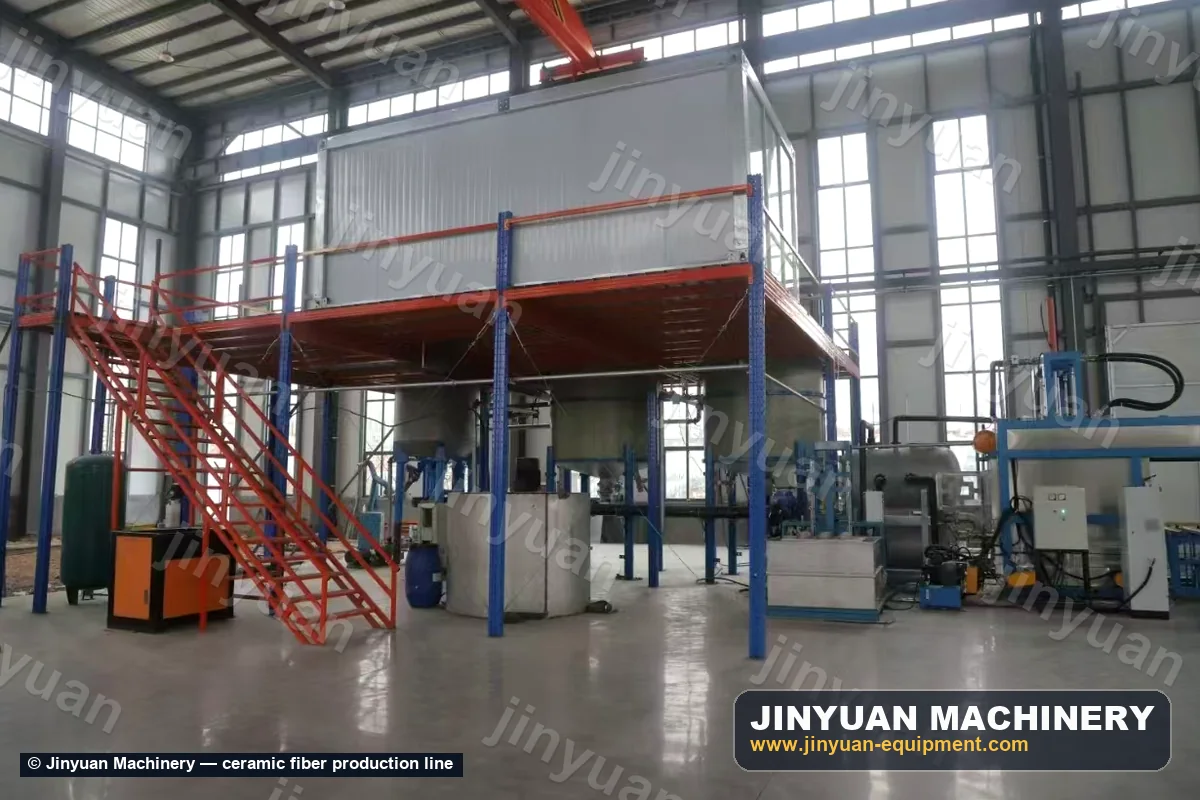
The continuous configuration is strongest when a few standard sizes account for most of the order book. A stable run lets the crew keep the belt, water cutters, tray loading and finishing settings aligned. With a succession of small orders, the crew spends more of the shift adjusting equipment and checking first pieces. Compare both line types on saleable output for the same order mix and calendar. For an introduction to how the board itself is made, see our ceramic fiber board guide. To compare batch and continuous systems, see the board equipment configurations.
Follow the board through four capacity checks
Engineering reference configuration. Confirm dimensions and duties against the project equipment schedule.
| Stage | Reference setup | Capacity check |
|---|---|---|
| Slurry preparation | Pulping, storage, screening and metered delivery | Stable feed through grade changes and planned stops |
| Wet forming | 2 m belt, longitudinal and transverse water cutting, vacuum transfer | Cut sheets per hour, transfer losses and wet thickness |
| Drying | Three electric drying rooms with tray and trolley handling | Loaded dry mass per cycle, loading time and release moisture |
| Finishing | Four-edge CNC cutting and double-sided sanding | Finished pieces per hour, trim allowance and rejects |
The 2 m figure is the forming width. The reference finished sheet is 1,200 by 1,000 mm. Confirm how the sheet sits on the belt and the tray, and reserve trim and handling allowances before calculating pieces per minute. The brochure lists 10–50 mm per mold set and 6–100 mm across configurations. Ask for throughput at the thicknesses you intend to produce.
What 6 Tonnes per Shift Means
| Brochure reference | 6 t/day on one 8-hour forming shift. |
|---|---|
| Example assumptions | 20 mm board and 90% yield from gross dry-equivalent production to accepted dry board. |
| Accepted output target | 6,000 kg of dry board that passes inspection after finishing. Dividing by 8 gives 750 kg per scheduled forming hour. |
| Gross output required | 750 ÷ 0.90 ≈ 833 kg of dry-equivalent output per scheduled forming hour. Apply yield once. |
The forming shift and dryer cycle can use different clocks. Check how many loaded trolleys can enter each room, how much dry-equivalent board each trolley holds, and how many cycles fit the agreed operating window. Include loading, unloading and changeover. For the CNC saw and sander, convert the mass target to finished boards per hour using the reference thickness and density, then test that rate through the whole finishing path.
Make site interfaces part of the purchase specification
Request a connected-load schedule that separates dryer heaters, fans and other drives from the estimated simultaneous demand. Agree the incoming power interface with the project electrical engineer before selecting a transformer. Request wheel loads and travel paths for loaded trolleys and lifting platforms so the civil designer can check local floor loads. The reference layout includes a 200 m³ recirculation reservoir in the owner scope. Confirm that boundary and size makeup water from evaporation, process losses and any discharge under the actual operating schedule. For the water circuit, use a shift water balance and recovered-solids ledger to distinguish internal flow from freshwater demand.
Quotation and Acceptance Checklist
- Product mix: List the fiber feed, finished length, width, thickness and dry density for each main grade. Flag the thickest and densest boards for sizing.
- Production schedule: Specify accepted dry tonnes per shift, scheduled forming hours and dryer operating hours. Agree how interruptions, changeovers and rejects will be recorded.
- Site and supply scope: State the available drying heat source, incoming power and water supply. Confirm who provides foundations, electrical distribution and the recirculation reservoir. Review the board line supply scope against your site plan.
- Acceptance run: Agree the reference grade, run length, sampling frequency, moisture limit and measurement points. Record accepted and rejected dry mass separately. Measure thickness after sanding and finished length and width after CNC cutting.
Send these requirements with your board line inquiry so the proposal can state the equipment scope and the agreed output basis together.
Frequently Asked Questions
Does 6 t/day mean round-the-clock operation?
The brochure reference uses an eight-hour forming shift. Define the dryer operating schedule separately and specify the measurement point for accepted dry output.
When is a continuous board line a good fit?
It is best suited to repeated flat-board orders with a small number of dominant sizes and enough stable demand to keep forming, drying and finishing loaded.
What should a buyer confirm before ordering?
Confirm the product mix, shift output basis, dryer cycle, finishing rate and the electrical, civil and water interfaces. Put the agreed conditions into the performance test.