
A ceramic fiber blanket test report is the only document that travels from your line to the customer's site with every batch, and every number on it was made by a method before it was made by a machine. Dimensions measured one way compare across parties; measured another way they do not. Conductivity measured wet reads high; measured dry it reads true. Tensile strength pulled along the machine direction and across it are two different numbers wearing one name. This page is the test program itself: the thirteen items the product standard calls for, what each method actually does at the bench, and — the question most report readers never ask — which production process owns the result when the number fails. And before any of those numbers can be compared across suppliers at all, each has to be read for what it actually answers — the semantics, the couplings and the grading number our performance indicators page sets out.
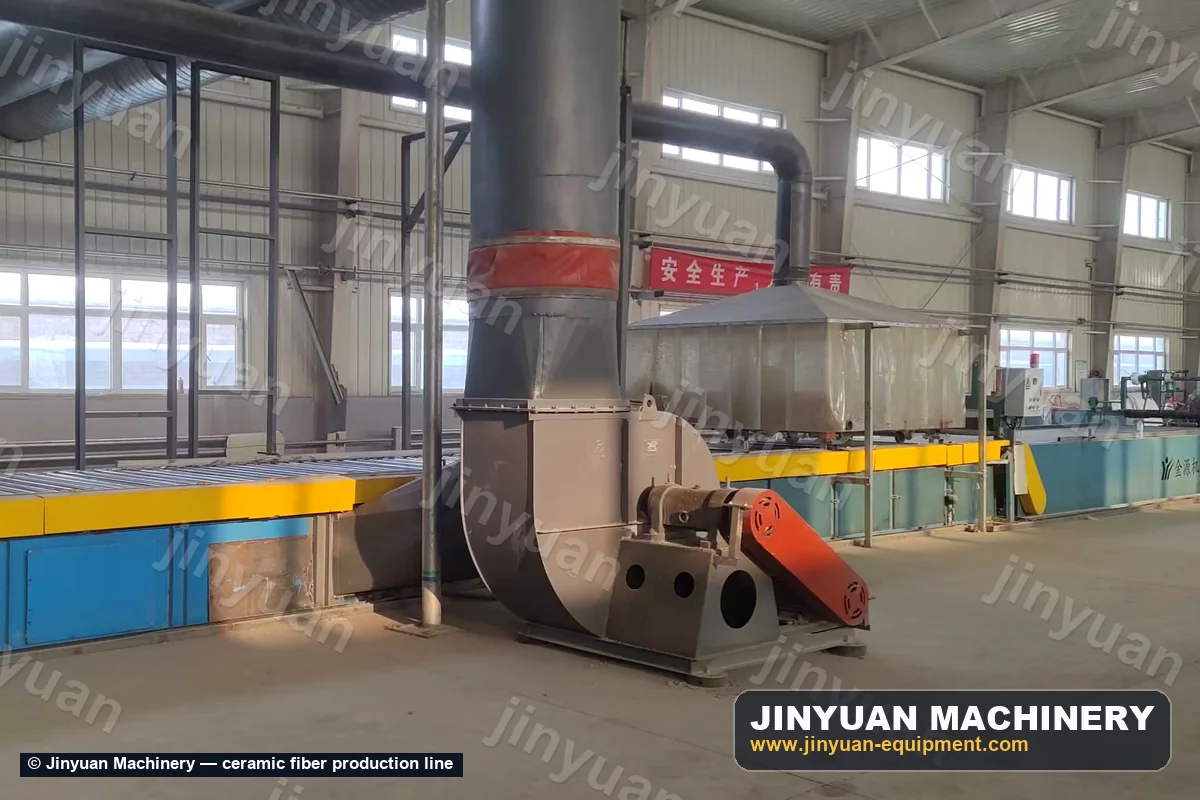
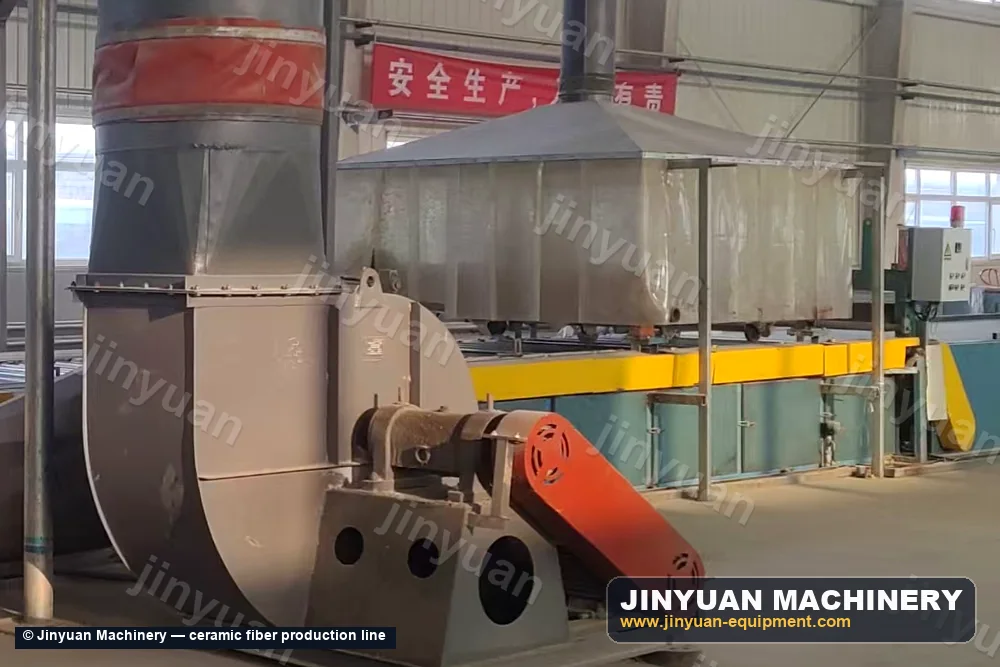
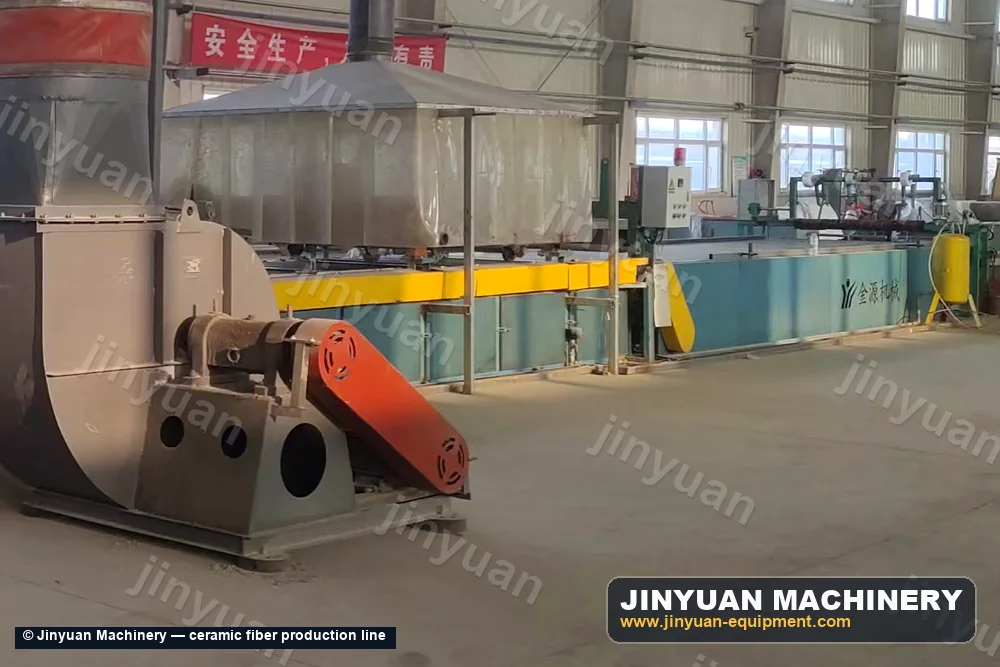
The acceptance values themselves live on our quality factors page as a reference panel, and corrective action for a failed item lives on our defect guide. What lives here is the middle layer: method, cadence and ownership. The hall photographed is our own, and the finishing run in it is where per-lot samples are drawn.
The Test Program: Thirteen Items, Three Questions Each
The product standard for alumino-silicate wool and its products, GB/T 16400, carries the normative list of test items, and each item borrows its method from a method standard. Read as a table, the program answers three questions per row: which standard measures it, and — in the last column — which process answers for it:
The thirteen test items, their method standards and their owners
| Item | Method standard | Process that owns it |
|---|---|---|
| Dimensions, length width thickness | GB/T 5480 | Cutting and rolling |
| Bulk density | GB/T 5480 | Collection and needling |
| Chemical composition | GB/T 6900 / 4984 | Batching |
| Shot content | GB/T 17911 | Fiberizing and collection |
| Permanent linear change | GB/T 17911 | Heat setting |
| Thermal conductivity | GB/T 10294 / 10296 | Whole line, combined |
| Tensile strength | GB/T 17911 | Needling |
| Compression and recovery | GB/T 13480 | Needling and packing |
| Fire reaction | GB 8624 | Recipe |
| Moisture content | GB/T 20313 | Drying and packing |
| Water repellency | GB/T 10299 | Recipe |
| Corrosion to metals | JC/T 618 | Recipe |
| Stainless steel suitability | GB/T 17393 | Recipe |
The last column is the reason this table exists. A test item with no owning process is a verdict without an address: the batch is rejected and nothing improves. A test item with an owner is a work order: shot over limit walks to the fiberizing end, shrinkage over limit walks to the furnace, tensile short walks to the needle loom. Thermal conductivity alone owns nobody and everybody, because it is the integral of the whole line — diameter, shot, density and uniformity all fold into it — which is exactly why it is the number customers quote and the number no single station can defend alone.
Thermal Conductivity: Why the Guarded Hot Plate Takes Hours
The reference method, the guarded hot plate of GB/T 10294, is a steady-state instrument: the specimen is clamped between a metered heating plate and a cold plate, the two faces are held at a fixed temperature difference, and the guard ring steers the heat flow to one dimension through the specimen. Only when the flow has truly settled — steady state — does the metered heater's input power equal the heat crossing the specimen, and only then does Fourier's law give the conductivity: power times thickness, divided by area and temperature difference. The steady-state criteria are what cost the time: over a continuous half hour the heating power must hold within ±1 % and the face temperatures within ±0.1 °C, and three such readings are averaged. A full test runs hours because a fibrous slab reaches thermal equilibrium in hours; the method is slow for the same reason it is trusted.
The alternatives trade some of that authority for speed, and a contract should name which one governs. The heat flow meter method of GB/T 10296 reaches an answer faster by measuring the flux through a calibrated sensor rather than waiting for full steady state, and serves routine comparison well. Transient methods such as the laser flash suit thin or highly conducting specimens where a steady-state stack is impractical, at some cost in accuracy for fluffy low-density slabs. Values from different methods are close but not identical, which is why two suppliers' reports disagreeing by a few percent may simply be two methods talking.
One preparatory rule decides whether any of these numbers mean anything: the specimen must be dried before testing. Adsorbed moisture conducts heat far better than the fiber matrix, so a damp specimen reads a conductivity it does not have, high by exactly the amount of water it carries. Moisture content itself is measured by the oven-dry method of GB/T 20313, and a conductivity report without a conditioning statement — dried, how long, at what temperature — is a number without a provenance.
Permanent Linear Change: The Ceiling Test
Permanent linear change is the test that sets the temperature a blanket may actually live at. The specimen is soaked at its classification temperature for 24 hours, cooled, and measured; the dimensional change that remains is permanent, and the typical requirement is within 3 %, with some grades allowed 4 %. Read physically, the test asks whether the fiber structure relaxes and sinteres at service temperature, and the answer in service is a lining that shrinks away from its anchors and opens gaps at every joint. That is why the owning process is heat setting: a blanket whose heat treatment did not finish the structure's relaxation finishes it in the customer's furnace instead, and the report line is where that debt first shows. The bands that write the number — burn-off, heat setting and the phase-conversion hold — are taken in sequence on our heat treatment page.
Shot Content and Fiber Diameter: A Sieve and a Microscope
Shot content is measured the honest way: the unfiberized granules are separated from the fiber by sieving and washing, and weighed as a share of the whole. The standard aperture counts particles above 0.212 mm, and one caution belongs in every quotation: some published material uses a 0.25 mm aperture instead, and the two figures are not comparable — a report must state its aperture or its shot number is unanchored. Shot matters beyond feel: granules conduct heat, shed as dust during handling and shorten service life, which is why the item owns the fiberizing and collection stages jointly, as our shot content page details.
Fiber diameter is a microscope measurement: diameters are read from micrographs and reported as a statistical mean, spun fiber typically around 3 to 5 µm. The mean alone flatters; the distribution width is what decides tensile behaviour and hand, and both belong to the spinning stage's account, as our diameter control page sets out.
Tensile Strength: Always Ask Which Direction
Tensile strength under GB/T 17911 is direction-dependent, and a report that quotes one number without a direction quotes half a number. Needled blanket is anisotropic by construction: with parallel needle layout the machine-direction and cross-direction strengths can differ by more than 30 %, while cross-laid needling holds the two within about 5 %. The owning process is needling — layout, density and depth — which is why the same loom appears behind tensile strength, compression performance under GB/T 13480, and the density column of the order. Compression and recovery matter at the other end of the roll's life: stacking, transport and the clamp load of an installed lining all press on the blanket, and a roll that does not recover its thickness leaves the lining thin where it was counted thick.
Three Layers of Inspection: Catch It at the Cheapest Point
The inspection layers and their cadence
| Layer | Items | Cadence |
|---|---|---|
| Incoming | Raw chemistry, grain size, moisture | Every lot |
| In-process | Melt temperature, batt weight, needling set, furnace temperature | Online and per shift |
| Final | Dimensions, density, shot, shrinkage, conductivity, tensile | Per lot, sampled |
The layers exist for economics as much as for quality: a chemistry error caught at incoming inspection costs a rejected truckload of raw material, while the same error caught at final inspection costs a rejected truckload of finished blanket plus the energy that made it. Sampling and lot division follow the acceptance rules of GB/T 16400, which the product standard cross-references with the mineral wool standards; the in-process layer is where the line's own instrumentation — melt temperature, batt weight, needle loom setpoints, furnace curve — acts as a continuous test, and the final layer is where the report that ships with the batch is born.
When a Batch Fails: Retest, Then Trace
Acceptance situations and where each one walks to
| Situation | Verdict and owner |
|---|---|
| All items within standard and contract | Accept; release to stock |
| One item fails | Retest per the standard's retest rule; a second failure rejects the lot |
| Density or thickness drifts | Process-control fault; trace collection and needling |
| Shot content over limit | Trace fiberizing and collection |
| Permanent linear change over limit | Trace heat setting |
| Tensile strength short | Trace needling |
The discipline has two moves and they must happen in order. First the retest: a single failed item triggers the standard's retest rule on reserve specimens, because one specimen can be unrepresentative and a lot should not die on a sampling accident. Second the trace: a confirmed failure is walked back to the process that owns the item, using the ownership column of the program table, and the corrective action follows the diagnoses on our defect guide. A plant that retests without tracing pays for the same failure every week; a plant that traces without retesting rejects good blanket on bad luck.
Reading a Test Report Like an Inspector
- Method per item: guarded hot plate or heat flow meter for conductivity — the two are not the same number.
- Conditioning statement: dried before conductivity, how long and at what temperature, or the value is unprovenanced.
- Sieve aperture for shot: 0.212 mm or 0.25 mm — unstated, the shot figure cannot be compared across reports.
- Tensile direction: machine or cross, or both — one undirected number is half a number.
- Conductivity temperature: the mean temperature the value was taken at, since conductivity rises with temperature.
- Standard editions: which version of each method standard the report cites, so two reports compare like with like.
Six lines, and most of the apparent disagreements between suppliers' reports dissolve into method differences rather than quality differences — which is precisely the distinction a buyer is paying the report to make.
What We Deliberately Do Not Claim
Three boundaries. We publish no measured values from our own works on this page: conductivity, shrinkage and strength are batch-specific and contract-specific, proven per lot and, where the market requires it, by a third-party laboratory, and a page of typical values would age into a lie. We do not restate acceptance thresholds as universal norms: the reference panel on our quality factors page is industry reference, and the governing values are the product standard's current edition and the contract. And we claim no equivalence between methods: guarded hot plate, heat flow meter and transient methods rank close but read different, and the contract names the referee.
The Bottom Line
A test program is a line's memory: thirteen items, each made by a named method, each owned by a named process, layered so that failures surface at the cheapest point and traced so that they surface only once. The guarded hot plate takes hours because physics takes hours; the specimen is dried because water lies about conductivity; the sieve aperture is stated because shot numbers without it are unanchored; tensile strength carries a direction because the blanket does. Read a report through those six inspector's lines and it stops being a certificate and becomes what it was meant to be — a map of the line that made the batch, and of the process that will answer if the map ever shows a fault.
Frequently Asked Questions
Which standards govern ceramic fiber blanket testing?
The product standard GB/T 16400 carries the normative item list, and each item borrows its method: GB/T 5480 for dimensions and bulk density, GB/T 6900 and GB/T 4984 for chemistry, GB/T 17911 for shot content, permanent linear change and tensile strength, GB/T 10294 or GB/T 10296 for thermal conductivity, GB/T 13480 for compression, GB 8624 for fire reaction, GB/T 20313 for moisture, GB/T 10299 for water repellency, JC/T 618 for corrosion and GB/T 17393 for suitability over austenitic stainless steel. Export contracts map these to the buyer's national equivalents.
How is thermal conductivity of ceramic fiber measured, and why does it take hours?
By the guarded hot plate of GB/T 10294: the specimen is clamped between a metered heating plate and a cold plate until one-dimensional steady state, when heater input power equals the heat crossing the specimen and conductivity follows from power, thickness, area and temperature difference. Steady state is declared only after half an hour with power within plus or minus 1 percent and face temperatures within plus or minus 0.1 degrees, averaged over three readings — and a fibrous slab reaches that equilibrium in hours, which is where the time goes.
Why must conductivity specimens be dried before testing?
Because adsorbed moisture conducts heat far better than the fiber matrix, so a damp specimen reads a conductivity it does not have, high by exactly the water it carries. Moisture content is measured separately by the oven-dry method of GB/T 20313, and a conductivity report without a conditioning statement — dried, how long, at what temperature — is a number without provenance. This is the single easiest preparatory error to make and the cheapest to avoid.
What does permanent linear change prove about a blanket?
It proves the temperature the blanket can actually live at. The specimen soaks at its classification temperature for 24 hours and the dimensional change that remains is permanent, typically required within 3 percent and within 4 percent for some grades. Physically it asks whether the fiber structure still relaxes and sinters at service temperature; in service the answer appears as a lining that shrinks from its anchors and opens gaps, which is why the owning process is heat setting.
How is shot content measured?
By separating the unfiberized granules from the fiber through sieving and washing and weighing them as a share of the whole. The standard aperture counts particles above 0.212 mm, and one caution matters in every comparison: some published material uses a 0.25 mm aperture instead, and the two figures are not comparable, so a report must state its aperture. Shot affects hand, conductivity, handling dust and service life.
Why does blanket tensile strength depend on direction?
Because needled blanket is anisotropic by construction. With parallel needle layout the machine-direction and cross-direction strengths can differ by more than 30 percent, while cross-laid needling holds the two within about 5 percent. A report quoting one undirected number quotes half a number, and the owning process is needling — layout, density and depth — the same loom behind compression performance and the density column.
What happens when a batch fails one test item?
Two moves, in order. First the retest: the standard's retest rule runs on reserve specimens, because one unrepresentative specimen should not kill a lot. Then the trace: a confirmed failure walks back to the process that owns the item — shot to fiberizing and collection, shrinkage to heat setting, tensile to needling, density and thickness to collection and needling process control — and corrective action follows the defect guide. Retesting without tracing repeats the failure; tracing without retesting rejects good blanket on bad luck.