
The batt that leaves the needle loom is not yet a product. It holds the spinning aids that made the fiber spinnable, the internal stress that needling left behind, and a crystal structure that is still the one the spinning process froze in — and in that state it will shrink badly the first time a customer heats it. Heat treatment is the stage that removes, orders and heals: it burns the aids out, sets the dimensions and drives the crystal phase toward stability, and it is the reason a finished blanket carries a service life at all. This page reads the tunnel as a sequence of material events — what leaves the fiber, what orders it and what heals it — with the public process windows attached to their sources and the finished-product numbers mapped to the stages that write them.
Our curing furnace page owns the machine: the four zones as duties, the ramp as a controlled variable, the six controls that keep the curve true, the air-versus-nitrogen trade-off, the maintenance clocks and the fault routing. Our process parameter page owns the dwell and line-speed windows, and our testing page owns how permanent linear change is measured. What lives here is the material story those pages act through: why the batt arrives carrying things that must leave, what each temperature band does to the fiber, which line of the test report each band writes, and the one safety number that nitrogen brings with it.
Three Jobs in One Tunnel: Burn-Off, Setting, Microcrystallization
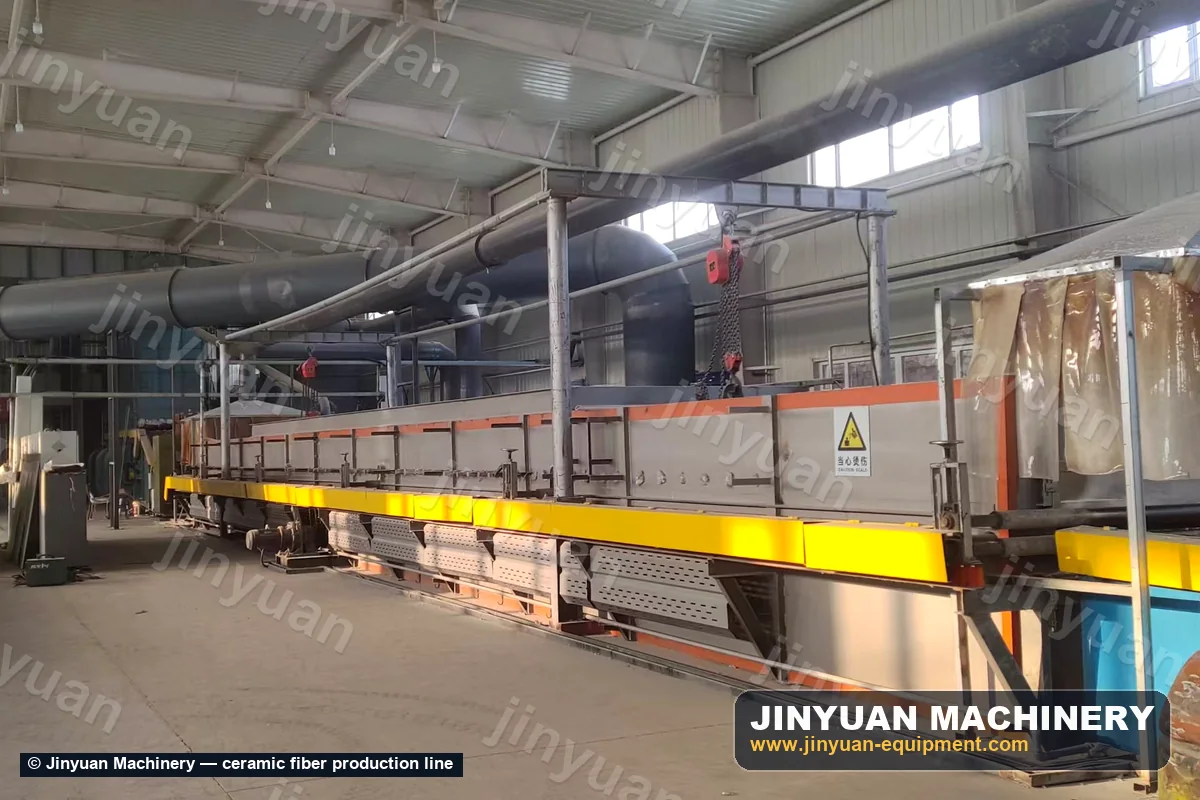
Heat treatment carries three jobs, and each one is gated by temperature because each runs on a different mechanism. Volatilizing and burning the organic aids happens in the low band; relieving internal stress and shrinking the blanket to ordered dimensions happens in the middle band; driving the crystal phase toward a stable structure happens only in the high band. A fourth movement, cooling, brings the blanket down to a safe winding temperature, because a blanket wound hot deforms under its own roll weight. The sequence cannot be compressed: a mechanism that is skipped is not saved, it is moved downstream, where it arrives as a carbonized face, a cracked felt or a shrinkage number that fails in the customer's lining.
Why the Batt Arrives Carrying Things That Must Leave
The organic content of a needled batt is not contamination; it is process chemistry that has finished its job. Softening and lubricating aids are added at fiber formation because the melt will not spin cleanly without them — the same reason shot content and fiber diameter are fought over at the spinner — and they ride into the batt with the fiber. The preheat band, roughly 200-400 °C, volatilizes and burns them out, and the organic content on the finished report is low because this band did its work. The same slow first heat relieves internal stress, most critically at the interface between shot and fiber, where uneven expansion cracks the bond if the blanket is heated hard from cold; and pre-shrinkage begins here, which is where part of the tensile strength and the surface flatness of the finished blanket are earned.
Starve the preheat band and the aids do not disappear; they carry forward into the hot band, where the temperature that drives crystallization bakes them into stain instead of burning them clean. That is the carbonized-face failure, and its routing — preheat temperature and exhaust first — sits with the other fault routes on our curing furnace page.
Setting: The Product Finds Its Final Dimensions at 600-800 °C
The middle band is where the blanket stops being a batt of uncertain dimension and becomes a product of ordered thickness. Fiber shrinks uniformly, the structure's internal bonds tighten, and the thickness that the gauge downstream will measure is fixed here rather than at the winder. The band is also where the ramp rate bites: industry notes caution against fast heating, some putting a ceiling near 50 °C per minute, because a blanket heated faster than it can equalize cracks from thermal shock and can flash-combust residual aids; patent examples hold 600-700 °C for 10-30 minutes, with 650-680 °C cited as the optimum. Tension and draw hold the thickness steady through the band — a control question rather than a material one, and owned by the six controls on the furnace page.
Microcrystallization: The Band That Repairs the Fiber
The high band, roughly 900-1200 °C, is where the fiber's crystal phase converts toward a stable mullite-type structure, and it carries the claim that makes this stage more than a drying oven: the heat-shrinkage step repairs mechanical damage the fiber suffered during formation — the working of spinning and needling — and in doing so cuts the heating linear shrinkage that would otherwise return in service. A granted Chinese patent (CN105442182B) states the window and the result: heat setting preferred at 550-750 °C for 10-30 minutes, heat shrinkage at 900-1200 °C for 15-40 minutes with 1000-1100 °C and 25-30 minutes preferred, and a finished product whose linear change after 1000 °C for 24 hours sits between -0.6 and -0.9 %.
Public heat-treatment windows, each with the source and counting basis it needs
| Window | Band and hold | Source |
|---|---|---|
| Heat setting | 550-750 °C, 10-30 min | Patent CN105442182B |
| Heat shrinkage | 900-1200 °C, 15-40 min | Patent CN105442182B |
| Phase-conversion hold | 800-900 °C, about 30 min | Industry staged-setting note |
| Ramp ceiling | Up to 50 °C/min | Industry note |
The caveat column of life is the counting basis. A patent hold time is not a line dwell, a zone-air temperature is not a bath temperature, and the industry ramp ceiling does not say what it is measured against; quote any of them without the basis and a specification error starts. How a ramp is actually held on a machine — including the two-stage curve of patent CN120247400B, first stage one degree per minute to 600 °C with a one-hour soak, then three degrees per minute to 1000 °C under nitrogen — is read on our curing furnace page. Treat every window here as a search space and the product as the selector.
The Property Ledger: What Each Stage Writes on the Test Report
Every line of the finished-product report that heat treatment touches can be traced to the band that wrote it, and the tracing is what makes a missed number actionable:
The finished-product numbers heat treatment writes, and where a miss points
| Test item | Stage that writes it | A miss reads as |
|---|---|---|
| Permanent linear change | Phase-change band | Service shrinkage; open seams |
| Tensile strength | Preheat plus setting | Weak felt at the winder |
| Surface flatness | Setting band | Wavy face; gauge rejects |
| Organic content | Preheat band | Carbonized face; odor |
| Surface shot loss | Furnace atmosphere | Dusty face; shot drop |
How each of these is measured — the method standards, the sampling and the acceptance practice — is owned by our testing page; the ledger answers the other question, the one a test report cannot answer about itself: which stage wrote the number, and therefore where to look first when it misses. A shrinkage number out of tolerance is not a testing problem and not a needling problem; it is a phase-change band that ran too cool or too short.
Why This Stage Decides Service Life
Put an untreated or under-treated blanket into a hot lining and the failure is not immediate; it is scheduled. At service temperature the fiber continues the shrinkage the tunnel did not finish, the insulation layer opens gaps at its joints, heat loss surges through the gaps and the shell runs hot — and the lining fails long before the fiber itself is spent. This is why permanent linear change is the service-life number on the report: it is the measured remainder of the shrinkage the treatment left undone, and the microcrystallization band is where that remainder is earned or lost. The buyer's reading follows directly: the grade ladder on our applications page assumes the treatment was actually carried out, because a blanket that economizes on dwell is selling a shrinkage debt that comes due in the customer's lining, not in yours.
When Nitrogen Runs, Oxygen Becomes a Life-Safety Number
Some recipes run nitrogen — 99.99 % purity — through the hot zones to keep the fiber from oxidizing and embrittling and to reduce shot loss; the process case for and against it is argued on our curing furnace page. The point that belongs here is the one a curve discussion never reaches: the same gas that protects the fiber is an asphyxiant on the working side of the furnace, so a nitrogen recipe makes furnace-zone oxygen content a monitored life-safety number, and entry follows confined-space discipline with the PPE and permit rules on our safety page. It is the single place in this stage where a process choice becomes a life-safety control, and it is why whether nitrogen runs is answered per project, with the monitoring scheme priced in, rather than per brochure.
What We Deliberately Do Not Claim
Five boundaries. The heating-element type of our own curing furnace, its actual zone setpoints, its ramp rate, its line speed and therefore its dwell, and whether it runs nitrogen are unconfirmed at our works and are not published here; each is project-specific and a page of typical values would age into a lie. The CN105442182B windows and the -0.6 to -0.9 % finished-product figure are patent examples cited as reference, not as our quotation, and the two-stage curve of CN120247400B is cited on the furnace page in the same spirit. The 50 °C per minute ramp ceiling is an industry note whose counting basis is not stated, and is quoted here with that gap visible. No measured shrinkage, energy or lining-life figures from customer service appear on this page, because those belong to the customer and to their operating conditions.
The Bottom Line
Heat treatment is the stage where a shaped semi-finished batt becomes a product with a service life: the aids leave, the dimensions order themselves, and the crystal structure heals and stabilizes in three bands that are not three ovens but one sequence of temperature-gated mechanisms. The property ledger turns that sequence into something a buyer can audit — each line of the report traced to the band that wrote it — and the permanent linear change is the line that decides whether a lining holds its face or opens its seams. Specify the dwell and the shrinkage number together, hold the ramp to the band that can absorb it, and treat nitrogen as the life-safety decision it is; do that and the fire after the needle loom becomes the reason the blanket survives the job it was sold for.
Frequently Asked Questions
What does heat treatment do to a ceramic fiber blanket?
Three jobs in one tunnel. It burns out the organic spinning aids carried in from fiber formation, which is what lowers the organic content of the finished product. It sets the dimensions, shrinking the blanket uniformly to its ordered thickness and relieving the internal stress needling left behind. And it microcrystallizes the fiber, driving the crystal phase toward a stable mullite-type structure that repairs formation damage and cuts the shrinkage that would otherwise return in service. A fourth movement, cooling, brings the blanket to a safe winding temperature.
Why does an untreated ceramic fiber blanket shrink in service?
Because the shrinkage is still in the fiber waiting for heat. Fiber leaves spinning in a metastable state, and the heat-treatment tunnel is where the pre-shrink and the crystal-phase conversion are done under control. Skip or starve that stage and the same conversion happens later at the customer's service temperature: the blanket shrinks in the lining, gaps open at the joints, heat loss surges and the shell runs hot. The measured remainder of that undone shrinkage is exactly what the permanent linear change test reports.
What is microcrystallization in ceramic fiber heat treatment?
The crystal-phase conversion driven in the high band, roughly 900 to 1200 degrees Celsius, where the fiber's structure develops toward a stable mullite-type phase. The conversion is what lowers the heating linear shrinkage, and patent CN105442182B additionally credits the heat-shrinkage step with repairing mechanical damage the fiber suffered during spinning and needling. It is the band that decides the service-life number, which is why its temperature and dwell are the least economizable settings on the line.
What does permanent linear change tell a buyer?
How much shrinkage the treatment left undone, and therefore how the blanket will behave when the customer heats it. It is measured by holding a specimen at a stated temperature for a stated time and reading the dimensional change; a small negative figure means the tunnel finished the shrinkage under control, while a large one means the lining will finish it in service, with gaps and heat loss following. Among the whole test report it is the line closest to service life, and the method itself is on our testing page.
Can heat treatment repair damage already in the fiber?
Partly, and this is the claim that separates the high band from a mere drying oven. Patent CN105442182B states that the heat-shrinkage step repairs mechanical damage inflicted on the fiber during formation, alongside the crystal-phase conversion that lowers service shrinkage. What it cannot repair is chemical or structural damage of other kinds - oxidized embrittled fiber, or shot-driven weaknesses - which is why the atmosphere and the spinning stages upstream still matter. Read the claim as the high band recovering mechanical working, not as a cure for everything.
Why do some curing processes run nitrogen, and what is the risk?
Nitrogen at 99.99 percent purity keeps the fiber from oxidizing and embrittling in the hot zones and reduces shot loss, which is why some recipes protect the high band with it. The risk runs the other way for people: nitrogen leaking to the working side is an asphyxiant, so a nitrogen recipe makes furnace-zone oxygen content a monitored life-safety number and entry a confined-space procedure. The process trade-off is argued on our curing furnace page and the entry discipline on our safety page; the short version is that nitrogen is a per-project decision with its monitoring priced in.