
Between the spinning machine and the needle loom stands the least glamorous box on the line and the one that decides whether the blanket will be uniform: the collection chamber, where loose spun fiber is pulled by negative pressure onto a moving mesh belt and becomes a batt. Nothing about it looks critical — a steel box, a belt, a fan — and everything about it is: thickness across the width, area weight per square metre, three-dimensional fiber orientation and the last physical chance to drop shot out of the stream are all settled inside this chamber, in seconds, before anyone can measure them.
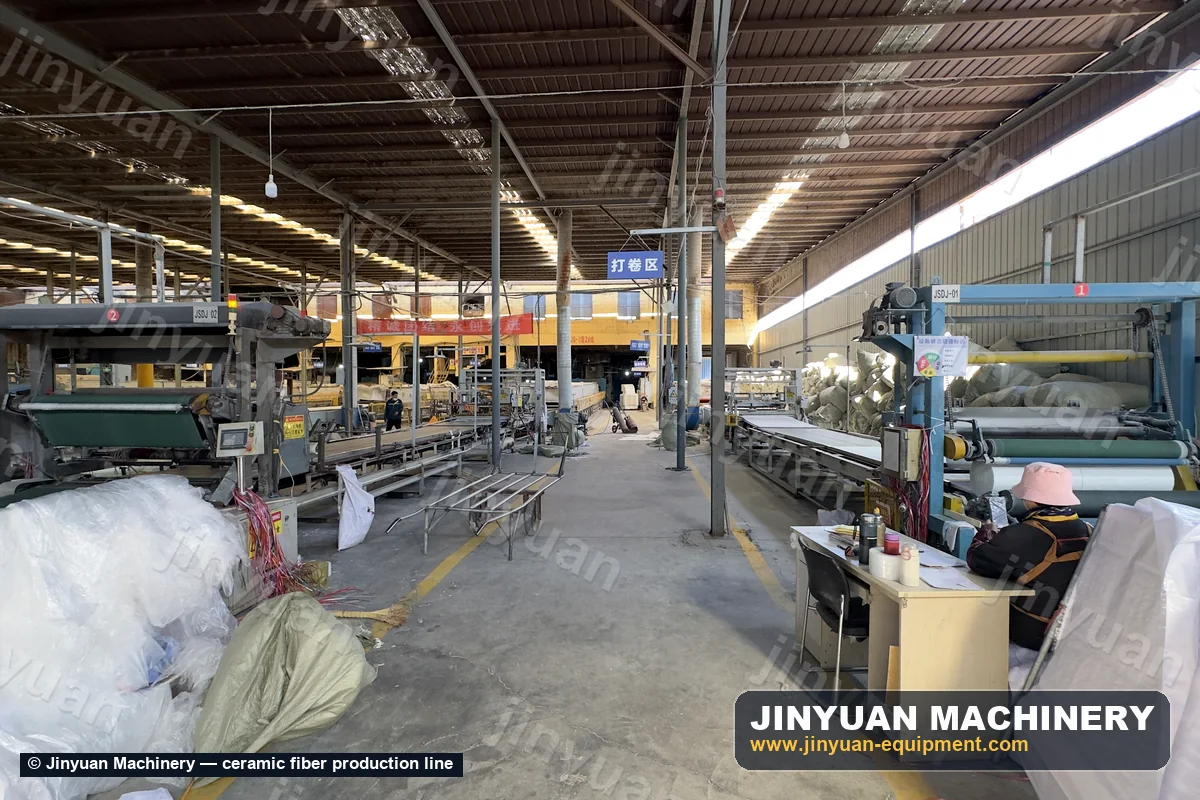
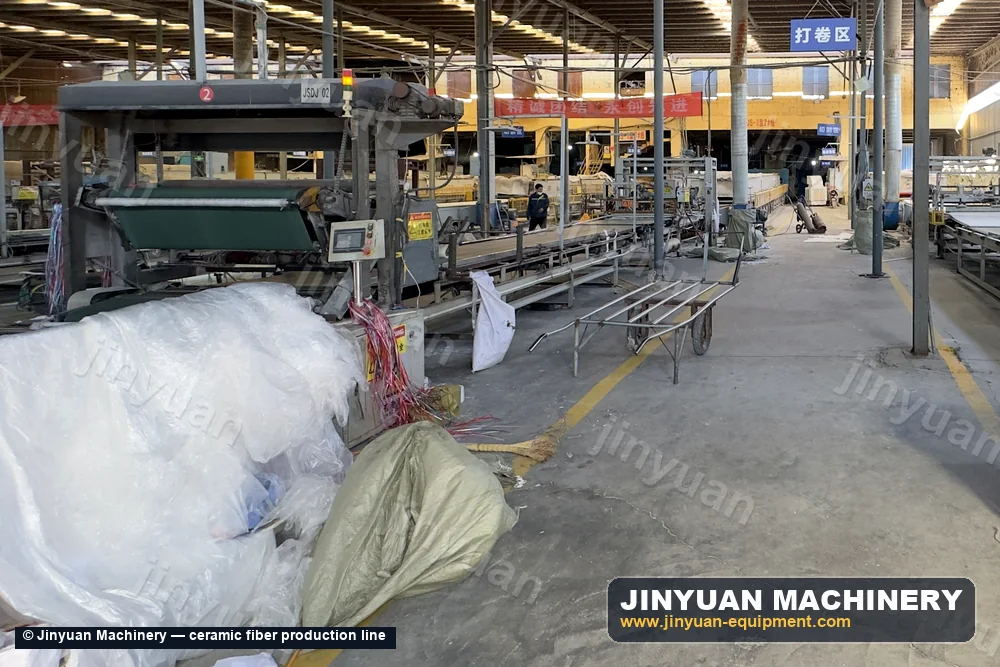
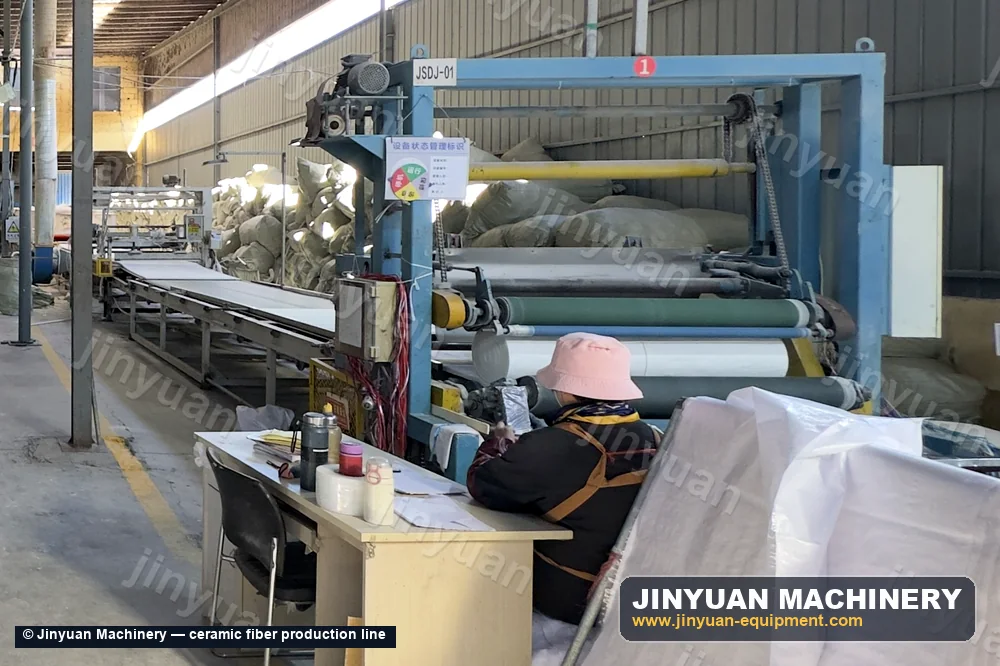
This page is the chamber itself: how the negative pressure builds the batt, why the S-shaped wind field separates shot, what each of the seven internal parts does, and the four handles — box vacuum, cross-direction air trim, belt speed and duct geometry — that set what the loom receives. The stage summary lives on our production process page and the control windows on the process parameter reference; the line photographed here is a commissioned customer project whose forming conveyor and rolling stands show exactly where collector errors end up.
The Collector's Job: Four Things the Batt Must Arrive With
The chamber's task compresses to four obligations, and the loom enforces every one of them:
- Uniform thickness across the width — no edge buildup, no center starvation, no bands.
- Consistent area weight — the same grams per square metre minute after minute, because area weight becomes density after needling.
- Three-dimensional random laydown — fiber settled in random orientation, which is what gives the blanket its isotropic in-plane behaviour.
- Shot left behind — unfiberized particles dropped out of the stream before the batt closes around them.
The reason the chamber outranks its looks is inheritance again, one stage later than the batching house: needling can lock a batt but cannot add to it. A thin place laid down here is a thin place in the finished roll, needled flat and sold that way. Every density and thickness promise on our thickness and density guide is kept or broken in this box.
How Negative Pressure Builds a Batt
The draft fan holds the chamber below atmospheric pressure while the spinning machine feeds spun fiber into it; collection happens in the balance between those two forces. The suction draws the airborne fiber through the duct and down onto the belt, and the belt carries the accumulating layer out of the chamber as a continuous batt. The balance has two failure directions, symmetric and equally expensive. Run the vacuum too high and the belt is over-compacted and blinded — fiber is pressed into the mesh, the batt runs thin and the holes that make the vacuum work start to close. Run it too low and fiber settles lazily and unevenly, drifting with every disturbance, and the batt arrives thick in places and cloud-thin in others. The working window is grade-dependent — our parameter reference quotes a collection-box vacuum of roughly −300 to −800 Pa as a machine example — and within that window the setpoint is tuned against batt appearance and sectional weight, not against the fan's nameplate.
The S-Shaped Wind Field: A Shot Separator Built Into the Chamber
The air path inside the chamber is not straight: it turns, and the turn is the point. Fiber, light and draggy, follows the bent airflow onto the belt; unfiberized particles — shot — carry too much mass per unit of drag to make the turn and fall out of the stream below the belt line, into a discharge that must stay clear every shift. This is why the collector is the last physical chance to reduce shot content: everything the spinning machine made is still separable here, and nothing is separable after the batt closes. The generation side of shot — melt chemistry, surface tension, roller speeds — is covered on our shot content page; the separation side lives here, and a blocked below-belt discharge silently cancels it.
Anatomy of the Collector
Public industry material and patent CN102978829A describe the chamber as seven working parts in a steel box whose length reaches about 10 m on full-size lines — length being what buys settling residence time and cross-direction distribution:
The seven working parts of a collection chamber (industry reference)
| Part | What it does |
|---|---|
| Frame | Carries the box, the belt and the duct loads |
| Fiber duct | Brings loose fiber from the spinner into the box |
| Upper and lower boxes | Form the vacuum plenum and the settling zone |
| Stainless single-side mesh belt | Carries the batt and passes the airflow |
| Air-volume trim system | Balances suction across the width |
| Drive | Moves the belt at the laydown speed |
| Draft and dust extraction | Holds the vacuum and cleans the return air |
Two of the seven deserve the operator's attention every shift: the mesh belt, because it is both the floor of the batt and the ceiling of the vacuum system, and the air-volume trim system, because it is the only handle that acts on widthwise uniformity directly.
Cross-Direction Air Trim: Where Widthwise Uniformity Is Set
Suction is never born even across a ten-metre box: corners starve, edges over-draw, and the batt copies whatever the air does. The air-volume deviation trim system exists to flatten that profile — zoned dampers and adjustable slots that redistribute suction until the laydown is even from edge to edge. The check is sectional weighing: cut strips across the green batt and weigh them, and industry practice looks for green-batt density deviation within about ±5% across the width. The two classic failures have opposite signatures and the same root: edge buildup means over-draw at the edges, center starvation means under-draw in the middle, and both are trim faults before they are anything else. Belt tracking belongs in the same paragraph — a belt that wanders presents a different mesh history to each edge and lays a band that moves with it. Widthwise uniformity is one of the seven points on our uniformity control page; this is the mechanism behind that point.
Belt Speed and Area Weight: The Arithmetic
The batt's area weight is not set by a dial; it falls out of a division. Grams of fiber delivered per minute, divided by square metres of belt presented per minute — belt width times belt speed — is the area weight, and nothing else in the chamber can change it. The consequences are the operating rules of the stage: raise the belt speed at constant fiber feed and the batt thins proportionally; hold the speed and let the feed drift and the area weight drifts with it; and because the mat is continuous from chamber to loom, the forming belt moves at the needling rhythm — it is one of the slowest drives on the line, not a conveyor in the ordinary sense. This is also why a grade change is a two-hand operation: the recipe for area weight is fiber rate and belt speed together, and adjusting one without the other changes the grade silently. The grade targets themselves live on our grade recipe page.
Duct Geometry: Keeping the Fiber From Arriving in Clumps
The duct between spinner and chamber is a shaping tool wearing a pipe's clothes. Its angle and length set how the fiber enters the settling zone — spread and decelerated, or bunched and fast. A duct angled wrong delivers fiber in pulses and ropes, and the batt shows it as lumps and streaks on the face that no amount of needling smooths away, because the lump is not a surface fault but a pocket of extra mass. The inlet airflow and the fiber feed determine the load the collection chamber has to distribute.
Mesh-Belt Hygiene: The Vacuum Lives in the Holes
The belt's holes are the vacuum system's lungs. Fiber and dust blind them gradually, and blinded areas lose suction locally — the batt over them lays loose and thick while the healthy areas compact, producing bands that repeat with the belt's circumference, which is itself the diagnostic: a defect repeating at belt length is a belt defect. The discipline is a scheduled compressed-air blow-down from the return side, tracked like any other maintenance interval, plus edge cleaning where carryover accumulates. Plants that skip it experience the failure as a mystery thickness problem that wanders across the width; plants that keep it never meet it.
Air-Laid, Cross-Lapped, Carded: Why Negative Pressure Wins Here
Web forming has three families, and ceramic fiber blanket belongs to exactly one of them:
Web-forming methods and where each fits
| Method | How the web forms | Where it fits |
|---|---|---|
| Air-lay, negative pressure | Fiber settles from an air stream in random 3-D orientation | Ceramic fiber blanket |
| Cross-lapping | Carded web folded back and forth in layers | Some nonwoven lines |
| Carded dry-lay | Carding cylinders comb the web parallel | General nonwovens |
The reason is the fiber itself. Ceramic fiber is short, brittle and made at 2,000 °C in a form no carding cylinder could survive touching; and the product wants random three-dimensional orientation, because that is what makes a blanket behave the same in every in-plane direction, thermally and mechanically. Air-lay forming is not the cheap option here — it is the only option that matches both the fiber and the service, and the negative-pressure chamber is simply its implementation.
The Invisible Quality: Why Collection Errors Survive Needling
Collection uniformity is invisible at the chamber: the batt looks like a batt, lofty and white, whether or not its grams are even. The error surfaces only after needling and heat setting, as density variation, surface wrinkling and thickness deviation — and by then it is structural, because needling compacts what it is given and adds nothing. This is the cost asymmetry that justifies the checks: sectional weighing and an online thickness scan at the chamber cost minutes per shift, while the same fault discovered in finished rolls costs the rolls, the diagnosis and the argument about whose stage caused it. The defect signatures in finished blanket are catalogued on our defect guide; the point here is which of them were actually born upstream of the loom.
Reading Batt Defects Back to the Collector
The five classic collector faults and their corrections:
Collector faults, symptoms and corrections
| Symptom | Cause | Correction |
|---|---|---|
| Thick and thin bands across the width | Uneven air distribution; belt wandering | Trim the dampers; track the belt |
| Batt running thin overall | Vacuum too high or belt too fast | Lower the vacuum or slow the belt |
| Lumps and streaks on the face | Duct angle delivering fiber in ropes | Reset duct angle and length |
| Shot carried into the batt | Wind field disturbed; discharge blocked | Clear below-belt discharge; review air path |
| Vacuum decaying over the shift | Mesh blinding | Blow down the belt from the return side |
Three discrimination rules keep the diagnosis honest. Collector faults repeat across the width in fixed positions, or repeat along the length at belt circumference; spinning faults follow fiber diameter and move with roller and furnace conditions; needling faults sit in the surface and the structure, not in the grams. Separate those three and the table above names the cause in one pass — the same discipline applied one stage earlier is on our batching page.
What We Ask Before Quoting a Collector
A collector is sized against its inputs, not picked from a catalogue. Five numbers settle most of it:
- Target grades and area weights — the grams per square metre the batt must carry, per grade.
- Line width and fiber rate — belt width and the kilograms per hour the spinner will deliver into the duct.
- Fiberizing route — spinner model and how many machines, because momentum sets the duct.
- Needling rhythm — the loom speed the forming belt must match, since the mat is continuous.
- Hall geometry — duct run and chamber orientation, because a ten-metre box does not forgive a bad floor plan.
With those five, the chamber, the fan, the trim system and the belt drive fall out of the arithmetic; without them, any quotation is a guess wearing a price.
What We Deliberately Do Not Claim
Three boundaries. The seven-part anatomy and the ten-metre box length are public industry and patent material, quoted as such; individual chambers differ by maker and capacity. Our own setpoints — chamber width, box vacuum per grade, belt speed range and area-weight targets — are per-line calibration values confirmed on site during commissioning, so we publish the handles and their checks rather than numbers that would pretend to be universal. And the defect table reads collector causes only: the same symptoms can be born at the spinner or the loom, and the discrimination rules above are part of using it.
The Bottom Line
The collection chamber is where a ceramic fiber line stops being a fiber machine and becomes a blanket machine: everything before it makes fiber, everything after it consolidates what this box laid down. Negative pressure builds the batt, the S-shaped wind field strips the shot, the trim system flattens the width, the belt-speed arithmetic sets the grams, and the mesh belt's holes keep all of it alive. None of it is exotic and none of it is forgivable, because needling locks errors in and adds nothing back. Treat the chamber as the precision instrument it behaves like — trim checked, belt cleaned, discharge clear, sectional weights recorded — and the loom receives the one thing it cannot make for itself: an even batt.
Frequently Asked Questions
What does a ceramic fiber collection chamber do?
It turns loose fiber into a batt. The draft fan holds the chamber under negative pressure, suction draws the spun fiber through the duct and down onto a moving mesh belt, and the belt carries the accumulating layer out as a continuous web. Thickness across the width, area weight, fiber orientation and shot separation are all settled inside the chamber, before needling.
Why does the batt need negative pressure to form?
Because airborne fiber will not settle evenly on its own. The suction gives every fiber the same destination and the same urgency, compacting the layer uniformly onto the belt and holding it there while the belt moves. Too much vacuum blinds the mesh and thins the batt; too little lets fiber drift and lay unevenly — the setpoint sits between, tuned per grade.
Why do unfiberized particles fall below the belt?
The air path inside the chamber turns, and the turn acts as a separator. Fiber is light and draggy and follows the bent airflow onto the belt; shot particles carry too much mass per unit of drag to make the turn, so they fall out of the stream below the belt line into a discharge. It is the last physical chance to remove shot before the batt closes.
What sets batt uniformity across the width?
The air-volume trim system and belt tracking. Suction is never born even across a long box, so zoned dampers redistribute it until laydown is even edge to edge; industry practice checks this by sectional weighing, looking for green-batt density deviation within about ±5%. A wandering belt adds its own moving band, which is why tracking is part of the same check.
How is batt area weight controlled?
By division, not by dial: grams of fiber delivered per minute divided by square metres of belt presented per minute, which is belt width times belt speed. Raise belt speed at constant feed and the batt thins proportionally; let feed drift and area weight drifts with it. A grade change therefore moves fiber rate and belt speed together.
Can needling repair an uneven batt?
No. Needling compacts and locks what it is given; it adds no mass and no thickness. A thin place laid down in the chamber is a thin place in the finished roll, needled flat and sold that way. This is why collection uniformity is checked at the chamber with sectional weighing and thickness scanning, where correction still costs nothing but a trim adjustment.
Why is air-lay forming used instead of cross-lapping?
Because of the fiber and the service. Ceramic fiber is short and brittle — no carding cylinder could touch it — and the blanket wants random three-dimensional orientation, which is what gives isotropic in-plane thermal and mechanical behaviour. Negative-pressure air-lay forming delivers both; cross-lapping and carding belong to other nonwoven industries.