
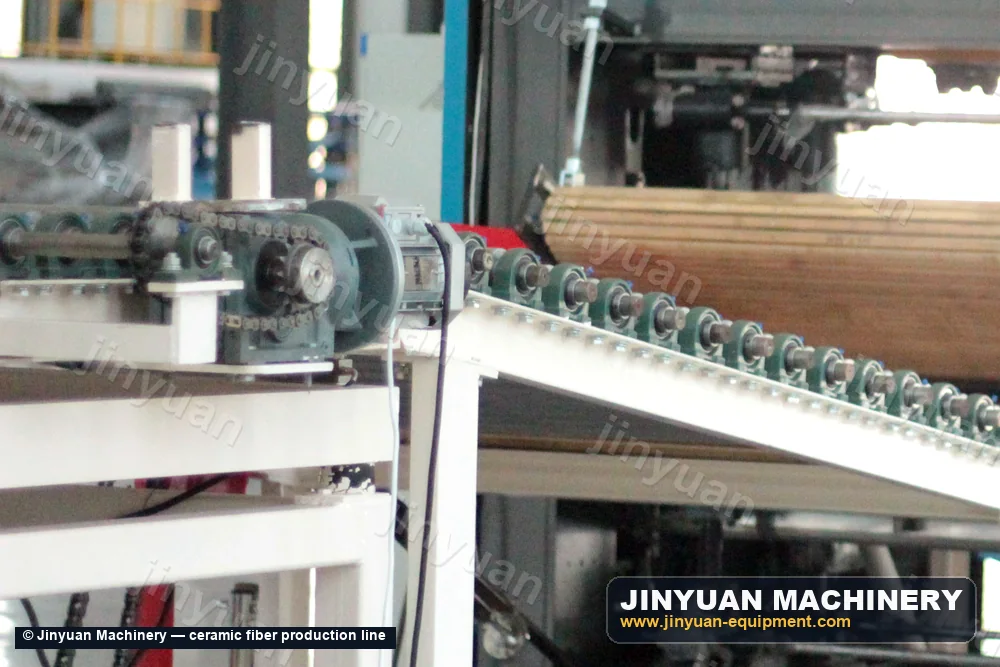
Every stage upstream of the needle loom produces something that is not yet a product. The batt arriving from collection is a cloud of laid fiber with almost no cohesion: it can be torn by hand, and it will not survive a winder. The needle loom is the machine that turns it into blanket, and it does so with no binder and no chemistry — only barbed needles driven through the web, thousands at a stroke, dragging fiber perpendicular to the plane until the layers hold each other. It is also the station that sets the line's pace: on a blanket line the needling stage is one of the two governors of throughput, and a loom that stops stops the line. This page is the loom as a machine: the mechanism chain from motor to needle tip, the lifters that set penetration depth, the three design moves that let it change specification without stopping, the needle itself, and the symptom-to-mechanism routing that makes its failures legible. The photographs show our own double-board loom on the line, together with its feed-side roller conveyors.
Our equipment list owns needling as one of the nine systems, our process page owns it as stage five of seven, and four companion pages own the settings: stroke rate, needle specification by thickness, density and tensile consequence and the board-layout choice. What lives here is the machine those settings act through: its mechanisms, its adjustments and its failure signatures.
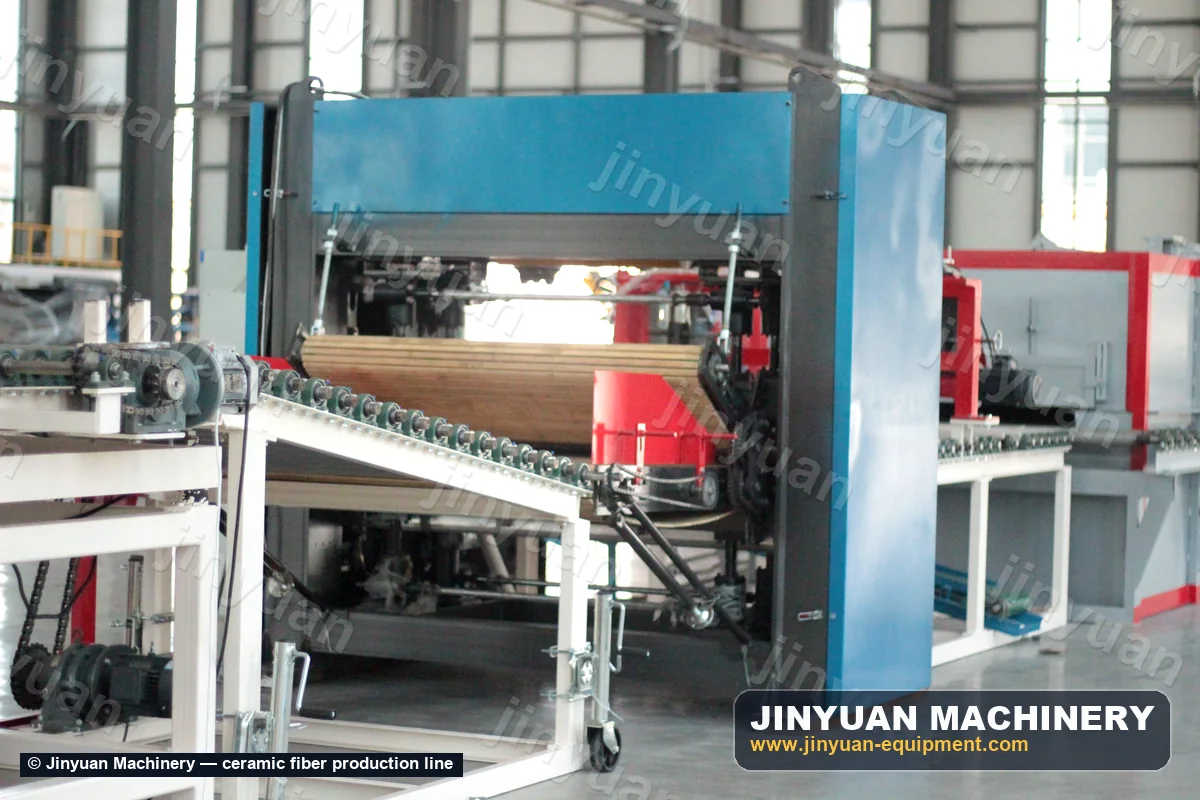
One Fork First: Single Board or Double Board
A needle loom is classified by where its needles punch from. A single-board machine punches from one face only; a double-board machine carries an upper and a lower needle board set opposite each other, punching from both faces. The patent literature states the consequence plainly: single-sided needling leaves the fibers oriented in one direction, so the felt's layers are not interlaced, and the product carries lower density and lower tensile strength. Double-board needling interlaces them, which is why it is the blanket standard across the 6-60 mm product band. The trade-offs and the exceptions — the products for which single-board is still the right answer — are argued in full on our single-board versus double-board page; this page walks the double-board machine, because that is the machine a blanket line buys.
The Mechanism Chain, from Motor to Needle Tip
Follow the power through the frame and the machine resolves into seven mechanisms, each with one job and one way of failing:
The double-board needle loom's seven mechanisms, their duties and their wear signatures
| Mechanism | Job | Wear signature |
|---|---|---|
| Gear motor and sprocket | Turns; drives the main shaft | Chain and sprocket wear |
| Main shaft, mid-span counterweight | Carries reciprocation; balances inertia | Bearing heat and play |
| Eccentric wheel and rod | Rotation into up-and-down stroke | Rod bushing play; stroke drift |
| Upper and lower lifters | Raise or lower frames; set depth | Desync; depth unequal |
| Presser plate, peel-off | Holds batt; self-adjusts gap | Plate wear; gap drift |
| Intermittent feed | Batt in step with stroke frequency | Sync loss; thickness waves |
| Fixed bed plate | Supports and guides the needles | Hole wear; needle deflection |
Two points in that chain deserve emphasis because they are where the machine's character lives. The first is the counterweight at the mid-span of the main drive shaft: a needle board accelerating up and down all day is an enormous alternating load, and the counterweight is what keeps that load from shaking the frame and wearing the bearings prematurely. The second is that rotation becomes reciprocation only at the eccentric wheel and connecting rod — everything upstream rotates and everything downstream translates — so bushing wear at that joint does not announce itself as noise; it announces itself as a stroke that no longer reaches the depth it was set for.
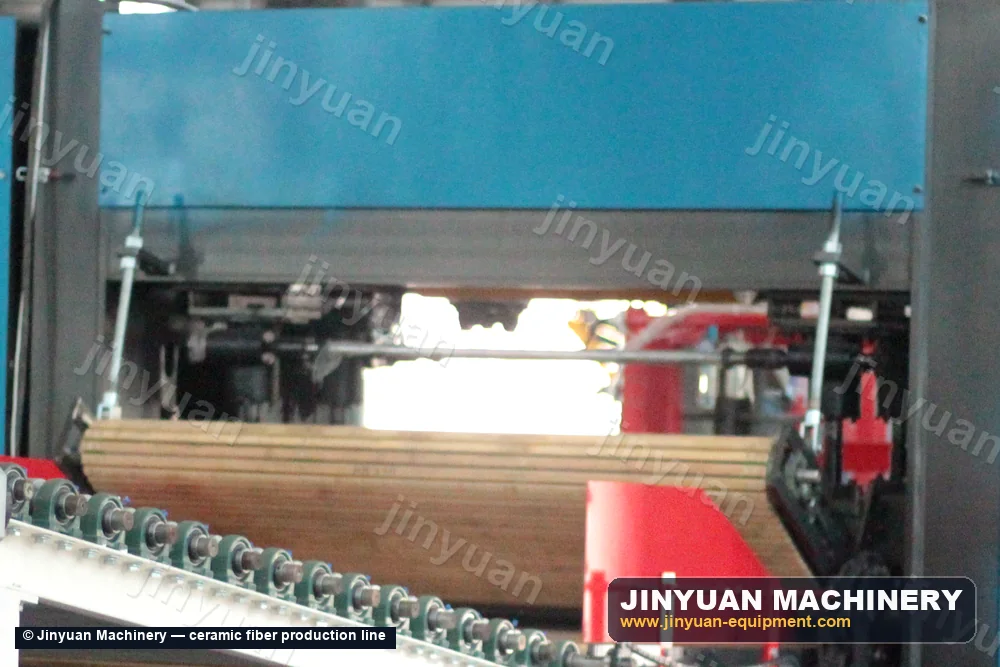
Penetration Depth Is Set by the Lifters, Not by Hope
Penetration depth — how far the needles enter the batt — is the loom's master setting, and it is a mechanical adjustment rather than a controller value. The upper and lower lifters raise or lower their needle frames, and frame height is depth. Too shallow and the needles never reach the far layers, so the felt bonds at the faces and delaminates in the middle; too deep and the needles overwork the web, tearing the surface and leaving visible needle eyes on the face. Both failures are depth failures before they are anything else, and both are corrected at the lifters.
The second half of the arrangement is what makes a double-board loom productive across a product range. A granted Chinese patent (CN102978829A) describes the lower bed adjusting the lower needles' penetration depth while the machine runs, tracking the thickness of the product being made: strength held to requirement without over-punching the surface, and the surface appearance corrected at the same time. Depth is therefore not a setting made once per product and defended; on this architecture it is a setting the machine holds against the product, which is exactly what a line running several thicknesses in a week needs. What depth does to the finished felt — the density and tensile consequence — is quantified on our density and tensile page.
Three Design Moves That Keep the Loom Running
Three mechanisms on the double-board loom exist for one purpose each: to remove a stop. They are worth naming separately, because together they explain why one loom changes product in minutes and another loses a shift.
- Depth that follows the product. The lower bed adjusts penetration depth during normal production as thickness changes, so a thickness change is a tracked adjustment rather than a shutdown and a re-set.
- A presser plate that moves with the bed. The presser plate — the peel-off plate that holds the batt down as the needles withdraw — rides with the upper needle bed and adjusts its own gap to the fixed bed plate automatically. Because that gap follows the bed, changing product specification does not require stopping to re-set it: the patent cites exactly this as the reason changeover costs neither production time nor energy.
- Feed in step with the stroke. An intermittent mechanism feeds the batt in discrete advances synchronized with stroke frequency, so the web is punched evenly and delivered smoothly. The defect it eliminates is specific: continuous feed against a fixed stroke frequency produces periodic thickness error and an irregular surface, and feeding in step with each change of stroke frequency is the remedy the same patent was granted for. Our defect routing page sends thickness waves through precisely this gate.
Read together, the three moves say what the machine was designed to protect: not top speed, but continuity. A needling stage that must stop to change specification pays for every changeover in lost metres of blanket, and on a line where needling governs the pace, those metres are the line's output.
The Needle: Triangular, Barbed, and Graded by Thickness
The working element is small and unforgiving. Needles carry a triangular cross-section with barbs on the edges, the barbs biting some 0.3-0.5 mm into the fiber; the material is high-hardness alloy steel, because a needle is a wear part from its first stroke. The gauge number is the needle's thickness read backwards — a higher gauge is a finer needle — and the grading logic follows directly: a thin blanket takes a finer needle, because a coarse needle over-punches and damages a thin web; a thick or high-density blanket takes a coarser needle, because only a stiff needle penetrates the full depth without breaking. Board patterns — gem, plum, triangle, arrow or straight-line layouts — are then chosen to balance strength against surface appearance.
The thickness-to-gauge grading table we apply in our own works is a factory standard and is published on our needle specification page; needle consumption, breakage patterns and their causes are the subject of our needle breakage page. What belongs here is only the coupling: gauge, depth and stroke rate are chosen as one set against the blanket, and a loom running the right depth with the wrong gauge still produces a weak or streaked felt.
What the Loom Can Hold, and What the Public Numbers Mean
Public complete-set data puts a double-board loom's product band at 6-60 mm of blanket thickness. The other published ranges are wider than they are useful, because their counting basis differs from source to source, and quoting them without saying so is how specification errors start:
Public needle-loom parameter ranges, with the counting basis each one needs
| Parameter | Public range | Caveat |
|---|---|---|
| Board needle density | 12-35 needles per sq cm | Needles standing in board |
| Penetration depth | 3-12 mm | Set against thickness |
| Stroke frequency | 40-3000 strokes per min | Counting basis differs |
| Blanket thickness | 6-60 mm, double board | The capability band |
The caveat column is the point. Board needle density counts needles standing in the board, not penetrations delivered to the web; stroke frequency counts differently again depending on whether a source counts one needle's action or a whole board's, which is why public figures reach thousands per minute while a heavy-blanket loom in real production runs near 130 strokes per minute at 50 Hz — the working baseline, its derivation and its frequency dependence are the subject of our stroke rate page. Treat every published range as a search space, and the product as the selector.
Five Symptoms, Five Mechanisms
A needle loom fails legibly: each common symptom points at one mechanism, and the first move is almost always at that mechanism rather than at the product.
Route the symptom to its mechanism before touching the product
| Symptom | Mechanism to check | First move |
|---|---|---|
| Frequent needle breakage | Spec, depth, board condition | Route to breakage guide |
| Uneven needle marks | Lifter sync; board looseness | Correct lifters; tighten |
| Thickness waves | Feed-to-stroke sync | Re-sync intermittent feed |
| Delamination | Depth too shallow | Add depth; confirm boards |
| Over-deep needle eyes | Depth too great | Reduce depth |
The breakage row is deliberately a hand-off. Needle breakage has four distinct causes — wrong spec for the thickness, shot content in the incoming fiber, misaligned guide plates and a worn board — and each reads differently in the broken needles themselves; that diagnosis, pattern by pattern, is on our needle breakage page. What the routing table adds is the discipline: before any of those four is investigated, confirm the depth and the sync, because a loom punching too deep or feeding out of step will break needles and wave the thickness at the same time, and fixing only one symptom leaves the other running.
The Maintenance Clock
Five items carry the loom, and each has its own interval:
- Needles. Wear, breakage and barb integrity checked on schedule; broken needles removed completely, every fragment, because a residual needle carried into the felt becomes a customer complaint rather than a maintenance record.
- Needle boards. Looseness and misalignment checked, with the straightener's condition confirmed; a board that has shifted is a depth error across its whole width.
- Lifters. Synchronization between upper and lower checked so that depth is equal across the width; desync here is the uneven-needle-mark symptom above.
- Lubrication. Drive bearings, eccentrics and rods lubricated to schedule; the alternating load makes the lubrication interval a structural matter, not a housekeeping one.
- Feed sync. The intermittent mechanism's timing against stroke frequency verified at every product change; this is the gate that keeps thickness waves out.
What We Deliberately Do Not Claim
Five boundaries. We publish no loom model, no board specification (gauge, needle type or pattern), no actual depth or stroke-frequency setpoints, and no breakage rate or needle change cycle for our own works on this page: every one of those is product- and contract-specific, confirmed per project, and a page of typical values would age into a lie. The 6-60 mm thickness band, the 0.3-0.5 mm barb depth and the public parameter ranges are complete-set and industry reference, cited as such with their counting basis noted. The structure, the three no-stop design moves and the lower-bed live adjustment follow patent CN102978829A and our internal equipment notes as reference, not as our quotation. And the 130 strokes per minute heavy-blanket baseline is field practice, owned by the stroke-rate page rather than repeated here as a specification.
The Bottom Line
The needle loom is the station where a cloud of fiber becomes a sellable blanket, and it does so with nothing but steel moving through steel: a counterweighted shaft, an eccentric and rod, lifters that set depth, a presser plate that follows the bed, and a feed that advances in step with the stroke. Those five mechanisms are also the five places the machine tells you what is wrong — depth errors read as delamination or needle eyes, sync errors read as thickness waves, spec errors read as broken needles — which is why the loom rewards operators who read symptoms as mechanism addresses. Specify gauge, depth and stroke rate as one set against the blanket, keep the five maintenance clocks, and the station that governs the line's pace stays the station nobody talks about in the morning meeting.
Frequently Asked Questions
What does a needle loom do on a ceramic fiber blanket line?
It turns the laid fiber batt into a coherent felt by mechanical needling: barbed needles reciprocate through the web and drag fiber perpendicular to the plane, interlocking the layers with no binder added. On a blanket line a double-board loom punches from both faces, which interlaces the layers and gives the higher density and tensile strength a blanket needs. It is also one of the two stations that govern line throughput, so its continuity sets the pace of the whole line.
What is the difference between a single-board and a double-board needle loom?
Where the needles punch from. A single-board machine punches one face, leaving fiber oriented in one direction, so the felt carries lower density and lower tensile strength. A double-board machine carries upper and lower needle boards set opposite each other and punches both faces, interlacing the layers. Double-board is the blanket standard across a 6 to 60 millimetre thickness band; single-board keeps its place in specific products, which is a product question rather than a machine question.
How is needle penetration depth adjusted on a needle loom?
Mechanically, at the lifters: the upper and lower lifters raise or lower their needle frames, and frame height is penetration depth. On the double-board architecture described in patent CN102978829A the lower bed additionally adjusts the lower needles' depth while the machine runs, tracking product thickness, so depth is held against the product rather than set once and defended. Too shallow delaminates the felt in the middle; too deep tears the surface and leaves needle eyes on the face.
Can a needle loom change product specification without stopping?
On the double-board architecture, largely yes, and two mechanisms are why. The presser plate rides with the upper needle bed and adjusts its own gap to the fixed bed plate automatically, so a specification change does not require stopping to re-set that gap. And the lower bed tracks penetration depth to the product thickness during normal production. The patent cites both as the reason changeover costs neither production time nor energy.
Why does blanket thickness come out uneven after needling?
Usually because the batt feed is out of step with the stroke frequency. Continuous feed against a fixed stroke frequency produces periodic thickness error and an irregular surface; the remedy is intermittent synchronous feed, advancing the batt in step with each change of stroke frequency, which is precisely the mechanism patent CN102978829A was granted for. If feed sync is confirmed and waves remain, the next gates are batt weight at collection and curing tension, in that order.
What needle gauge should be used for a thick ceramic fiber blanket?
A coarser needle, which means a lower gauge number: gauge reads needle thickness backwards, so higher gauge is finer. A thick or high-density blanket needs a needle stiff enough to penetrate the full depth without breaking, while a thin blanket takes a finer needle because a coarse one over-punches and damages a thin web. The thickness-to-gauge grading table applied in our works is published on our needle specification page, and gauge is always chosen together with penetration depth and stroke rate.