
Ask for a “spinning machine” and you will be quoted one of several fundamentally different machines: a horizontal-roller machine that throws melt into blanket-grade fiber, a vertical disc that spins gel solution into polycrystalline nano-fiber, or a vacuum chamber that makes amorphous alloy fiber for magnetic shielding. They share a name and little else. This page maps the family tree, marks which branch belongs to which raw-material route, and ends with the selection table a buyer can actually use.
On sourcing of the claims below: parameters marked manufacturer data come from published maker documentation for the niche machines; the mainstream-status claims come from current industry practice — modern domestic blanket lines run two-roller machines — and where public textbooks still teach the opposite we say so plainly and point to the evidence page. Field practice marks what we see commissioning lines.
The Family Tree in One View
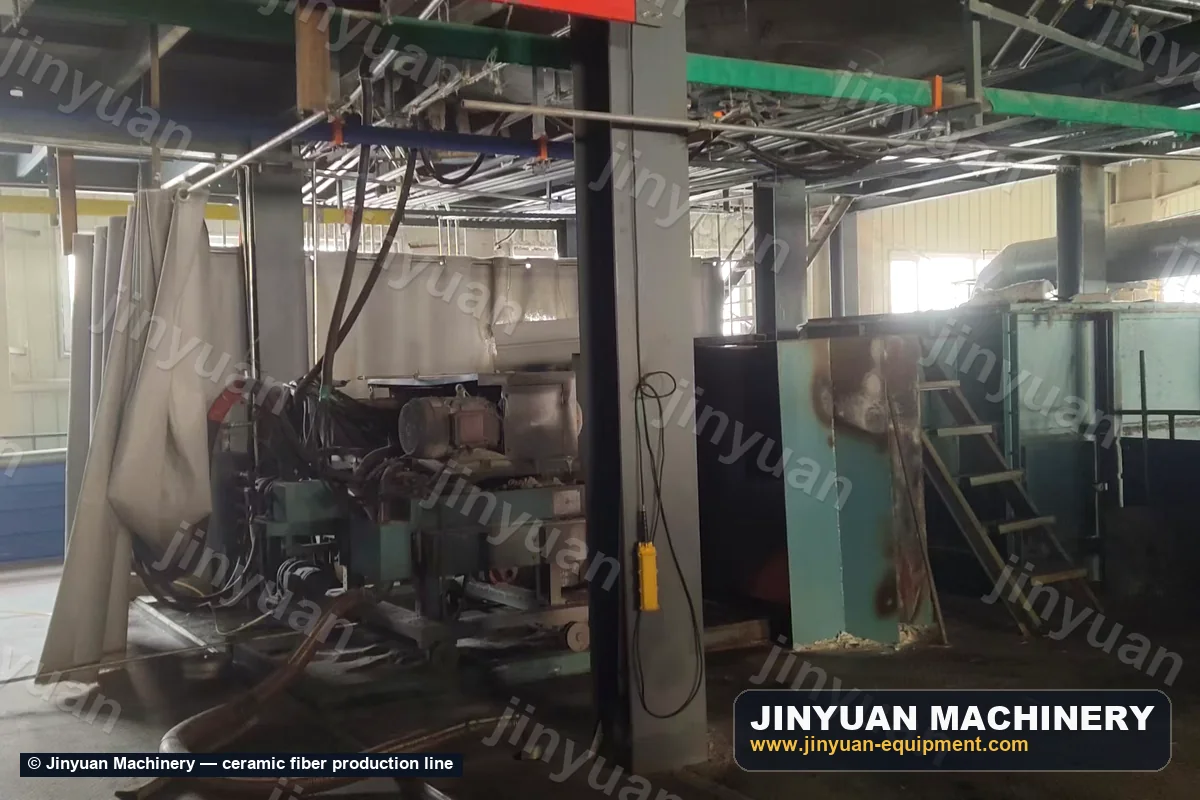
Three families, separated first by drive geometry and second by the state of the material they fiberize:
The three families of fiberizing machine
| Family | Drive and axis | Material route and home |
|---|---|---|
| Roller spinner | Horizontal shafts, counter-rotating rollers, speed increasing stage by stage | Melt route: aluminosilicate blanket, modules, bulk — the mainstream of the industry |
| Disc spinner | Vertical shaft, one high-speed disc | Colloidal sol-gel route: polycrystalline and nano-fibers |
| Vacuum spinner | Design-dependent, inside a vacuum chamber | High vacuum with argon: amorphous metastable alloys, research scale |
Within the roller family sit three generations — single-roller, two-roller and three-roller — and that is where most of the commercial confusion lives, because the generation order is the opposite of what older textbooks imply. The rest of this page walks the tree branch by branch.
Roller Spinners: The Melt-Route Workhorse
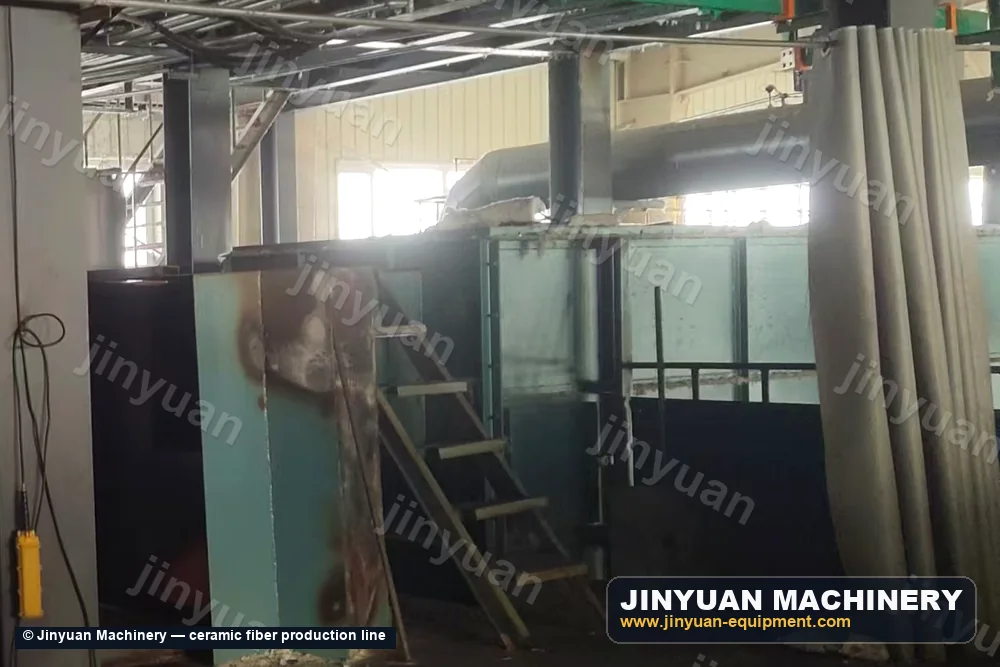
All roller machines share a construction: hollow heat-resistant stainless rollers cooled by internal water circuits, each on its own motor with variable-frequency speed control and a speed-increasing flat-belt drive, adjacent rollers turning in opposite directions with speed rising stage by stage. What changes between generations is how many times the fiber changes hands:
Roller spinner generations
| Type | Structure | Character | Status today |
|---|---|---|---|
| Single-roller | One high-speed roller | Simplest possible machine; uneven fiber, high shot content | Largely obsolete; test rigs only |
| Two-roller | Distribution roller plus one high-speed spinning roller; a single transfer | Long fiber (150–250 mm), reliable, low maintenance cost | The modern mainstream for melt-route lines |
| Three-roller | Distribution roller plus three spinning stages; repeated transfers | Fiber broken at every transfer; bearing failures frequent | Early technology, pre-2010s, phasing out |
One correction matters enough to state twice, because it reverses what many public references still teach: the three-roller machine is not the advanced option and never was the mainstream of modern practice. Public science encyclopedias and older textbook entries still describe it as the most widely applied design, which no longer matches the industry: current domestic lines of the leading producers run two-roller machines almost without exception. One transfer instead of three keeps the fiber continuous and long; halving the bearing count halves the most common failure source. The full argument and its evidence sit on our two-roller versus three-roller page.
What a Two-Roller Machine Looks Like in Numbers
The mainstream machine reduces to two surfaces and one air circuit:
Two-roller spinner reference parameters (manufacturer data, this line class)
| Part | Surface speed | Speed reference |
|---|---|---|
| Distribution roller | 20–30 m/s | — |
| High-speed spinning roller | 150–190 m/s class | 7,000–12,000 r/min, by roller diameter and product |
Its strengths and its demands come from the same design decision — putting the whole draw on one high-speed surface:
Two-roller design: what it gives and what it asks
| Strength | Corresponding demand |
|---|---|
| Long fiber (150–250 mm), low shot, high tensile strength | High rim speed: exacting roller material and dynamic balance |
| Few bearings, low failure rate, cheap maintenance | Compressed-air assist required to hold fineness |
| Single-machine capacity at the thousand-tonne-per-year class | Roller diameter, speed and melt-feed conditions must be matched finely |
| Lower investment and power draw than early multi-roller machines | — |
Between two two-roller quotations the differences that matter are roller diameter, roller length, bearing grade and drive precision — not the paint and not the price alone. Those are also the parts that decide your spare-parts bill, which is why we keep a separate wear-parts list for them.
Disc Spinners: The Colloidal Route to Polycrystalline Fiber
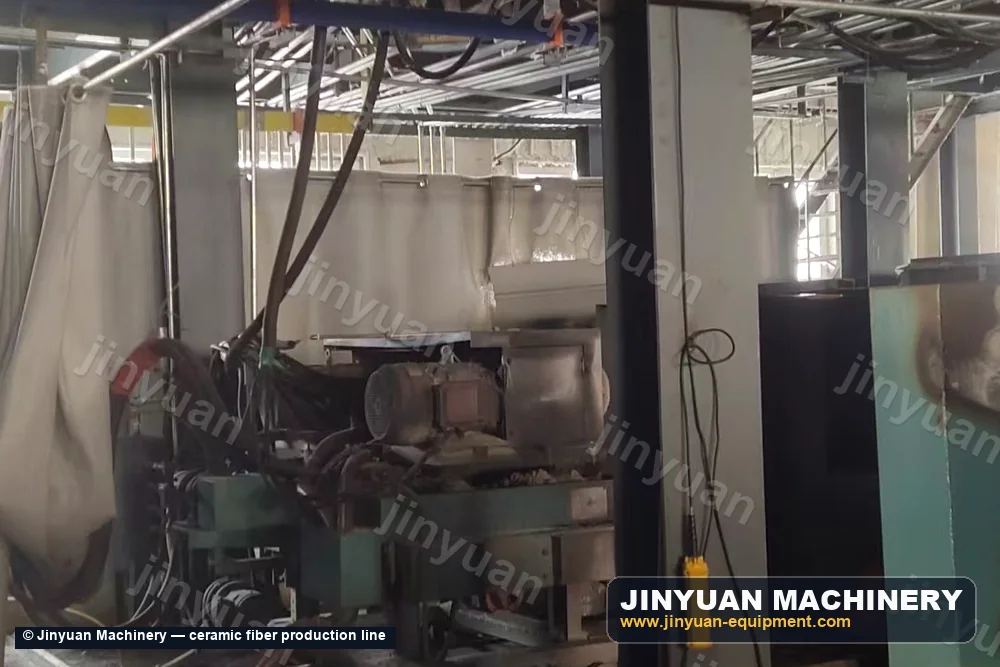
The disc machine belongs to a different chemistry entirely. A colloidal sol-gel solution drains from a small orifice at the bottom of its container as an extremely fine stream — or as droplets — onto a high-speed spinning disc, which throws it out by centrifugal force as gel fiber; drying and heat treatment then convert it to polycrystalline fiber. The product is not aluminosilicate blanket fiber but nano-scale (50–200 nm) polycrystalline fiber — polycrystalline mullite, polycrystalline alumina — rated to the 1,600 °C class and bought for aerospace and ultra-high-temperature lining work.
Disc spinner reference parameters (manufacturer data)
| Parameter | Value | Note |
|---|---|---|
| Disc speed | above 5,000 r/min | Colloidal route |
| Disc rim linear speed | 1,850–2,200 m/min | Colloidal route |
| Ambient temperature | 25–40 °C | The gel chemistry is room-sensitive |
| Ambient humidity | below 40% | The gel chemistry is room-sensitive |
The honest summary: the disc machine makes fibers a roller machine cannot — nano-scale, polycrystalline, ultra-high-temperature — at outputs and process strictness that put it outside a blanket line entirely. Its fiber is too short to needle. If someone offers a disc machine for a blanket project, the conversation has gone wrong somewhere early.
Vacuum Spinners: The Branch That Leaves the Industry
For completeness, because the family tree is the point: a vacuum spinner fiberizes special alloy melts under high vacuum with argon protection, producing amorphous metastable fibers for magnetic shielding, wave-absorbing and other functional-material research. It has no direct relationship to aluminosilicate blanket production and we list it as knowledge, not as an option — the branch of the tree that leaves the industry rather than serving it.
The Cross-Family Comparison
Compressed to the dimensions a specification actually turns on:
Cross-family comparison of fiberizing machines
| Dimension | Two-roller (modern mainstream) | Disc | Vacuum |
|---|---|---|---|
| Raw-material route | Melt: calcined bauxite or alumina melt | Colloidal sol-gel | Special alloy melt |
| Main axis | Horizontal | Vertical | Design-dependent |
| Typical product | Blanket, modules, bulk | Polycrystalline and nano fiber | Amorphous functional fiber |
| Fiber diameter | 3–4.5 μm | Nano scale, 50–200 nm | Material-dependent |
| Fiber length | 150–250 mm | Too short to needle | Material-dependent |
| Single-machine capacity | High: thousand-tonne class per year | Low | Very low |
| Operating environment | Atmospheric, high temperature | Temperature- and humidity-controlled room | High vacuum, inert atmosphere |
The three-roller column is deliberately absent: it is the same route and the same product as the two-roller machine with a worse transfer count, so it competes within a generation, not across families. That comparison has its own page.
Choosing the Family: Five Scenarios
Selection by scenario
| Scenario | Machine | Why |
|---|---|---|
| New aluminosilicate blanket line | Two-roller spinner | Long fiber, reliability, cost; the industry's universal choice |
| Rock wool or mineral wool line | Four-roller centrifuge | Higher melt viscosity needs stepwise dispersion across rollers |
| Small or experimental line, fiber cotton only | Small two-roller or single-roller test machine | Low investment, easy maintenance |
| High-value polycrystalline fiber product line | Disc spinner | The only viable route for the colloidal chemistry |
| Special functional fiber research | Vacuum spinner | Atmosphere and purity requirements |
Two configuration notes from practice. Large lines sometimes run two spinning machines side by side, one per furnace, buying redundancy and maintenance flexibility at the cost of floor space and utilities. And a handful of lines have tried roller-plus-disc combinations to cover blanket and special cotton at once; the management complexity and low utilisation have kept that arrangement rare.
Common Misconceptions
- Three rollers are more advanced than two. The opposite: two-roller is the modern mainstream and three-roller is pre-2010s technology being phased out.
- More rollers mean finer, better fiber. More transfers mean fiber broken repeatedly and more bearings failing; two rollers with compressed-air assist already hold 3–4.5 μm.
- A disc machine can make blanket. Its fiber is too short to needle; the route and the product are different businesses.
- Spinning machines are all alike, so buy on price. Bearing grade, drive precision and roller material decide service life and fiber quality — and your spares bill.
What We Deliberately Do Not Claim
Three boundaries. The mainstream-status claims describe current domestic practice and the equipment we see commissioned; public textbooks lag practice, and where they contradict this page we have said which side we stand on and why, with the evidence linked. The disc and vacuum parameters are manufacturer data for niche machines, quoted to place those families on the map — they are not acceptance values and we do not build those machines. And the scenario table is a map, not a specification: your melt chemistry, product mix and capacity decide the branch, and a line configured against the wrong branch cannot be corrected cheaply afterwards.
The Bottom Line
The name “spinning machine” hides a tree: roller machines for the melt route, disc machines for the colloidal route, vacuum machines for research alloys — and inside the roller family, a settled answer that older references still get backwards. For a blanket line the choice is a two-roller roller spinner, judged on roller diameter, bearing grade and drive precision rather than on roller count or price; for polycrystalline fiber the disc is the only door; for everything else the tree tells you where not to look. Choose the family by raw-material route and product first, the generation second and the quotation last — in that order the machine you buy is the machine your product actually needs.
Frequently Asked Questions
What are the main types of ceramic fiber spinning machine?
Three families. Roller spinners use horizontal counter-rotating rollers on the melt route and come in single, two-roller and three-roller generations; disc spinners use a vertical high-speed disc on the colloidal sol-gel route for polycrystalline and nano-fibers; vacuum spinners fiberize special alloys under high vacuum with argon for functional-material research. For aluminosilicate blanket lines the relevant machine is the two-roller roller spinner.
Is a three-roller spinning machine more advanced than a two-roller one?
No — the reverse. Public textbooks and science encyclopedias still describe the three-roller machine as the most widely applied design, but that no longer matches industry practice: modern domestic blanket lines run two-roller machines almost without exception. One transfer instead of three keeps fiber long and continuous, and halving the bearing count removes the most common failure source. The three-roller machine is early-2010s technology now phasing out.
Why did the two-roller spinning machine become the mainstream?
Because fiber quality and reliability both improved when the third roller went. A single transfer between distribution roller and spinning roller produces fiber 150–250 mm long with low shot content, the bearing count halves, maintenance cost falls, and single-machine capacity reaches the thousand-tonne-per-year class with lower investment and power draw than early multi-roller machines. Fineness is held with compressed-air assist rather than extra transfers.
Can a disc spinning machine produce ceramic fiber blanket?
No. The disc machine belongs to the colloidal sol-gel route: it throws gel solution into nano-scale polycrystalline fiber rated to the 1,600 °C class for aerospace and ultra-high-temperature lining. That fiber is too short to needle, the output is low and the process needs a temperature- and humidity-controlled room. It is a different product business, not an alternative blanket machine.
What is a vacuum spinning machine used for?
Research-scale functional materials: fiberizing special alloy melts under high vacuum with argon protection to make amorphous metastable fibers for magnetic shielding, wave-absorbing and similar applications. It has no direct relationship to aluminosilicate blanket production and appears in the taxonomy only to complete the family tree.
What speeds does a two-roller spinning machine run at?
The distribution roller runs at 20–30 m/s surface speed and the high-speed spinning roller at the 150–190 m/s class, roughly 7,000–12,000 r/min depending on roller diameter and product. These are manufacturer-data reference values for this line class; the exact set belongs to the machine's own documentation and commissioning record.
What should a buyer specify for a roller spinning machine?
State the fiber grade, target output, diameter and shot content, along with the furnace outlet, cooling-water supply and collection interface.