
Some braiding defects start with the fiber feedstock. Qualify the wool for carding, drafting and twisting before tuning the braider.
This article is the material prerequisite to the braiding process series: the rule that decides whether a bag of wool is worth threading at all, the four criteria a textile-grade wool has to pass, how the five classification grades map onto braided products, and the reinforcement decision that caps the rating of everything made from them.
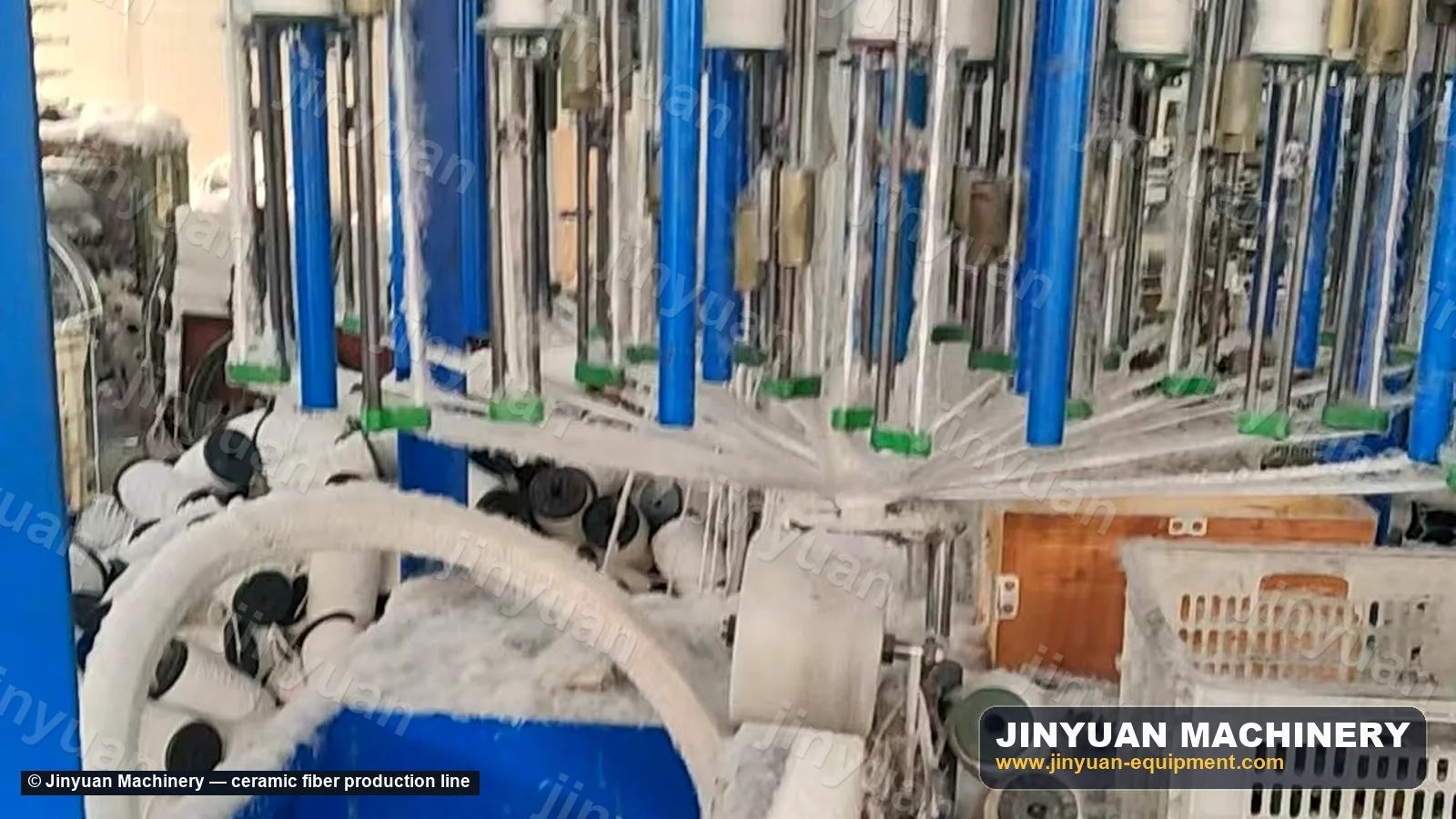
Start With Textile-Grade Spun Wool
Specify spun ceramic fiber made for textiles. Check fiber length distribution, lubricant, shot content and non-fibrous inclusions on the lot intended for yarn production.
The Four Criteria a Textile-Grade Wool Has to Pass
A wool offered as textile-grade should be judged on four points, and all four have to hold at the same time. Failing any one of them stops the yarn.
1. Lubricant present — and still present on arrival
Spun textile wool leaves the fiber plant with an organic lubricant already applied, and that is part of how the grade is made rather than a finishing treatment added afterwards. In the documented yarn route the pre-treatment applies 3–8 wt% organic lubricant to the wool before it is blended and carded. (patent example: CN1091788A — one published route, which does not represent current plant practice)
The failure mode is storage, not supply. Wool that has been stored damp, left where oil mist can settle on it, or handled with contaminated equipment can lose the film; lubricant that has migrated or degraded turns a perfectly good grade into a card that sheds. If there is doubt, re-run the pre-treatment rather than adding card speed to compensate, because speed hides the symptom and worsens the web.
2. Shot content low
Shot — un-fiberized melt particles — does not draft. It abrades the card wire, and any that survives into the yarn becomes a weak point or a hard inclusion in the finished packing. Published figures for the spun route run below 15% and commonly below 10%, with a working target in the 8.5% region for grades that are going to be carded. (industry reference)
The blunt version: shot is the practical quality gate on any fiber destined for a card, and it is fixed at the spinning section — melt stability and roller condition first, separation second. Where shot comes from and how it is held down is the subject of the shot content article.
3. Non-fibrous material low
Non-fibrous inclusions — undissolved batch, refractory fragments, dust and foreign matter — do the same damage as shot, less predictably, because they are not one size and not one hardness. A batch that will be carded needs a cleanliness specification rather than an assumption, and a cleanliness specification needs a test method, not a visual inspection of the bag.
4. Fiber length sufficient
This is the criterion that decides whether the card produces a web or a dust cloud, and it is the one that has to be agreed with the supplier rather than assumed from a grade name. Published spun-wool length ranges sit around 150–250 mm, but the card does not see a range — it sees a distribution, and the fraction of very short fiber in a bag is what reappears as carding loss and as a yarn with thin places. A buyer specifying a textile grade should ask for a length distribution with the short-fiber fraction stated, and should treat the mapping from a distribution to a yarn count as the supplier's own specification to be requested as such. (industry reference)
The Five Classification Grades, and Which Ones a Braider Can Use
Ceramic fiber wool is sold in five grades, separated by classification temperature and alumina content. The ladder is usually presented as a quality ladder — higher grade, higher price, better product — and for insulation products that is broadly fair. For braided textiles it is not, because the same chemistry that raises the classification temperature also stiffens the fiber, and stiff fiber cards badly and breaks at the braiding point.
| Grade | Classification temp. | Working temp. | Al2O3 | Braided textile |
|---|---|---|---|---|
| Common (C) | 1100 °C (a second source gives 1050 °C) | <1000 °C | 44% | Spinnable; mid and low temperature static seals where cost decides |
| Standard (S) | 1260 °C (a second source gives 1150 °C) | 1050 °C | 46% | The mainstream textile grade — the bulk of braided packing and braided rope |
| High purity (P) | 1260 °C | 1100 °C | 47–49% | Spinnable; low Fe2O3 and low alkali, for contamination-sensitive service |
| High alumina (A) | 1360 °C (a second source gives 1350 °C) | 1200 °C | 52–55% | Spinnability falls away as the fiber hardens; used where the temperature requires it |
| Zirconia (Zr) | 1430 °C | 1350 °C | 39–40% plus ZrO2 15–17% | Highest-temperature service; ZrO2 raises resistance to devitrification and slag attack; the most expensive grade |
The table carries one honest complication, and it is worth stating rather than smoothing over: the same grade appears with two classification temperatures. Standard grade is listed at 1260 °C in some specification sheets and 1150 °C in others; common grade at 1100 °C and 1050 °C. These are two conventions in the market, not a typographical error, and the useful response is neither to average them nor to quote the friendlier number. Run both, and require the supplier's classification-temperature test report for the actual lot, because classification temperature is a test result rather than a nominal value, and the test method is defined nationally. (national standard: GB/T 17911—2018) (industry reference for the two conventions)
The practical consequence for a braider is short: standard grade is the textile workhorse. Common grade is spinnable and cheaper, and it is right for low-temperature static seals. High purity buys cleanliness, not temperature. High alumina and zirconia are ordered when a service temperature genuinely demands them, and the carding loss that comes with stiffer fiber is accepted as part of that decision.
What Actually Caps the Temperature: the Reinforcement
Yarn made from ceramic fiber alone has low tensile strength, and a braided packing has to survive being pulled into a gland and compressed. Every textile piece therefore carries a second material decision, and it is that decision — not the wool grade — which usually sets the ceiling.
| Construction | Reinforcement | Temperature limit | Character | Where it is used |
|---|---|---|---|---|
| Unreinforced | Ceramic fiber only | Set by the wool grade | Softest, easiest to form, lowest strength | Low-pressure static seals and soft conforming service |
| Glass reinforced | Alkali-free E-glass | 650–800 °C | Low cost, good dielectric strength, moderate tensile strength | Below 800 °C where electrical insulation is also required |
| Wire reinforced | Stainless steel 310 / 316 (316L) | 1050–1260 °C | High tensile strength, resistant to vibration and corrosion | 1000 °C and above with pressure or vibration |
A zirconia-grade wool braided around E-glass yarn still fails where the glass softens. The wool survives the temperature; the reinforcement does not, and once the reinforcement goes the braid unravels and the seal is lost. Reading the ceiling off the wool grade alone is the most common specification error in this product family. (field practice)
The Chinese national standard treats this as a product-defining distinction rather than a footnote. GB/T 3003—2006, clause 5.10 classifies braided packing by its yarn reinforcement into G (glass-fibre reinforced) and S (high-temperature stainless steel wire reinforced), in a designation of the form CBR-grade-diameter G or CBR-grade-diameter S. A drawing that names the grade but not the reinforcement letter does not identify the product at all. (national standard)
| Service | The three-line decision |
|---|---|
| Ordinary furnace doors and low-pressure static seals | Unreinforced ceramic fiber braid |
| Below 800 °C, electrical insulation required | E-glass reinforced (G) |
| 1000 °C and above, with pressure or vibration | Stainless steel wire reinforced (S) |
Decide the reinforcement letter before the wool grade. The reinforcement is what the rating will actually be limited by, so choosing the wool first means choosing a grade that the reinforcement then makes irrelevant.
Specifying a Textile-Grade Wool: What to Put in the Enquiry
An enquiry that gets a usable answer asks for five things, and one of them by name:
- Fiber grade. Specify spun ceramic fiber wool for textiles and ask for the lot test data before ordering.
- Grade. Standard grade unless service temperature or contamination control says otherwise, with the classification-temperature test report for the delivered lot.
- Shot content as a weight percentage together with the screen size it was measured on. A shot figure without its screen size cannot be compared between suppliers.
- Length distribution, not a length range, with the short-fiber fraction stated.
- Lubricant. Confirm the grade is supplied lubricated for spinning, and state the storage conditions between delivery and use — because that is where a correct grade is most often lost.
If the wool is going to be braided for pressure or vibration service, the reinforcement letter (G or S) belongs in the same enquiry, ahead of the wool grade, for the reason given above.
Where This Sits in the Line
Upstream of the braider, textile wool is spun on a ceramic fiber spinning machine, and whether a given line can produce a textile grade is a question about its roller configuration and its separation stage rather than about its furnace. The two-roller configuration that has become standard in Chinese spinning lines is the same centrifugal route that produces textile wool in the first place, which is why a blanket line and a textile wool supply can come from the same melting end; the two-roller vs three-roller comparison sets out what changed and why. (field practice)
From there the wool goes through yarn preparation — pre-treatment, blending, opening, removal of shot and short fiber, carding and twisting — and only then reaches a braider. Everything the braider does starts from the yarn, not the wool: the braiding process article covers the twelve stations, and the pitch, braid angle, tension and changeover settings are the four articles that follow it in this series.
The distinction is also what makes a defect traceable. Density that is uniform but wrong along the whole run is a pitch answer. A pattern that repeats once per revolution is a deck answer. Shot marks, thin places and a web that sheds are wool answers — and they were decided before the first bobbin was loaded.
Frequently Asked Questions
What makes ceramic fiber wool suitable for yarn?
Specify textile-grade spun wool with suitable fiber length, lubricant and low shot content. Check its behavior in carding and drafting before approving the grade.
Is fiber diameter enough to qualify textile-grade wool?
Fiber length distribution, lubricant and shot content also affect drafting. Agree the limits with the yarn supplier and confirm them with a representative sample.
What lubricant content does textile-grade ceramic fiber wool need?
Spun textile wool is supplied with an organic lubricant already applied; it is part of how the grade is made, not a finishing treatment. In the documented yarn route the pre-treatment applies 3-8 wt% organic lubricant to the wool before blending and carding (patent example CN1091788A — one published route, not a statement of current plant practice). The practical failure mode is storage rather than supply: wool stored damp, exposed to oil mist or handled with dirty equipment can lose the film, and lubricant that has migrated or degraded turns a good grade into a card that sheds. Re-run the pre-treatment rather than speeding up the card to compensate.
What shot content is acceptable in textile-grade ceramic fiber?
Shot does not draft: it abrades the card wire and, if it reaches the yarn, becomes a weak point or a hard inclusion in the finished packing. Published figures for the spun route run below 15% and often below 10%, with a working target in the 8.5% region for grades intended for carding (industry reference). Any shot figure should be quoted as a weight percentage together with the screen size it was measured on, because a number without its screen size is not comparable between suppliers. Shot content is fixed at the spinning section — melt stability and roller condition first, separation second — not at the packing line.
Which classification grade of ceramic fiber wool is used for braided packing?
Standard grade is the mainstream textile grade: a classification temperature of 1260 degrees C in most specification sheets (a second convention gives 1150 degrees C), a working temperature around 1050 degrees C and about 46% alumina. It carries the balance of temperature capability against the fiber stiffness that carding can tolerate. Common grade is spinnable but is chosen for mid and low temperature static seals where cost matters; high-purity grade suits contamination-sensitive service; high-alumina and zirconia grades are spinnable but the fiber stiffens as alumina rises, and they are selected only where the temperature requires them. Standard grade remains the reference point for braided packing and rope.
Does a higher classification grade mean a higher-temperature braided packing?
Usually not, because the reinforcement wire caps the rating before the wool grade does. Unreinforced ceramic fiber braid takes its limit from the wool; E-glass reinforcement is good to roughly 650-800 degrees C; stainless steel 310 or 316 wire reinforcement reaches 1050-1260 degrees C. A zirconia-grade wool braided around E-glass yarn still fails where the glass softens, and when the reinforcement goes the braid unravels. The Chinese national standard treats the distinction as product-defining: GB/T 3003-2006 clause 5.10 classifies braided packing by yarn reinforcement into G (glass-fibre reinforced) and S (high-temperature stainless steel wire reinforced), in a designation of the form CBR-grade-diameter G or S. A drawing that names the grade but not the reinforcement letter does not identify the product.
In This Series
This article is the material prerequisite to the ceramic fiber braiding cluster. The article below it in the sequence takes the wool from bag to bobbin: