

Lamination line for aluminum foil faced insulation blankets
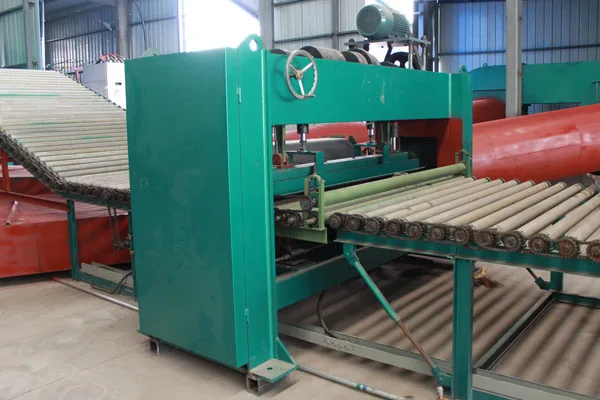
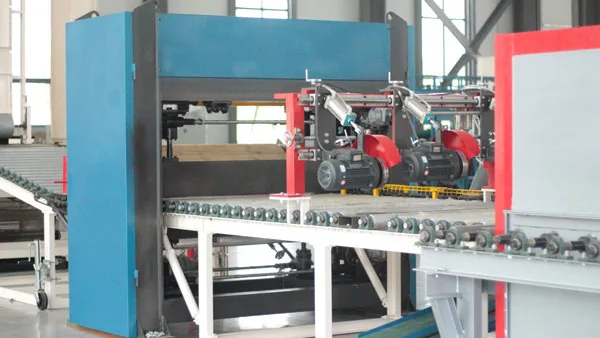
A foil-facing line laminates aluminum foil or foil-reinforced kraft onto one or both faces of an insulation blanket. It is a conversion stage that sits downstream of a blanket line and adds a vapour barrier, a radiant heat reflector and a clean handling surface to the base product.
The process looks simple — apply adhesive, bring foil and blanket together, nip, cure, slit, roll — but the quality outcomes depend on three details: adhesive coat weight consistency, nip pressure uniformity across the web, and web tension control through the whole span. Poor tension control shows up as foil wrinkling and edge curl, which is the most common complaint in this product category.
Foil-faced products are sold into HVAC duct insulation, building envelope insulation and appliance thermal barriers, where the vapour barrier performance is as important as the thermal resistance. If your market includes any of those, foil-facing capability converts a commodity blanket into a specified product with a better margin.
| Web Width | Up to 1220mm |
|---|---|
| Line Speed | 5 – 25 m/min (configuration dependent) |
| Base Material | Ceramic fiber blanket, glass wool, rock wool |
| Facing Material | Aluminum foil, foil-scrim-kraft (FSK), reinforced foil |
| Foil Thickness | 7 – 50 μm |
| Adhesive | Water-based or hot-melt, gravure or spray application |
| Lamination | One-side or two-side (configurable) |
| Embossing | Optional in-line embossing unit |
| Slitting | Rotary slitting to ordered widths |
| Tension Control | Closed-loop dancer + load cell |
| Control System | PLC + HMI with recipe storage |
| Power Supply | 380V/50Hz/3Phase (customizable) |
How a foil-faced blanket production line runs from raw material to finished product
Where the output of this line is used
Foil-faced wrap and duct liner where vapour barrier performance is specified.
Wall, roof and floor insulation with an integrated vapour retarder.
Reflective barriers for ovens, water heaters and white goods.
Engineering decisions that show up in your daily operating cost
Load-cell feedback on both unwinds and dancers through lamination keeps foil flat. Wrinkling and edge curl are tension problems, not adhesive problems.
Gravure application with controlled coat weight prevents the two failure modes in this product: dry spots that delaminate, and excess adhesive that bleeds at the edges.
Configuration change is a recipe and roller-gap change, so short runs of two-side product do not cost you a shift of changeover.
Common questions before ordering a foil-faced blanket production line
Other production lines we build
Technical guides and buyer resources
Send us your capacity requirement and product specifications for a tailored proposal.
Get a Free Quote