
The Two Numbers That Define a Blanket Order
Every ceramic fiber blanket order reduces to two numbers: thickness and density. Thickness — commonly from 6 mm up to 50 mm — sets how much insulation you get and how the blanket conforms to the surface it is wrapping. Density — commonly 64 to 160 kg/m³ — sets how much fiber is packed into that thickness, which drives thermal performance, mechanical strength and compression resistance. Get these two numbers right and the blanket performs; get them wrong and the best-made blanket on the market is the wrong product.
Both numbers are produced, not just specified, at the needling stage, which is why understanding them is as much a production question as a purchasing one.
Thickness: What It Means in Service
Thickness is the single largest lever on a blanket's insulation value. Thermal resistance rises with thickness, so a 50 mm blanket insulates substantially better than a 25 mm blanket of the same density. The trade-off is conformance: thicker blanket is stiffer and harder to wrap around tight radii, while thin blanket conforms easily but provides less insulation per layer.
Common thicknesses run from 6 mm — thin felt-like blanket for wrapping and gasketing — through 13 mm, 25 mm, 38 mm and 50 mm for furnace lining and other high-temperature insulation. The choice is driven by how much insulation the application needs and how much conformance the installation demands.
Density: What It Means in Service
Density sets the fiber content per unit volume, and it drives three properties:
- Thermal performance — within the normal range, a denser blanket insulates better at a given thickness, up to the point where the fiber is so packed that convection and conduction trade-offs flatten the gain.
- Mechanical strength — denser blanket is stronger and handles better during installation, because there is more fiber interlock holding it together.
- Compression resistance — denser blanket resists the compression of being packed and shipped, and recovers better when it is the resilient spring in a furnace lining or module.
The common commercial densities — 64, 96, 128 and 160 kg/m³ — give a graded range from lightweight and economical up to dense and high-performance.
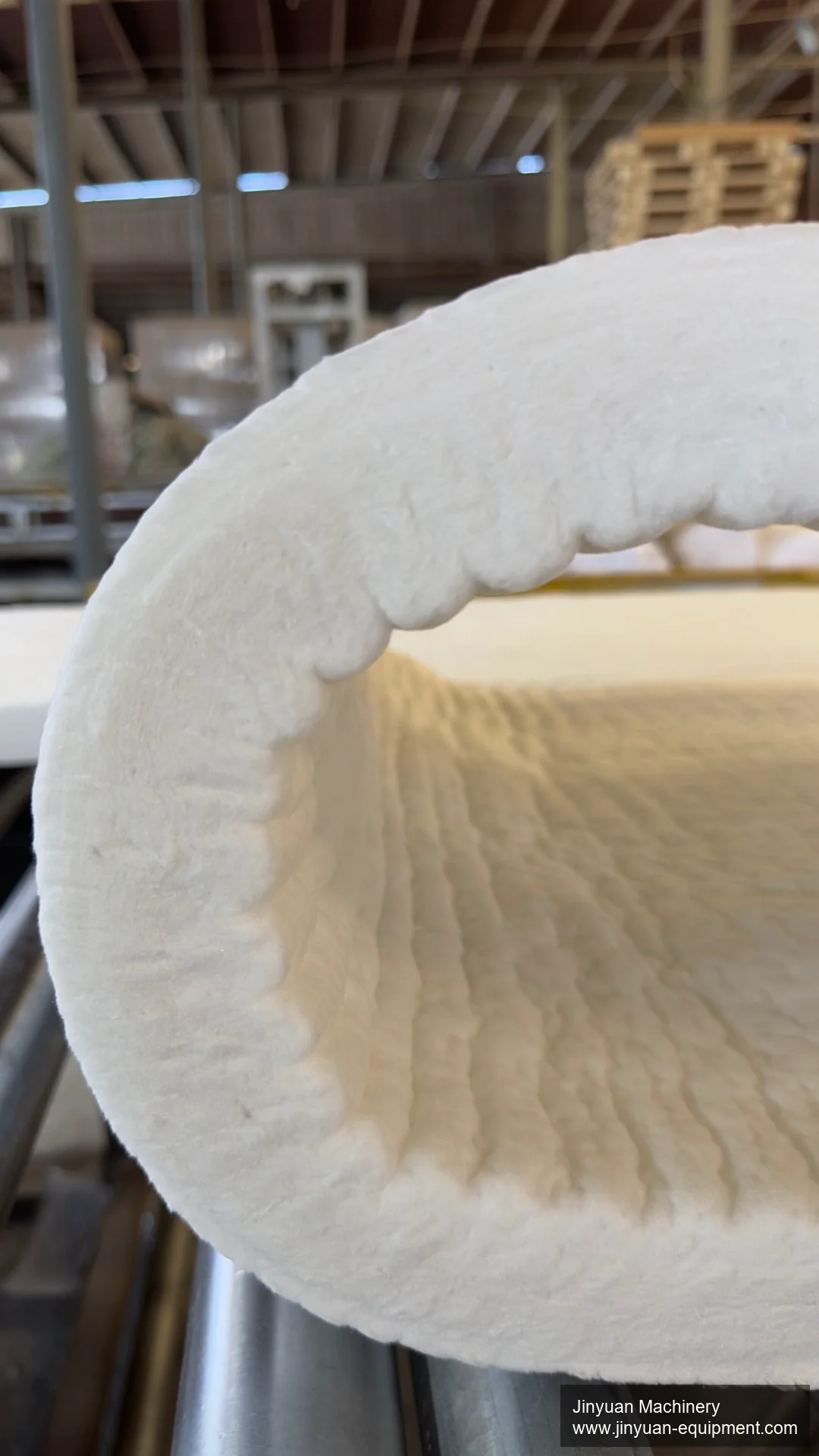
How the Line Produces Each Combination
Thickness and density are not independent — they are produced together at the needling stage, and this is where the production side of the choice lives:
- Thickness is set by the web feed and the needling setup — how much fiber is laid and how the web is built before and during bonding.
- Density is set by penetration density — how many needle penetrations per unit area compact the web — which follows from stroke rate and line speed.
The needle specification is graded by thickness — heavier needles for thick blanket, finer for thin — so that a 50 mm heavy blanket and a 6 mm felt are each bonded with the right tool. A line set up to run the full commercial range is a line whose needling stage can switch between thickness-graded needle sets and stroke rates.
Choosing the Right Combination
The selection logic in practice runs like this:
- High temperature, thick lining — thick, denser blanket (e.g. 50 mm at 128–160 kg/m³) for maximum insulation and compression resistance in furnace linings.
- General insulation — mid-thickness, mid-density (e.g. 25 mm at 96–128 kg/m³) as the workhorse for piping and equipment insulation.
- Wrapping and gasketing — thin, lighter felt (e.g. 6 mm at 64–96 kg/m³) where conformance and drape matter more than maximum insulation.
The point is that thickness and density are chosen against the application, not in the abstract — and the line that produces them is specified to reach the combinations your market actually orders.
The Bottom Line
Thickness and density are the two numbers that define a blanket order: thickness drives insulation value and conformance, density drives thermal performance, strength and compression resistance. Both are produced at the needling stage — thickness by the web and needling setup, density by penetration density — with the needle set graded by thickness. Choose them against the application, and specify the line to produce the combinations you sell.
Related Reading
Continue with these guides and equipment pages: