
What Needle Punching Actually Does to the Web
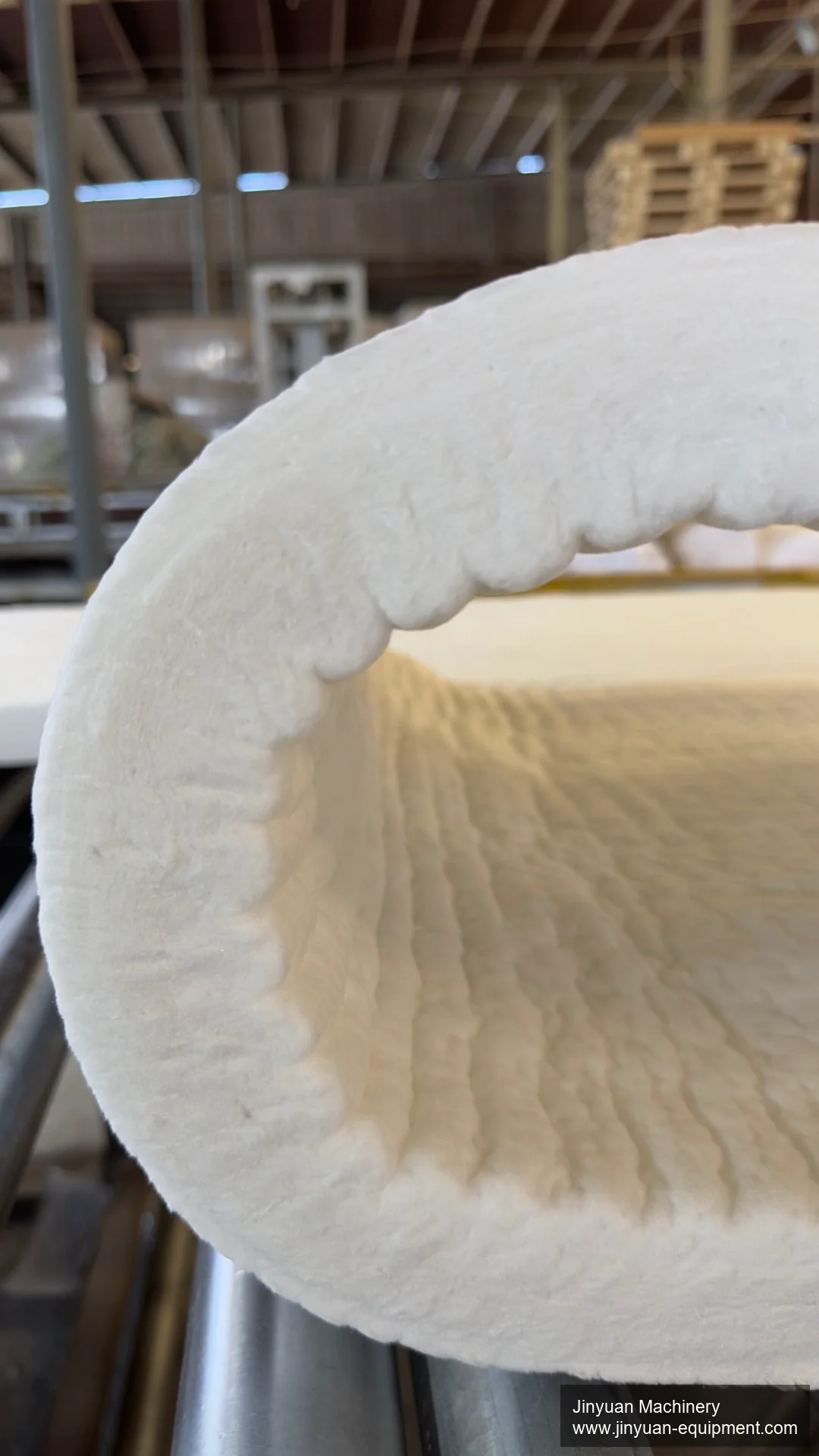
Needle punching is a mechanical bonding process with no binder. The needle loom drives rows of barbed needles through the laid fiber web; as each needle penetrates, its barbs catch individual fibers and drag them down through the web, re-orienting and entangling them. Repeating this thousands of times per minute turns a loose, laid web into a cohesive, handleable blanket.
The two product properties that needle punching directly controls are density and tensile strength. They are not incidental outcomes — they are the reason the needling stage exists, and they are set there, quantitatively, by how the needling is configured.
Density: How Much Fiber Ends Up in Each Unit Volume
Blanket density — typically specified in the 64–160 kg/m³ range for commercial blanket — is the mass of fiber per unit volume of finished product. Needle punching sets it by how much the web is compressed and entangled as the needles work it.
More penetrations per unit area — a higher penetration density — mean more fiber is pulled into interlock, compacting the web and raising density. Penetration density is the product of stroke rate and line speed: higher stroke rate or slower line speed gives more penetrations per metre of web, and therefore higher density.
The upper bound is set by the fiber and the needle: past a point, more needling stops adding density and starts damaging the web — overworking the fiber into a stiff, brittle sheet. The goal is the penetration density that reaches the target density without crossing that line.
Tensile Strength: How Well the Fiber Holds Together
Tensile strength is the web's resistance to being pulled apart, and it comes from the same mechanism — fiber interlock. Longer, more entangled fibers create more interlock points per unit volume, and more interlock points mean higher tensile strength.
This is where the connection to the upstream spinning machine becomes concrete. Spun fiber is long and uniform, which is exactly what needle punching needs to build interlock. Short fiber and high shot content create weak planes where the blanket tears, no matter how well the needling is set. Tensile strength is a needling-stage property, but it is built on fiber that was drawn well upstream.
The Parameters That Set Both
Density and tensile strength are not set by a single dial — they are the combined output of the needling parameters acting together:
- Penetration density — set by stroke rate and line speed; the primary lever on density.
- Penetration depth — how far the needle barbs reach into the web; sets whether the core is bonded or only the surface.
- Needle specification — gauge, blade length and barb pattern; sets how aggressively each penetration bonds.
- Board layout — single- or double-board; double-board bonds uniformly through the full thickness.
Change any one and you move both density and tensile strength, usually together and usually with side effects. A blanket needled too aggressively reaches its density but overworks the fiber, losing tensile strength and developing a stiff, brittle feel. A blanket needled too lightly stays soft but falls short on both density and strength. The target is the setting combination that lands on the specification without crossing into overworking.
Why the Spec Must Come First
The practical lesson is that you cannot set up a needling stage sensibly without knowing the product specification. Density and tensile strength targets come from the product grade; the needling parameters are then derived from those targets together with the blanket thickness. A needling stage set up "to run blanket" without a specific density and tensile target is a machine producing an unspecified product — it will land somewhere, but not necessarily where the customer's order says it must.
The Bottom Line
Needle punching sets blanket density and tensile strength through penetration density and fiber interlock. Density follows penetration density — stroke rate and line speed — while tensile strength follows interlock, built on long, low-shot fiber drawn upstream. Set the parameters together against the product specification, and the needling stage produces exactly the blanket the grade calls for.
Related Reading
Continue with these guides and equipment pages: