
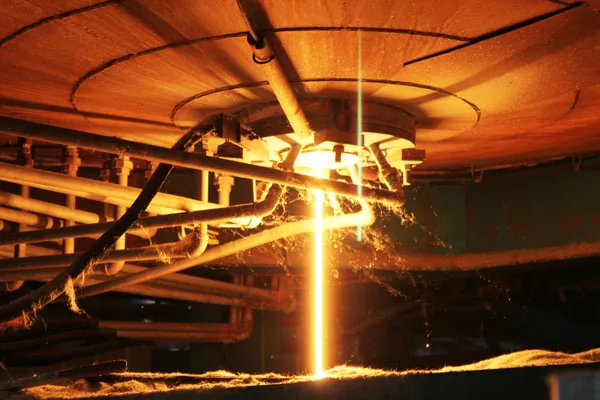
Two-roller centrifugal fiberising — the stage that decides fiber diameter, shot content and the grade ceiling of everything downstream
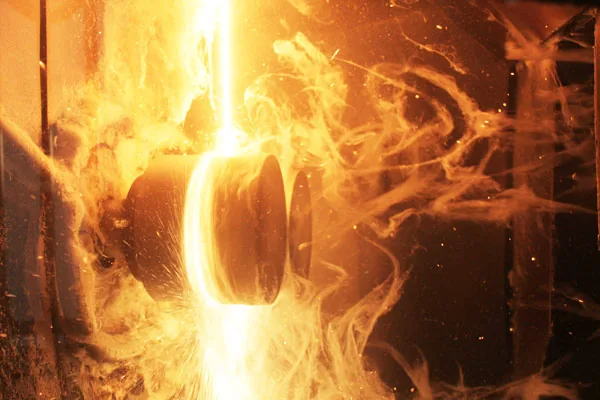

The spinning machine — also called a centrifugal fiberising machine or, in some markets, a spinner — is the stage where molten alumina-silicate material is converted into fiber. The melt stream from the furnace is delivered onto a set of high-speed rollers; centrifugal force throws the material off the roller edges and draws it into fine fiber before an air stream carries it to the collection chamber. Every downstream product in a ceramic fiber plant begins here.
Because it is the first conversion step, the spinning machine sets the quality ceiling for the whole plant. Fiber diameter distribution, shot content and the handling behaviour of the fiber are all decided at this stage, and no amount of downstream needling, forming or wet-processing will recover a fiber that was drawn badly. That is why we treat the fiberising section — not the melting furnace alone — as the most important engineering decision on the line.
The industry has converged on the two-roller configuration. The older three-roller design added a third roller to the attenuation chain but was phased out around a decade ago: it cost more to build, drew more power and needed more maintenance without a compensating gain in fiber quality. When we size a spinning section today, the two-roller machine is the default, with roller diameter, roller speed and melt feed each specified around your target fiber grade rather than a catalogue figure.
| Fiberising Method | Centrifugal spinning (high-speed rollers) |
|---|---|
| Roller Configuration | Two-roller (current industry standard) |
| Fiber Diameter | 2 – 5 μm (spun fiber) |
| Shot Content | < 15% (spun, non-fiberised) |
| Melt Feed | From electric arc / resistance furnace |
| Melt Temperature | Approx. 2000°C (per grade) |
| Roller Drive | Variable-frequency, high-speed (per roller diameter) |
| Fiber Transport | Air stream to collection chamber / cyclone |
| Feeds Downstream | Blanket, board, cotton, felt, paper forming |
| Control System | PLC + HMI + SCADA (remote capable) |
| Power Supply | 380V/50Hz/3Phase (customizable) |
How the melt becomes fiber at the spinning section
Where the spun fiber goes next
Spun fiber feeds pendulum forming and needle punching for blanket and felt — the largest market for ceramic fiber.
Low-shot spun fiber is the preferred feedstock for wet-formed board and wet-laid paper, where shot causes pinholes and weak spots.
Baled spun fiber sold to converters without their own melting capacity, or used directly as loose-fill insulation.
Engineering decisions that show up in your fiber quality and roller life
The two-roller design is the current standard because it costs less to build, draws less power and is easier to maintain than the retired three-roller layout — with no penalty in fiber quality. We size roller diameter and speed to your target fiber grade.
Roller speed, melt temperature and melt flow rate are controlled as a set, because diameter drift is always a combination of the three — not a single setting you can correct in isolation.
Shot content drives downstream needle wear and surface defects. Removing unfiberised particles before collection costs less than replacing needles and scrapping blanket later.
Common questions before ordering a spinning machine
Other machines and lines we build
Technical guides on the fiberising stage
Send us your target fiber diameter, shot content and annual tonnage for a tailored proposal.
Get a Free Quote