

Wet-laid paper manufacturing for thin, flexible high-temperature gasketing

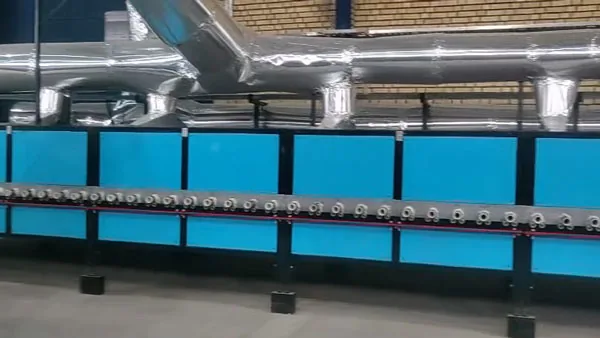
Ceramic fiber paper is a thin, flexible sheet made by a wet-laid process closely analogous to conventional papermaking. Bulk fiber is dispersed in water with a small binder fraction, formed on a wire at very low basis weight, dewatered, dried and calendered. The result is a sheet that can be die-cut, folded and wrapped — the thinnest and most formable product in the ceramic fiber family.
It fills the gap that needled products cannot. Below roughly 3mm, needling becomes impractical and paper takes over. Typical uses are gasketing, expansion joint filling, wrap for irregular shapes and electrical or thermal insulation in tight clearances. Because the sheet is thin and low-mass, even a modest line covers a large area of finished product.
The two process parameters that decide quality are formation uniformity at very low basis weight and controlled shrinkage through the dryer. Formation defects show as thin spots and pinholes; uncontrolled shrinkage shows as curl and dimensional drift. Both are addressed in the forming head design and the dryer tension profile, which is where we concentrate the engineering.
| Annual Capacity | 200 – 1,500 tons/year |
|---|---|
| Classification Temperature | 1260°C / 1350°C / 1430°C |
| Thickness Range | 0.5mm – 6mm |
| Roll Width | Up to 1200mm |
| Basis Weight | Approx. 100 – 1200 g/m² (thickness dependent) |
| Density | Approx. 180 – 250 kg/m³ |
| Forming Method | Wet-laid on forming wire |
| Binder Content | Low, organic binder burned out in service |
| Drying | Multi-cylinder or through-air dryer |
| Finishing | Calendering, slitting, rewinding |
| Control System | PLC + HMI with basis weight monitoring |
| Power Supply | 380V/50Hz/3Phase (customizable) |
How a ceramic fiber paper production line runs from raw material to finished product
Where the output of this line is used
Die-cut gaskets for furnace doors, flanges, manways and access panels.
Compressible filler for expansion joints and irregular gaps in refractory linings.
Thin wrap insulation for tight clearances, electrical insulation and heat shields.
Engineering decisions that show up in your daily operating cost
The forming head and dilution system are designed for uniform sheet at 0.5mm, which is where thin spots and pinholes originate on under-specified lines.
Independent zone tension prevents the curl and dimensional drift that come from drying a thin sheet too fast at the wet end.
Process water is recovered, screened and returned, which matters more on paper than any other ceramic fiber line because of the water-to-fiber ratio.
Common questions before ordering a ceramic fiber paper production line
Other production lines we build
Technical guides and buyer resources
Send us your capacity requirement and product specifications for a tailored proposal.
Get a Free Quote