
A ceramic fiber blanket line fails or succeeds on paper long before the first roller turns. The planning task is to reconcile four forces that pull in different directions: the process flow wants a short, straight, one-way line; energy and environmental rules want containment, extraction and recovery hardware everywhere; safety and fire codes want separation distances and protected zones; and the automation roadmap wants capacity reserved today for sensors and systems that may only arrive in year three.
The fiberizing zone — melting plus spinning — is where all four forces collide. It is the most heat-intensive, most mechanically complex and most frequently maintained area of the plant, and the quality of its planning directly decides capacity attainment and regulatory compliance. This article walks the full planning scope: workshop layout, zone design parameters, energy benchmarking, environmental and fire compliance, automation headroom, and the investment structure — ending with the checklist we run before any layout is frozen. For the buyer's-side view of specifying a line, see our production line buyer's guide.
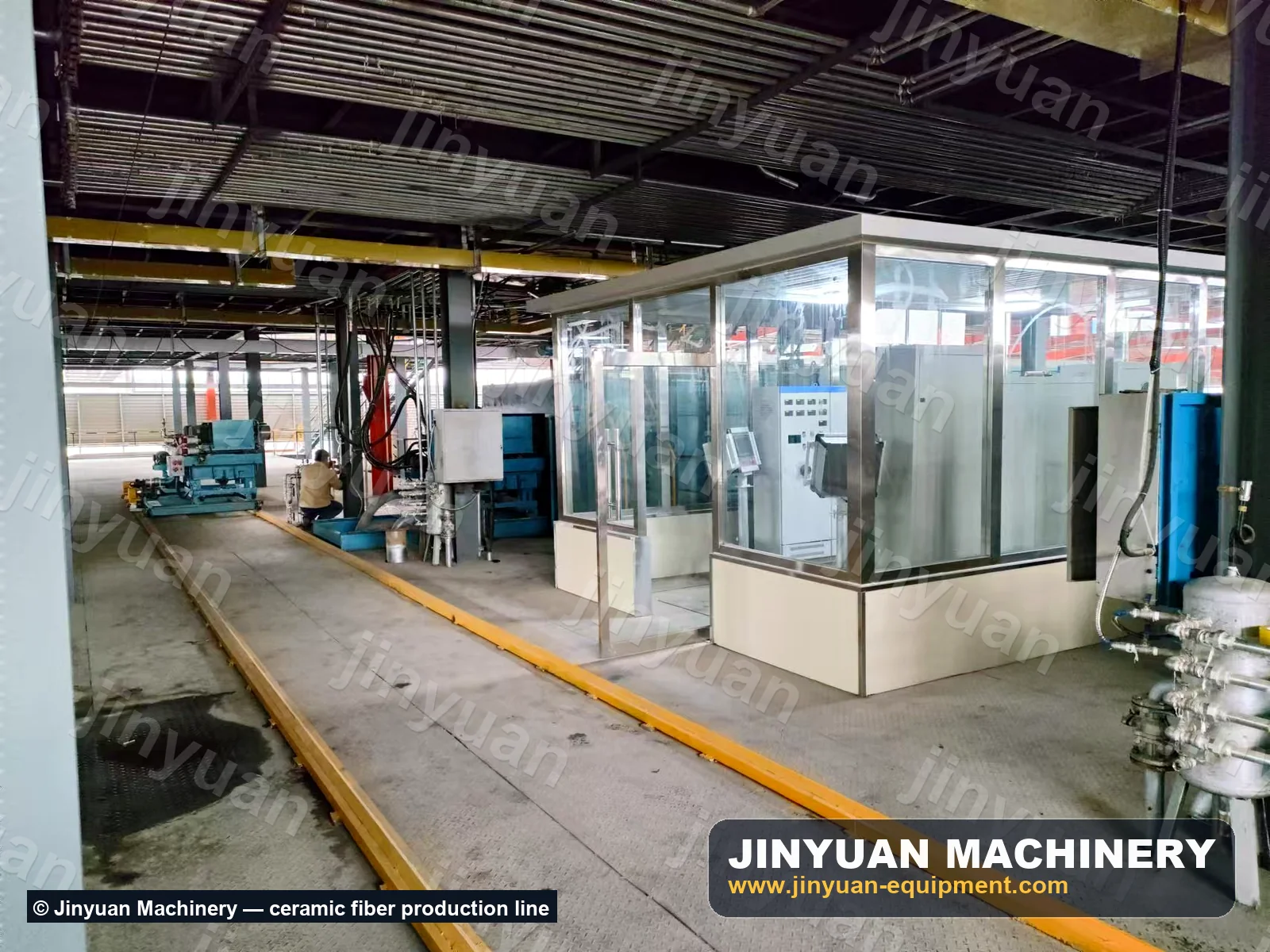
Process Flow and Workshop Layout
The process flow is fixed by the process itself — there is exactly one sensible direction:
Raw material storage & batching → Melting (resistance or arc furnace) → Fiberizing (spinning machine) → Collection (fiber collector) → Needle punching (double-sided needle loom) → Heat setting (blanket furnace) → Slitting & winding → Finished goods / dispatch
Six layout rules follow from that flow (field practice):
- One-way flow, no backtracking. Material moves from raw to finished without crossing itself — this prevents contamination of finished blanket by raw-material dust and keeps forklift routes from intersecting.
- Fiberizing sits next to the furnace. A short melt launder means less temperature loss between furnace and rollers, and melt temperature directly drives fiber diameter stability. Every extra meter of launder is a diameter-control problem you chose to have.
- Slitting and winding sit near the dispatch door. Finished rolls are the bulkiest material in the plant; minimizing their travel saves the most handling.
- Maintenance access and spares near the fiberizing zone. The spinning machine is the highest-frequency maintenance point on the line (roller service, bearing checks). Walking distance here is downtime.
- Keep collection ducting short and straight. Every bend adds pressure loss and becomes a fiber deposition point that needs cleaning.
- Reserve automation space from day one. Floor space, power and routing for automatic thickness gauging, automatic weighing and AGV transfer — even if none of it is in phase one.
The process steps behind each zone are detailed in our production process walkthrough, and the equipment-level view in the production line overview.
Zone-by-Zone Design Parameters
Each zone has one or two design decisions that dominate its performance. The reference values below are the planning figures we start from (industry reference and field practice):
| Zone | Key Design Points | Reference Parameters |
|---|---|---|
| Melting | Furnace body water cooling, furnace temperature held within ±10–20 °C, adequate power supply capacity | Resistance furnace ≈120 kWh/t |
| Fiberizing | Spinning machine water cooling and oil-mist lubrication utilities, negative-pressure extraction, maintenance platform | Spinning rollers ≈9,500–9,600 rpm |
| Collection | Negative-pressure air system, duct sealing, fiber recovery | Air velocity sized to collection efficiency |
| Heat setting | Silicon-carbide rod heating, zoned temperature control, exhaust gas extraction | Multi-zone temperature control |
| Slitting & packaging | Cross and length cutting, weighing and winding | Automation preferred |
| Environmental | Baghouse filtration ≥99%, dust recycling | Complies with GB 16297 |
Two notes on this table. First, the roller speed figure describes the spinning rollers on a modern two-roller machine — the current industry standard that replaced three-roller machines; see our two-roller vs three-roller comparison. Second, the furnace temperature band is the honest industrial figure: ±10–20 °C, not the ±5 °C sometimes quoted from laboratory furnaces. The control and instrumentation layer that holds these parameters is covered in our electrical and automation system article.
Energy Planning: Benchmark Against GB 40877
Energy compliance is a hard gate for a new line in China, not a soft target. The governing standard is GB 40877-2021, the national norm for energy consumption per unit of product, which sets three tiers of electricity-consumption limits for ceramic fiber. A new line is expected to meet the advanced value, or at minimum the tier-3 limit (national standard).
| Item | Planning Basis |
|---|---|
| Standard | GB 40877-2021, energy consumption limit per unit of product |
| Metric | Electricity consumption per tonne of ceramic fiber, three limit tiers |
| Compliance bar | New lines: advanced value or at least tier-3 limit |
| Reference figures | Resistance furnace ≈120 kWh/t; arc furnace 1–2 t/h at 200–500 kW |
Five measures move a design toward the advanced tier (industry reference):
- Furnace waste-heat recovery — preheating raw material or winter space heating.
- Multi-stage PID temperature control — cutting holding losses across the furnace zones.
- Variable-frequency drives on fans, the collection system and slitting — the largest parasitic loads.
- Low-conductivity, high-alumina furnace lining — less shell heat loss, less power to hold temperature.
- Concentrated production scheduling — cold starts are the single most expensive operating state; fewer of them is pure savings.
A line that falls below the tier-3 limit faces production restrictions, electricity price surcharges or mandatory rectification. The energy figure belongs in the equipment technical agreement and in the acceptance protocol — a supplier who will not commit to a kWh/t number at acceptance is telling you something.
Environmental Compliance: the "Three Simultaneities"
Chinese environmental law requires that environmental facilities be designed, built and commissioned simultaneously with the main works — the "three simultaneities." In practice this means the baghouse, ductwork and noise control are not a follow-up project; they are in the main contract, on the main schedule, from day one.
| Item | Requirement | Basis |
|---|---|---|
| Three simultaneities | Environmental facilities designed, built and commissioned with the main works | Environmental Protection Law |
| Dust emission | Baghouse ≥99% efficiency, within emission limits | GB 16297-1996 |
| Noise | Boundary noise within limits | GB 12348-2008 |
| Solid waste | Baghouse dust and edge trim recycled or disposed of compliantly | EIA approval |
| Energy | Unit product electricity within limit tiers | GB 40877-2021 |
| Occupational health | Dust and noise protection at operator positions | Occupational health standards |
On cost: a published environmental impact assessment for a ceramic fiber products project (1,800 t board, 900 t felt, 5,000 t modules) records total investment of 20 million RMB, of which environmental investment is 2.232 million RMB — about 11.2% (public record). Treat roughly a tenth of the budget as non-compressible compliance spending. Buyers outside China should map this logic onto their local permitting regime — the four categories (air, noise, waste, occupational health) exist in every jurisdiction even where the standard numbers differ.
Safety and Fire Protection Design
Five risk sources drive the safety design of a fiber line:
| Risk Source | Design Countermeasure |
|---|---|
| Molten material / furnace body | High-temperature signage, anti-scald guarding, emergency drench points |
| High-speed spinning rollers | Interlocked guards, lockout-tagout for maintenance access |
| Electrical fire | Fire-resistant control cabinets, fireproof cable coating, zoning |
| Dust accumulation | Scheduled cleaning, negative-pressure extraction, no open flames |
| Occupational health | Local exhaust at operator positions (face velocity ≥1.2 m/s), noise protection |
Fire protection design follows GB 50016 (the building fire protection code), and respiratory PPE is supplied to GB 2626. Emergency provisions — extinguishers, first aid, emergency lighting, evacuation routes — are checked against the fire review, not assumed. Our production line safety article goes deeper into operator-level protections.
Automation and Digital Headroom
The cheapest automation upgrade is the one you never have to retrofit. Plan in layers, and make the first phase generous with what later phases will need:
| Layer | Phase-One Configuration | Reserved for Upgrade |
|---|---|---|
| Equipment | PLC control, variable-speed drives, online bearing temperature and vibration monitoring | Additional sensor points |
| Process | Furnace PID control, melt-flow monitoring | Laser stream gauging, automatic thickness feedback |
| Management | Production data logging, batch traceability (furnace number → chemistry → finished-roll code) | MES integration |
| Optimization | Energy statistics | Thermal-field simulation, energy benchmarking dashboards |
The working rule is simple: reserve 30% spare electrical I/O points, 50% spare cable-tray routing, and keep every data interface open (field practice). A line built this way accepts sensors, gauging and MES connections as bolt-on work. A line built without it faces panel rebuilds and cable re-pulls that cost several times the original reservation — which is why so many "phase two" automation plans quietly die.
Investment Structure: Where the Money Goes
Absolute investment varies widely with capacity, land, power tariffs and local policy — only a feasibility study produces a bankable number. The structure, however, is stable across projects (industry reference, experience-based shares):
| Cost Block | Typical Share | Notes |
|---|---|---|
| Melting + fiberizing system (furnace + spinning machine) | 30–40% | Highest technical threshold; defines line capability |
| Collection + needling + heat treatment | 20–25% | Mature domestic equipment |
| Slitting, packaging + auxiliaries | 10–15% | — |
| Building and civil works | 15–20% | Including fire protection and ventilation |
| Environmental + safety + utilities | 10–15% | Compliance-driven, non-compressible |
Read this table as a sanity check on quotations. The melting and fiberizing block is where capability lives: a quote that prices it well below 30% has usually under-specified the furnace, the spinning machine, or both — and the shortfall shows up later as diameter instability, roller problems and capacity shortfalls. How the core machine itself should be specified is covered in our spinning machine technology guide, and the durability side in built tough, run smart.
The Pre-Freeze Planning Checklist
Before a layout is frozen and contracts are signed, every item on this list should have a written answer:
| # | Checklist Item | Pass Criterion |
|---|---|---|
| 1 | One-way process flow fixed | Fiberizing adjacent to furnace; no material backtracking |
| 2 | Energy benchmarked against GB 40877-2021 | A documented path to the required limit tier |
| 3 | Three simultaneities in the main contract | Environmental works on the main schedule, not a follow-up |
| 4 | Fire, explosion-zoning and occupational health reviews passed | Signed-off special reviews |
| 5 | Automation headroom reserved | 30% I/O, 50% tray routing, open data interfaces |
| 6 | Utilities calculated | Power capacity, cooling water, compressed air all sized |
Items 2 and 3 are the ones most often deferred — and the two that regulators will not let you defer after the fact. For the supplier-selection side of the same project, see how to choose a ceramic fiber blanket line.
Frequently Asked Questions
How do you lay out a ceramic fiber blanket production line?
Lay the line out as a one-way flow: raw material storage and batching, melting furnace, fiberizing (spinning machine), fiber collection, double-sided needle punching, heat setting, slitting and winding, then finished goods and dispatch. Keep the fiberizing zone immediately beside the furnace so the melt launder is short and temperature loss stays minimal — melt temperature drop directly destabilizes fiber diameter. Put slitting and winding near the dispatch door to cut finished-roll handling, put maintenance access and the spares store near the fiberizing zone (the highest-maintenance area), keep the collection ducting short and straight to reduce pressure loss and fiber build-up, and reserve floor space and utilities for later automation such as automatic thickness gauging, weighing and AGVs.
How much electricity does a ceramic fiber production line use?
As a planning benchmark, a resistance-furnace line consumes roughly 120 kWh per tonne of product, while an arc furnace is rated by throughput — typically 1–2 t/h at 200–500 kW. In China, new lines must also satisfy GB 40877-2021, the national energy-consumption limit standard for unit product electricity use, which sets three tiers of limits. A new line is expected to reach the advanced value or at least the tier-3 limit; falling below the limit brings production restrictions, surcharges or mandatory rectification. The energy figure should be written into the equipment technical agreement and verified at acceptance, not treated as a brochure number.
What environmental requirements apply to a ceramic fiber plant in China?
Four regimes apply. First, the three-simultaneities rule of the Environmental Protection Law: environmental facilities must be designed, built and commissioned together with the main works. Second, dust: baghouse filtration at 99% or better efficiency to meet the emission limits of GB 16297-1996. Third, boundary noise must comply with GB 12348-2008. Fourth, solid waste — baghouse dust and edge trim — must be recycled or disposed of as approved in the environmental impact assessment. On cost, a published EIA for a ceramic fiber products project (1,800 t board, 900 t felt, 5,000 t modules) shows environmental investment of 2.232 million RMB out of a 20 million total — about 11.2% — which is a realistic, non-compressible share of any compliant build.
How much does it cost to build a ceramic fiber blanket production line?
Total cost depends heavily on capacity, land, power tariff and local policy, so a feasibility study is the only reliable number. The stable part is the structure: the melting and fiberizing system (furnace plus spinning machine) typically takes 30–40% of the budget and carries the highest technical threshold; collection, needling and heat treatment take 20–25%; slitting, packaging and auxiliaries 10–15%; the building itself, including fire protection and ventilation, 15–20%; and environmental, safety and utility works 10–15%. If a quotation shows the melting and fiberizing share far below 30%, the core equipment has usually been under-specified.
What safety measures does a ceramic fiber plant need?
Design against five risk sources. Molten material and furnace bodies need high-temperature signage, anti-scald guarding and emergency drench points. High-speed spinning rollers — which run around 9,500–9,600 rpm — need interlocked guards and lockout-tagout for maintenance. Electrical fire risk is handled with fire-resistant control cabinets, fireproof cable coating and zoning. Dust accumulation is controlled with scheduled cleaning, negative-pressure extraction and a strict no-open-flame rule. Occupational health requires local exhaust at operator positions (face velocity at least 1.2 m/s) and noise protection. Fire design follows GB 50016 (the building fire code) and respirators are supplied to GB 2626.
How should a new line be designed for future automation upgrades?
Follow the spare-capacity rule: reserve 30% spare electrical I/O points, 50% spare cable-tray routing, and keep every data interface open from day one. A sensible first phase already includes PLC control, variable-speed drives, online bearing temperature and vibration monitoring, furnace PID control, melt-flow monitoring and batch traceability from furnace number through chemistry to finished-roll code. The reserved capacity then absorbs later additions — laser stream gauging, automatic thickness feedback, more sensor points, MES integration and energy benchmarking dashboards — without rebuilding panels or re-pulling cable. Retrofitting automation into a line that was not designed for it typically costs several times the original reservation.