
A ceramic fiber blanket starts as a pile of clay and alumina powder and leaves the line as a flexible, heat-resistant felt that can wrap a furnace at 1260 °C. Nothing chemical happens in between that a refractory engineer would call a reaction. What happens instead is a chain of physical operations — melt, stretch, collect, entangle, stabilize — each of which must hit a numeric window, or the product fails a spec somewhere downstream.
This guide walks the full dry-process route: raw material batching, resistance-furnace melting at 1900–2200 °C, centrifugal spinning, vacuum collection, double-sided needle punching, heat setting, and slitting and rolling. For each stage we give the parameters that matter, what goes wrong when they drift, and what the operator on the floor actually watches. It is written for the three people who need it most: the engineer specifying a line, the operator running one, and the manager auditing quality.
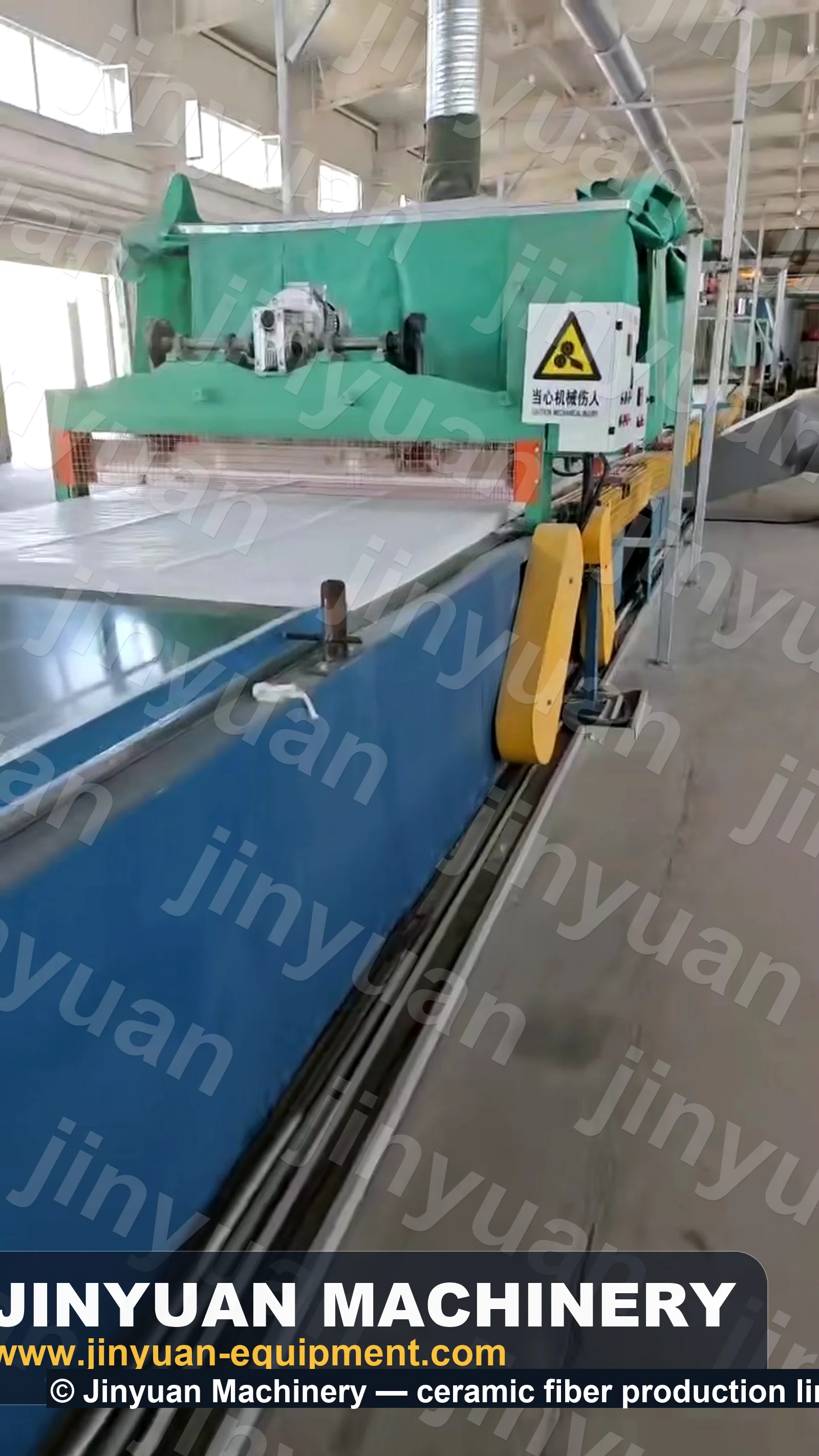
The Process at a Glance
Every mainstream needle-punched blanket line in the world follows the same seven-stage sequence:
| # | Stage | What happens | Key number |
|---|---|---|---|
| 1 | Batching | Clay, calcined kaolin and alumina weighed and blended | Al₂O₃/SiO₂ 45/55–50/50 |
| 2 | Melting | Resistance furnace, molybdenum electrodes | 1900–2200 °C |
| 3 | Fiberizing | Two-roller centrifugal spinning | 3–4.5 µm, 150–250 mm |
| 4 | Collection | Fiber laid on a belt under vacuum suction | thickness tolerance < 5% |
| 5 | Needling | Double-board needle loom, both faces | 200–300 punches/cm² |
| 6 | Heat setting | SiC-element furnace burns out lubricant, stabilizes the felt | 800–1200 °C |
| 7 | Finishing | Slitting, cutting to length, thickness gauging, rolling | to order |
Typical values are industry reference; furnace and loom parameters vary by product grade and equipment generation.
Stage 1: Raw Material Batching — Where Composition Is Locked In
Two raw-material routes feed the industry. The natural route uses hard clay chamotte, calcined kaolin (known in China as jiaobaoshi) and kaolin — cheap, widely available, and good enough for standard 1260 °C grades. The synthetic route uses alumina powder and silica flour, milled and blended for high-purity and high-alumina products where alkali and iron impurities must be held down.
The chemistry target is an alumina-to-silica ratio between 45/55 and 50/50 for standard grades (industry reference), with iron oxide kept at or below 1.2% and alkali metals controlled tightly, because impurities lower the service temperature and raise shrinkage. Two properties that buyers of finished blanket rarely think about — but that dominate melt behavior — are particle size and moisture consistency of the batch. A wet or unevenly milled batch changes melt viscosity hour by hour, and the spinning machine feels it immediately as fiber diameter drift and shot spikes.
The physics of why composition controls fiberization — the viscosity window, the temperature sensitivity — is covered in detail in our article on the physics of ceramic fiber formation.
Stage 2: Melting — 1900–2200 °C in a Water-Cooled Steel Shell
Most continuous blanket lines melt in a resistance furnace: a steel shell, cooled by circulating water, with three molybdenum electrodes immersed in the melt. The melt itself is the heating element — current passes through the ionized molten charge and dissipates heat volumetrically. Large furnaces draw hundreds of kilowatts; temperature sits in the 1900–2200 °C band common to both furnace types.
| Resistance furnace | Electric arc furnace | |
|---|---|---|
| Heating principle | Three molybdenum electrodes; melt heats by its own ionic conductivity | Arc discharge between electrodes |
| Temperature | 1900–2200 °C | 1900–2200 °C |
| Power class | Medium and large lines, hundreds of kW | 200–500 kW |
| Throughput | Continuous tapping | ≈ 1–2 t/h |
| Best fit | Mainstream continuous blanket lines | Small or batch-type lines |
Manufacturer data and industry reference values; furnace sizing depends on line capacity.
What the operator actually manages is not the setpoint but the stability of it. Industrial furnaces hold temperature within roughly ±10–20 °C (field practice) — not the ±5 °C sometimes quoted in idealized literature — and that band is tight enough, because melt viscosity moves steeply with temperature and viscosity is the first gate of fiber quality. Melt flow rate is the twin variable: it must match what the spinning machine can stretch, which is why modern lines interlock flow and roller speed in the PLC (see our guide to line electrical and automation systems).
Melting is also the most hazardous zone on the line: molten splash above 1900 °C, water-jacket leaks flashing to steam, and high-power electrical systems. We cover the specific controls in safety on a ceramic fiber blanket production line.
Stage 3: Fiberizing — The Spinning Machine
The melt stream falls onto a distribution roller that spreads it into a film, then onto a high-speed spinning roller whose peripheral speed — around 150 m/s on the current two-roller generation — centrifugally stretches the film into fiber in a single transfer. Compressed air assists the stretch, cools the fiber below its working point, and carries it toward the collection chamber. The result, on a healthy line, is fiber of 3–4.5 µm diameter and 150–250 mm length with low shot content.
The equipment generation matters here more than anywhere else on the line. Today's standard in China — where most new capacity is built — is the two-roller machine: one distribution roller, one spinning roller, compressed-air assist. It replaced the three-roller layouts of the 1980s–2000s because a single transfer stretches the melt without the fiber-shortening second and third roller contacts, and because two bearing sets maintain faster than three. The full story is in our comparison of two-roller and three-roller spinning machines, and the machine itself is described in ceramic fiber spinning machine technology explained.
An alternative process exists — blowing, which uses a high-velocity air jet instead of a roller to stretch the melt. Blown fiber is finer (2–3 µm) but short and shot-rich. Both processes have legitimate products; only one of them can make blanket, and the reason is the next stage.
Stage 4: Vacuum Collection — Building the Batt
Fiber and air arrive at a steel-framed collection chamber: a mesh belt conveyor running under a negative-pressure plenum. Suction pulls the fiber down uniformly onto the belt, where it accumulates as a randomly oriented, lofty batt. Belt speed versus fiber feed rate sets the area weight and thickness — the two numbers that, multiplied by density, decide whether the roll will stamp 96, 128 or 160 kg/m³.
| Control point | Target | If it drifts |
|---|---|---|
| Laydown thickness uniformity | variation < 5% | finished blanket thick/thin spots |
| Batt area weight | matched to 96 / 128 / 160 kg/m³ grade | density out of spec |
| Moisture and lubricant carryover | uniform, trace | needle slippage; smoke in the heat-setting furnace |
Targets are manufacturer process requirements; tolerance practice varies between plants.
Uniformity at this stage is cheap and uniformity lost here is expensive: nothing downstream — not needling, not heat setting — can repair a batt that was laid down unevenly.
Stage 5: Needle Punching — Where Blanket Becomes Blanket
The batt enters the needle loom still a cloud of fibers with almost no cohesion. Barbed needles mounted in boards reciprocate through it at high frequency, and with each stroke the barbs drag fibers perpendicular to the plane, stitching the layers to each other. After several thousand penetrations per square meter, the batt is a felt: strong enough to tension, fold and ship without tearing.
Blanket lines use double-board looms that punch from both faces alternately. Compared with single-sided needling, the double-board arrangement delivers measurably higher tensile strength and a much lower delamination risk, because both surfaces are consolidated rather than one worked and one passive. The trade-offs between single and double boards are compared in single-board vs double-board needling.
| Parameter | Typical range |
|---|---|
| Needle punching density | 200–300 punches/cm² |
| Penetration depth | 10–15 mm |
| Stroke rate (machine capability) | up to ≈ 800 strokes/min |
Industry reference; Dilo-class loom data for stroke capability. Actual settings are tuned per density and thickness.
Two corrections to common assumptions. First, stroke rate and punching density are not the same thing: a heavy-blanket loom may run near 130 strokes/min at 50 Hz in real production (field practice) because penetration depth — not speed — limits the cycle on thick batt. Machine capability and process setting live in different ranges. Second, punching density is not "more is better": below ~200 punches/cm² the felt lacks interlock and delaminates; push too far the other way and the needles mill the fiber into short fragments, the board face densifies, and the blanket loses the compressibility and resilience that make it useful. The optimum is found per product by trial — the relationship between density, needling and tensile strength is analyzed in needle punching density and tensile strength, and needle selection by blanket thickness in needle specifications for blanket thickness.
Stage 6: Heat Setting — The Furnace That Finishes the Job
The needled felt passes through a tunnel furnace heated by silicon carbide elements, conveyed on heat-resistant steel rollers with instrument-controlled temperature zones. Three things happen in the 800–1200 °C soak (industry reference, set by product grade):
- Burnout — residual process lubricant and any trace binder from the collection stage are incinerated;
- Dimensional stabilization — the felt relaxes into its final thickness and loses the internal stresses needling introduced;
- Controlled pre-crystallization — a mild devitrification pre-heat that converts some amorphous fiber to fine crystalline phase, suppressing the shrinkage the blanket would otherwise suffer in the customer's furnace.
Residence time runs 4–6 hours depending on thickness and density, with conveyor speed tied to the soak schedule. The failure mode operators watch for at the furnace exit is under-set blanket — felt that re-expands or changes dimension after rolling — which is why furnace exit temperature deserves a permanent probe on the control panel.
Stage 7: Slitting, Cutting and Rolling
Out of the furnace, the blanket is slit lengthwise into ordered widths, cross-cut to length, measured by an electronic thickness gauge, and rolled or stacked and wrapped against moisture and dust. This stage looks trivial next to a 2200 °C furnace, but slitting accuracy is what decides how cleanly blankets butt-joint inside a furnace lining — a 5 mm width error shows up as a visible seam gap at installation. Roll diameter, length and marking follow the order.
Dry Process vs Wet Process — And Why Blanket Is Always Dry
The seven stages above describe the dry process. A parallel wet-process family exists, and knowing where the boundary sits clarifies what a blanket line can and cannot make.
| Dry process (needle-punched) | Wet process (vacuum forming) | |
|---|---|---|
| Forming | Mechanical needling of a dry batt | Fiber dispersed in water slurry, vacuum-dewatered |
| Binder | None or trace; burned out in heat setting | Organic/inorganic binders required |
| Strengths | Continuous production, low energy, no wastewater, long fiber retained | Very uniform density; complex shapes possible |
| Limits | Thickness/density uniformity harder to hold | Wastewater treatment, higher energy, lower throughput |
| Typical products | Needle-punched blanket, modules | Boards, pipe shells, special shapes, paper |
Needle-punched blanket and modules together account for roughly 45% of total ceramic fiber output (industry estimate). The dry route's long-fiber advantage exists only because spinning — not blowing — makes the fiber; the entire pairing of spinning machine plus needle loom is one technology choice expressed as two machines.
The Five Control Points That Decide Final Quality
Strip away the detail and five variables explain most quality outcomes on a blanket line:
| Stage | Variable | Controls |
|---|---|---|
| Melting | Temperature stability (±10–20 °C), melt flow | Viscosity window → fiber diameter, shot |
| Fiberizing | Roller speed matching (stretch ratio), roller surface state | Diameter distribution, shot rate |
| Collection | Vacuum level, belt speed | Area-weight uniformity |
| Needling | Density, depth, frequency | Tensile strength, delamination |
| Heat setting | Temperature, soak time | Linear shrinkage, crystallization |
Each row is a gauge or a recipe in the PLC. A plant that logs all five against batch quality data accumulates, within months, a process database that turns troubleshooting from archaeology into lookup. The deeper mechanisms are covered in fiber diameter control and shot content in spun fiber.
What a Line Costs to Run: Energy and Capacity Reference Points
| Item | Reference value | Source |
|---|---|---|
| Melting power (resistance furnace) | hundreds of kW, scales with furnace size | manufacturer data |
| Arc furnace throughput | 1–2 t/h | manufacturer data |
| Single-line capacity (spinning, dry process) | thousand-ton class per year | industry reference |
| Needling density | 200–300 punches/cm² | industry reference |
These numbers are for orientation, not budgeting; actual energy per ton depends on furnace class, utilization, and product mix. For capacity planning and investment economics, treat them as the first filter, not the last word.
Operating Discipline: Five Habits of Consistent Plants
The lines that hold spec month after month share the same habits (field practice, from plants we commission):
- Parameter record cards. Furnace temperature, roller speed, needling settings and heat-setting schedule logged per batch and linked to that batch's quality data. This is the process database above — the cheapest quality system available.
- First-article checks on every changeover. New grade or new thickness means a trial sample checked for diameter, shot, and thickness before the line runs at rate.
- Melt-flow / roller-speed interlock. A flow surge with fixed roller speed is the classic cause of a shot spike; interlocking them in the PLC removes the failure mode.
- Furnace exit temperature monitoring. Catches under-set blanket before it is rolled, rather than after the customer unrolls it.
- Scheduled roller and needle maintenance. Roller surface condition and needle wear are silent quality killers; see spinning machine roller maintenance and needle breakage on needle looms.
If You Are Buying a Blanket Line
The process above translates directly into a specification checklist. Four questions separate generations of equipment:
- Fiberizing: two-roller spinning machine or older layout? This single choice caps the fiber length, shot rate, and product ceiling of the whole line.
- Needling: double-board loom, and is stroke rate matched to your heaviest planned product rather than the brochure maximum?
- Control: does the PLC interlock melt flow with roller speed, and log the five control-point variables per batch?
- Heat setting: zoned temperature control with an exit probe, sized for your thickest product at full rate?
A line that answers all four well will make blanket to spec for a decade. Our production line buyer's guide and the line selection guide expand these into full procurement criteria.
Frequently Asked Questions
What are the main steps in the ceramic fiber blanket production process?
What temperature is used to melt ceramic fiber raw materials?
Why is needle punching used to make ceramic fiber blankets?
Why do blanket lines use spinning instead of blowing to make fiber?
What is the difference between dry process and wet process ceramic fiber production?
What are the most important quality control points in blanket production?
The Bottom Line
A blanket line is seven stages and five control points. The stages — batch, melt, spin, collect, needle, set, finish — are fixed by physics and forty years of industry convergence; what separates a good line from a struggling one is not the sequence but the precision held at each stage: furnace stability inside ±10–20 °C, a two-roller spinning machine feeding long low-shot fiber, a batt laid down within 5%, needling tuned to the product instead of maximized, and heat setting verified at the furnace exit. Buyers should read a line proposal as a list of answers to exactly those five questions — and operators should read their control panels the same way.
Related Reading
Continue with these guides and equipment pages: