
A braiding line is short — a dozen stations from yarn package to packaged roll — but it concentrates a disproportionate amount of process risk into that short distance. Yarn tension, pitch, spindle speed and haul-off are coupled: change one, the other three must follow, and the consequence shows up as a defect that can be seen but not always traced.
This article walks the whole main line. For each station it gives the key control point, the deviation that actually happens on a running machine, and the defect that deviation produces — which is the order an operator needs when a defect appears and the question is where to look. It then covers the upstream yarn preparation that feeds a braider, the material prerequisite that decides whether a fiber can be braided at all, and the acceptance criteria the finished packing is measured against.
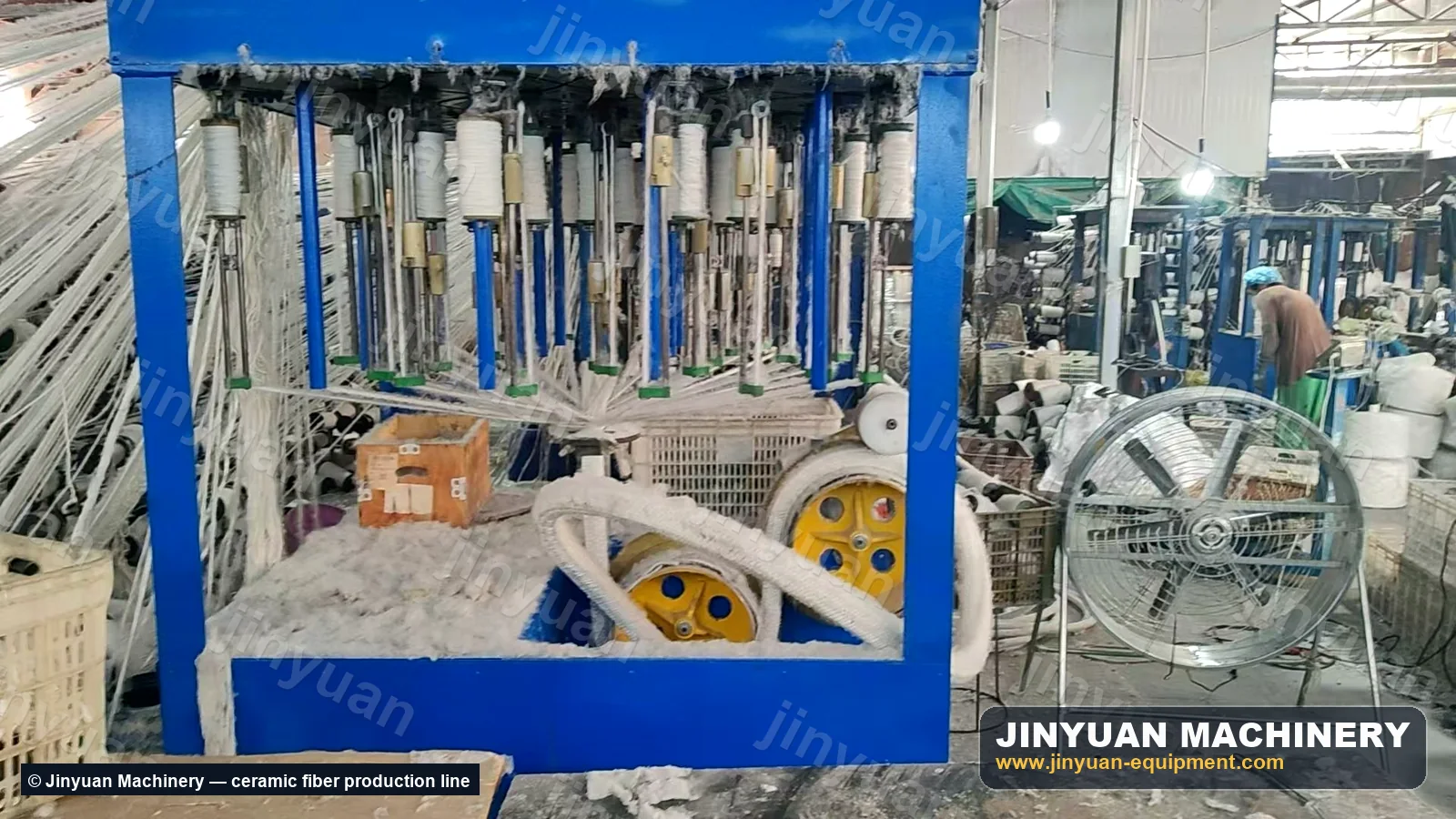
The Twelve Stations of the Main Line
The yarn path is fixed: raw material → bobbin → tension control → braiding point → haul-off → finished product. Expressed as stations inside the braiding workshop:
Raw yarn (spun fiber bulk or ceramic fiber yarn) → bobbin loading → yarn threading (guide rollers, tension drop-weight, ceramic eyelet) → core / reinforcement yarn feed to the braiding point → pitch and haul-off speed setting → braiding (carrier spindles crossing) → impregnation (optional) → haul-off and winding → doffing → cut-to-length → post-treatment / inspection → packing and warehousing
Two inputs join this line rather than start it: the core yarn or reinforcement yarn (316L stainless steel wire, ECR glass fiber yarn) enters directly at the braiding point, and the impregnation emulsion feeds the optional impregnation stage. The fiber that goes into the yarn package comes from an entirely separate workshop — covered further down.
The machinery itself is the upstream-cast counterpart of the fiber line: the yarn is made from bulk fiber spun on a ceramic fiber spinning machine, whose fiber quality decides whether the yarn can be carded and twisted at all.
Station by Station: Control Point, Deviation, Consequence
This is the working table for the shop floor. Each row names one station, the one thing that must be right, the deviation that occurs in practice, and what it costs:
| Station | Key Control Point | Common Deviation | Direct Consequence |
|---|---|---|---|
| Bobbin loading | Bobbin size matched to the spindle (the 336 series takes a φ70 × 165 mm bobbin); left center pin properly engaged with the elastic pin; right center aligned to the bore before the flange sleeve is turned back | Bobbin not clamped, centers out of alignment | Pay-off wobble, bobbin run-out, periodic tension fluctuation |
| Yarn threading | Through guide roller → first eyelet of the tension drop-weight → through the ceramic eyelet → to the braiding point; the path must not cross itself and must not bypass the drop-weight | Drop-weight missed, yarn routed backwards around a guide roller | Reversed tension, frequent break-stop trips, dropped stitches |
| Core / reinforcement feed | Core centered; its tension controlled independently of the outer yarn; reinforcement yarn introduced to the braiding point in step with the outer yarn | Core off-center, reinforcement entering out of phase | Eccentric rope body, locally weak sections, out-of-square cross-section |
| Pitch and haul-off setting | Pitch, haul-off speed and spindle speed matched as a set (see the pitch / braid angle relationship) | Speed changed before threading; parameters not matching the process card | Density uniformly too loose or too tight along the whole run |
| Braiding | Carrier track clear of foreign matter; spindle speed stable; spindle temperature comfortable to the hand (≤60 °C) (industry reference) | Airborne fiber build-up, carrier binding, broken yarn not knotted | Dropped stitches, whiskers, pattern disorder |
| Impregnation (optional) | Inverted high-speed models combine braiding and impregnation using a central emulsion heating plate with powered lift (industry reference) | Emulsion contaminating the yarn path; plate not fully raised or lowered | Locally uneven impregnation, yarn slipping |
| Haul-off and winding | Even pressure across the haul-off rollers, constant winding tension, no overlapping edges | Winding eccentricity, overlapping edges | Finished product bent, pressure marks in the braid |
| Doffing | Power off before doffing; never remove a roll from a running machine | Working on a live machine | Injury risk; yarn tangled beyond recovery |
| Cut-to-length | Standard lengths of 200 / 100 / 50 / 25 / 15 m; negative deviation is not permitted (national standard, GB/T 3003-2006 clause 5.10) | Short lengths released to dispatch | Non-conforming delivery |
| Post-treatment / inspection | Appearance: uniformly tight, smooth surface, closely packed pattern; no broken ends; soft spots, exposed yarn ends, bends and dropped stitches each limited to no more than 3 places within any continuous 10 m; no oil contamination (national standard) | Appearance defects exceeding limits | Judged non-conforming |
| Packing and warehousing | Moisture-proof, dust-proof storage; leftover yarn stored the same way | Yarn exposed to moisture | Moisture content above specification, reduced spinnability on the next run |
Upstream: From Spun Fiber to Ply Yarn
A braider does not make yarn and was never designed to. Yarn preparation runs in a separate workshop along the following route, documented in patent example CN1091788A:
Spun fiber bulk (lubricant present, low shot) → chemical pre-treatment for spinnability → blend with organic fiber → mechanical opening and blending → removal of shot and short fiber → carding into web and splitting into strips → twisting into a carded cake → plying with reinforcement wire and twisting → single yarn → 2–4 yarns plied and reverse-twisted → ply yarn onto the braider
Pre-treatment applies an organic lubricant at 3–8 wt%; the blend adds organic fiber at roughly 6.5% (viscose, cut to length). The material balance in the patent example runs as follows (patent example):
| Process Node | Input | Output | Equipment |
|---|---|---|---|
| Lubricant pre-treatment | 3 kg lubricant + 48 kg water, sprayed onto 1,000 kg ceramic fiber | — | High-speed mixer |
| Organic fiber blending | +65 kg viscose fiber (2.50 × 62 cm) | — | — |
| Opening, shot removal | 1,000 kg ceramic fiber + 65 kg viscose | ≈800 kg blend | Wool opener / blending opener |
| Carding and strip splitting | 800 kg blend + 18.2 tex combed cotton yarn | ≈600 kg 840 tex carded cake | Woolen card |
| Twisting into single yarn | 840 tex cake + φ0.15 mm metal wire | ≈500 kg 1,000 tex single yarn | Flyer ring spinning frame |
| Plying, reverse twist | Two single yarns plied | 2,060 tex two-ply yarn | — |
| Weaving | Two-ply yarn | ≈460 kg, 3 mm thick cloth | Loom, 44 × 24 construction |
The Material Prerequisite: Spun Fiber Only
Before any of this is worth discussing, the fiber itself has to be braidable. The distinction is hard and worth stating plainly (industry reference):
| Fiber Type | Lubricant | Shot / Non-Fibrous Content | Suitability |
|---|---|---|---|
| Spun fiber | Present (applied in production) | Low | Textile raw material — spinnable, cardable, twistable |
| Blown fiber | None — untreated | Higher | Furnace filling, vacuum-formed shapes, fiber paper, coatings. Not a textile raw material |
The mechanism is straightforward: carding and twisting need long, lubricated, shot-free fiber to slide past itself and lock into a yarn. Blown fiber lacks the lubricant and carries more shot; put it through a card and it breaks down instead of drafting. Shot content is the practical quality gate on the spinning side — the subject of our shot content article — and the fiber diameter and length distribution that determine it are set by the formation physics of the spinning process.
Reading the Speed on a Braiding Machine
One trap causes more confusion in braiding specifications than any other: the word "speed." Two unrelated mechanisms both have one, and the numbers differ by more than an order of magnitude (industry reference and field practice):
| Machine Type | What the Figure Describes | Typical Range |
|---|---|---|
| Traveling-head (maypole-type) braider | Main shaft / carrier motion of the whole machine | 300–800 rpm; high-speed machines above 1,200 rpm |
| Square braiding machine (packing) | The spindle itself | BZ-32: 16 min⁻¹; 336-series host: 25 rpm |
Whenever a speed appears — in a quotation, a manual, a process card — the mechanism it refers to has to be stated alongside it. A 25 and a 1,200 are not a slow machine and a fast machine; they are two different measurements of two different things. Quoting one as the other makes any comparison worthless.
Process Parameters and Where They Come From
Braiding parameters should carry their source travel with them, in three categories: plant / equipment documentation (for example bobbin φ70 × 165 mm and 25 rpm host speed from the 336-series manual), industry reference (spindle temperature ≤60 °C, tension adjustment sequence), and standard clauses (length specifications and appearance defect limits from GB/T 3003-2006). A parameter without a category is a parameter nobody can defend when a customer, an auditor or the next shift asks where it came from.
This is also why a process parameter record should be filled in before every production run, and kept — the field list and the record form are what make a defect traceable back to a parameter rather than to an opinion.
Acceptance: Length and Appearance
Finished braided packing is checked against two groups of requirements, both from GB/T 3003-2006 (national standard; export contracts map these to the buyer's local equivalent):
- Length: standard lengths of 200, 100, 50, 25 and 15 m. Negative deviation is not allowed — a short roll is not released regardless of how good it looks.
- Appearance: uniformly tight, smooth surface, closely packed pattern, no broken ends, no oil contamination; soft spots, exposed yarn ends, bends and dropped stitches each capped at three occurrences within any continuous 10 m.
Note what the standard does not require: instrumentation. The two tools that matter at final inspection are a tape measure and a trained eye on a lit surface — which means the defect table further up this article is the inspection procedure, just read in reverse.
Frequently Asked Questions
What is the ceramic fiber braiding process?
Ceramic fiber braiding turns a bobbin of ceramic fiber yarn into finished braided packing or rope. The main line runs through twelve stations: raw yarn, bobbin loading, yarn threading through guide rollers and tension drop-weights, core or reinforcement yarn feed to the braiding point, pitch and haul-off speed setting, braiding where the carrier spindles cross, optional impregnation, haul-off and winding, doffing, cut-to-length, post-treatment and inspection, then packing and warehousing. The yarn path is always raw material, bobbin, tension control, braiding point, haul-off, finished product — one direction, with no backtracking.
Can blown ceramic fiber be used for braiding?
No. Only spun ceramic fiber is a textile raw material. Spun fiber is produced with a lubricant, has low shot content and few non-fibrous inclusions, and its fibers are long enough to card, twist and plait — the combination that makes it spinnable. Blown fiber contains no lubricant and receives no textile preparation; it is a furnace-filling material and a feedstock for vacuum-formed shapes, fiber paper and coatings, not for yarn. Starting a braiding line on blown fiber produces a yarn that breaks down in carding and twisting, and packing that fails on tensile and appearance checks.
Why do ceramic fiber braiding machines have two different speed ratings?
Because two unrelated mechanisms are both called spindle speed. On traveling-head (maypole-type) braiders the figure describes the main shaft or carrier motion — typically 300–800 rpm, with high-speed machines above 1,200 rpm. On square braiding machines used for packing, the figure describes the spindle itself — for example 16 min⁻¹ on a BZ-32 and 25 rpm on a 336-series host. The two numbers differ by more than an order of magnitude. When a quotation, a manual or a process card quotes a speed, the mechanism it refers to must be stated; quoting one as the other invalidates the comparison.
Why is emergency stop prohibited on a braiding machine?
Stopping discipline is a process rule, not a preference. The machine must be decelerated to no-load before the drive is switched off; an emergency stop under load can damage machine parts and throws the yarn into a tangle that has to be re-threaded by hand, losing both material and production time. Doffing is likewise prohibited while the machine is running — power must be off before a finished roll is removed. The same discipline applies to the yarn path: a yarn missed through the tension drop-weight or routed backwards around a guide roller reverses the tension, causing frequent break-stop trips and dropped stitches.
What are the acceptance requirements for braided ceramic fiber packing?
Two groups of requirements apply, both from the Chinese standard GB/T 3003-2006. First, length: braided packing is delivered in standard lengths of 200, 100, 50, 25 and 15 m, and negative deviation is not permitted — short lengths may not be released. Second, appearance: the braid must be uniformly tight, smooth-surfaced and closely patterned, with no broken ends and no oil contamination. Soft spots, exposed yarn ends, bends and dropped stitches are permitted at no more than three places within any continuous 10 m. Material that exceeds these limits is judged non-conforming; the visual check and the tape measure are the two tools an inspector actually needs.
What happens upstream of a ceramic fiber braiding machine?
Braiding machines only form the product; the yarn is prepared in a separate workshop. The route runs spun fiber through chemical pre-treatment with 3–8 wt% organic lubricant, blending with about 6.5% organic fiber such as viscose, mechanical opening and blending, removal of shot and short fiber, carding into a web and splitting into strips, twisting into a carded cake, plying with a reinforcement wire and twisting into single yarn, then two to four single yarns plied and reverse-twisted into the finished ply yarn that goes onto the braider. Those material-balance figures come from patent example CN1091788A and are illustrative of one documented route, not a statement of any current plant's process.