
Maypole braiders that turn ceramic fiber yarn into gland packing, braided rope and sleeve — carrier count, track and braid structure sized to the section you actually sell
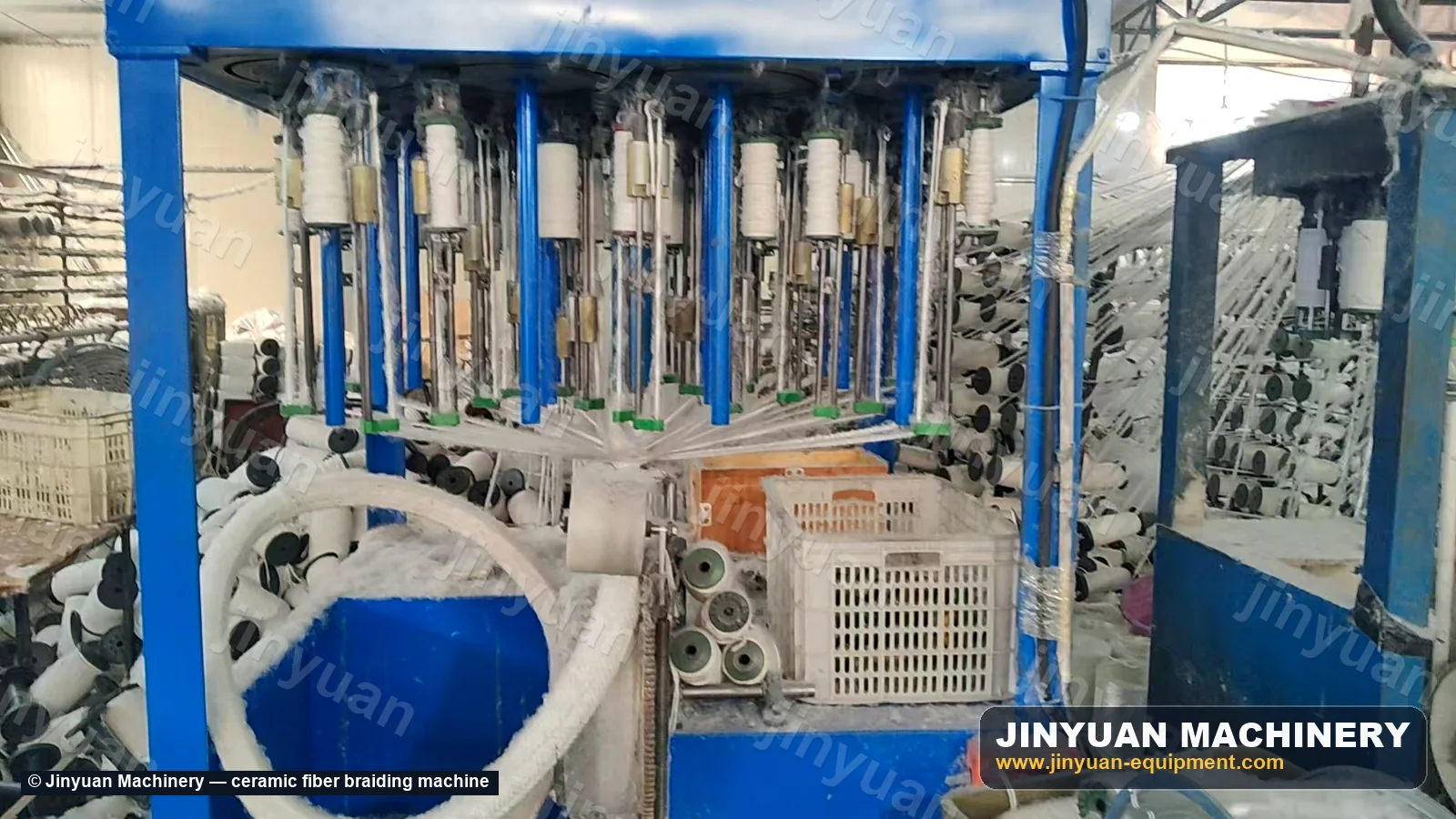
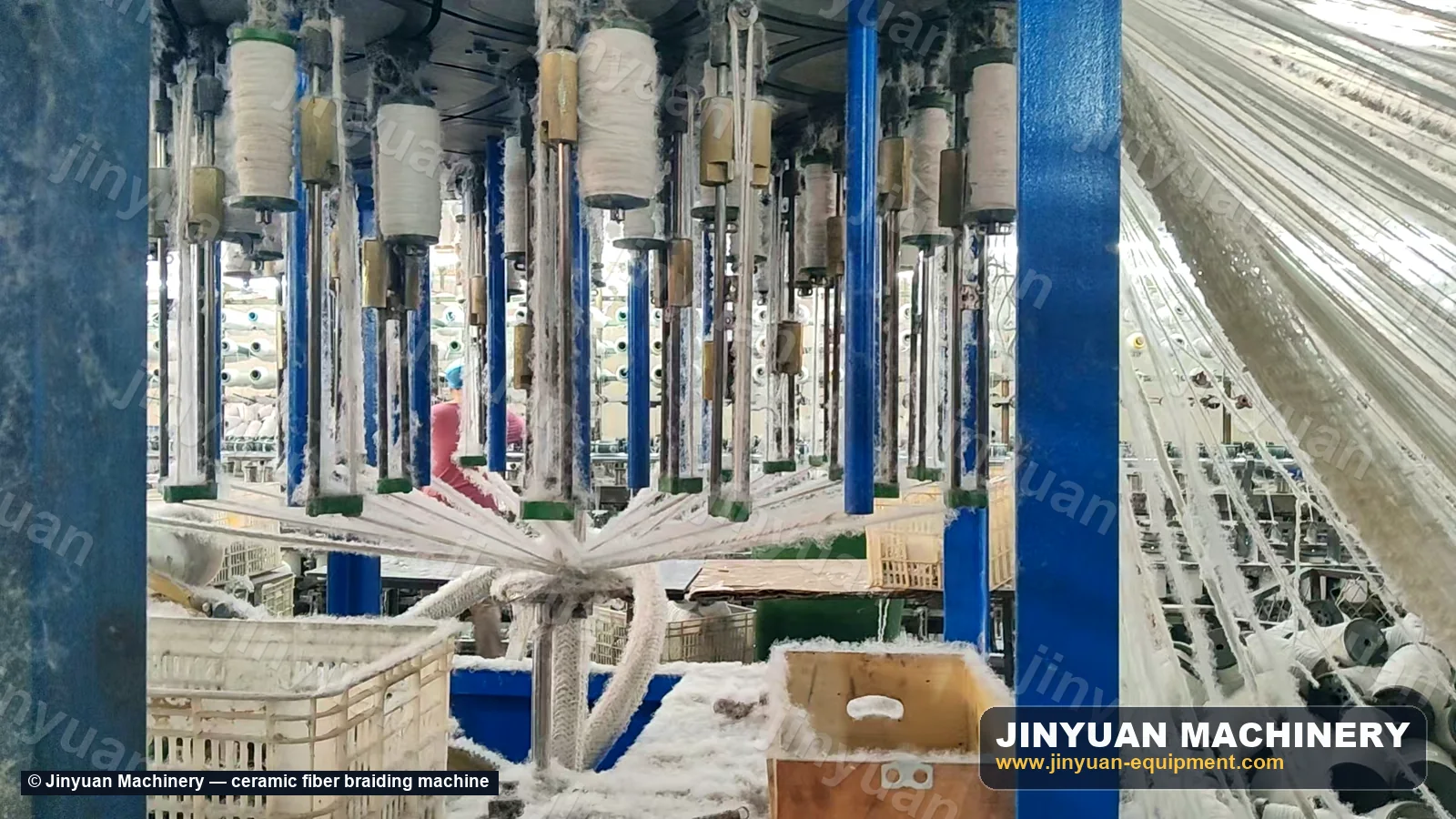
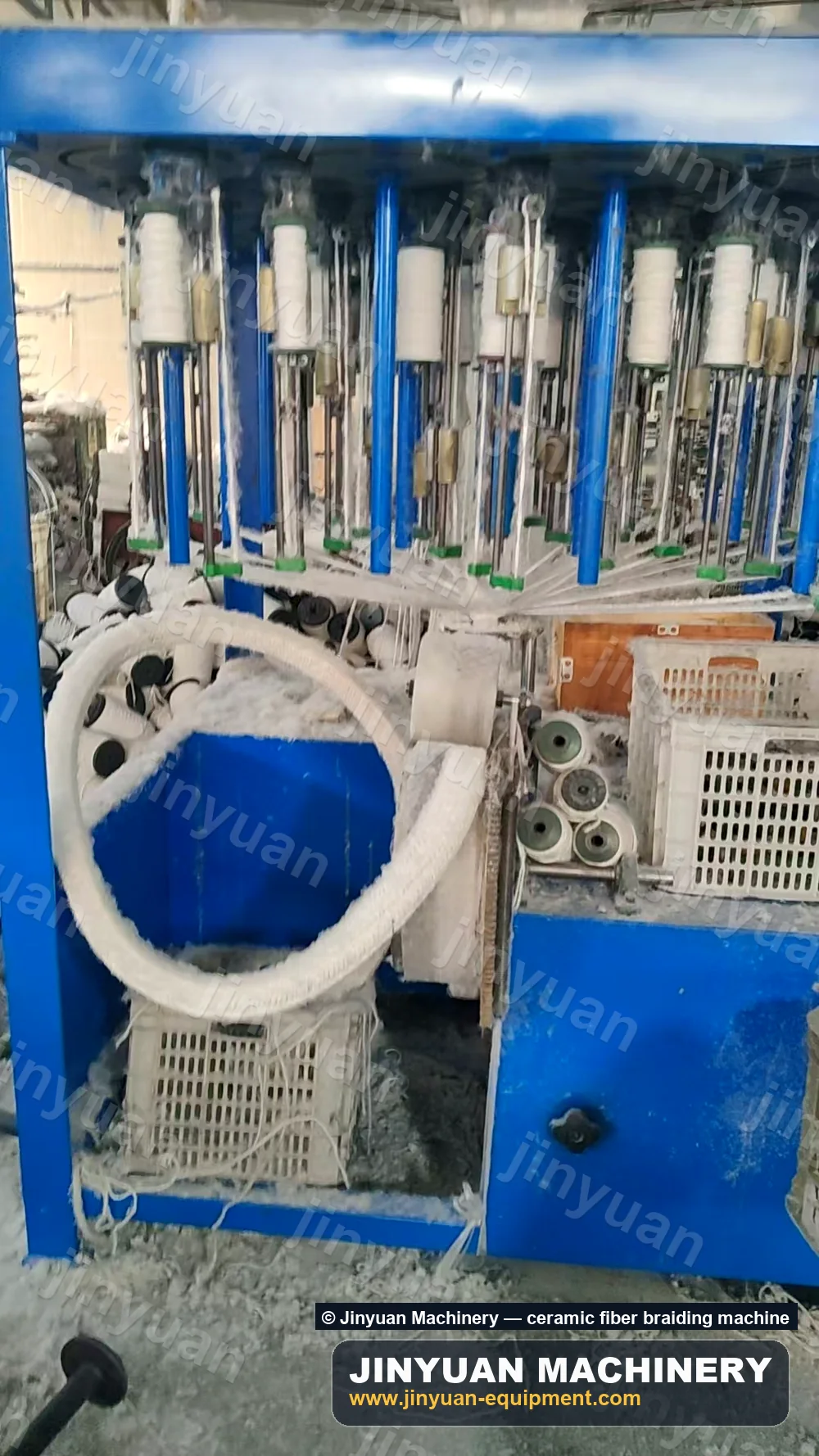
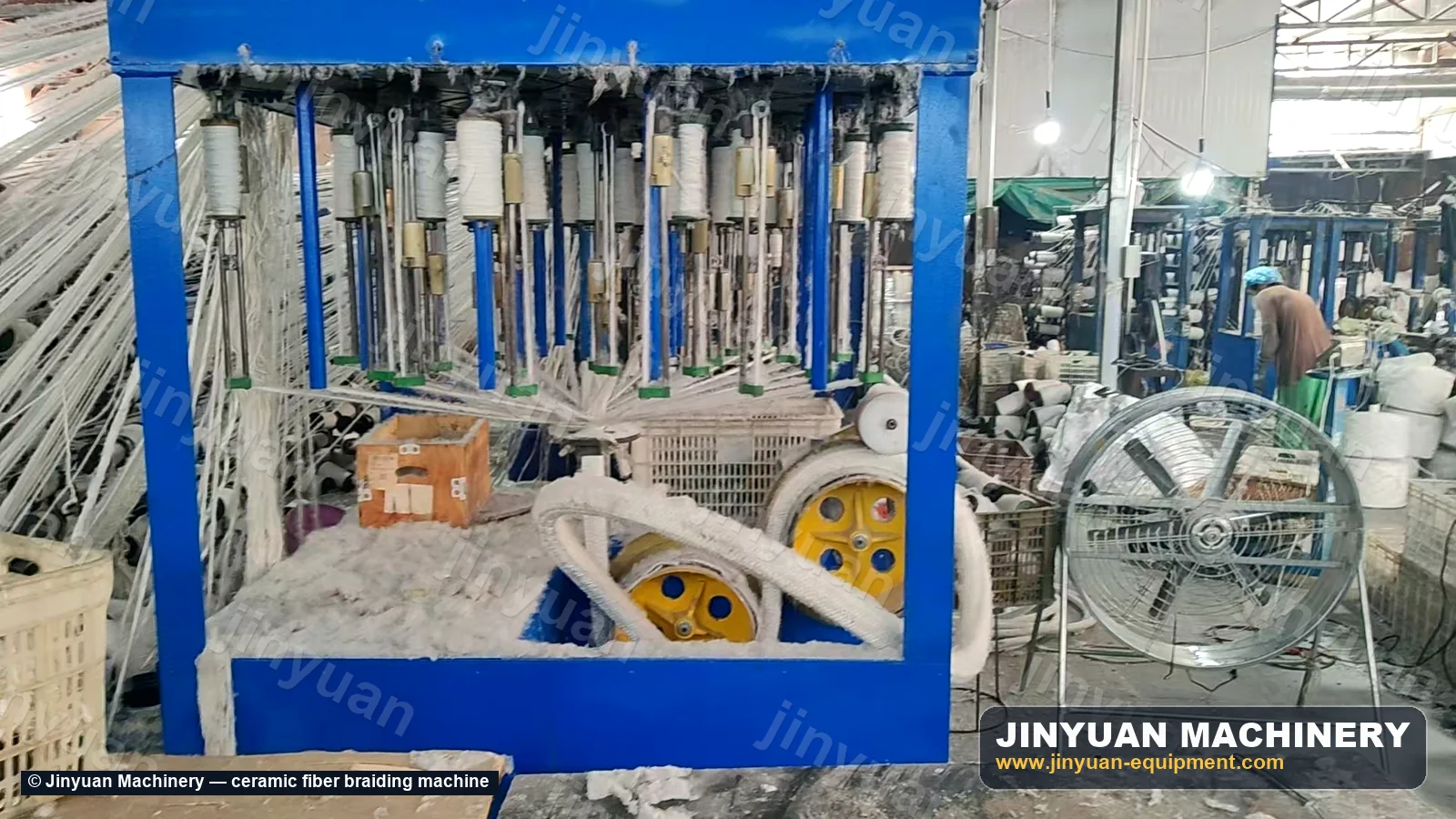
A ceramic fiber braiding machine — a maypole braider — converts continuous ceramic fiber yarn into gland packing, braided rope and sleeve. Yarn packages sit on carriers that travel around a track plate; as the carriers cross, the yarns interlace at the braiding point at the centre, and a take-up pulls the finished braid away. Nothing is heated and nothing is bonded: the product is held together by the geometry of the interlace alone.
That makes carrier count, track count and take-up speed the three decisions that define the machine. Carrier count follows the largest section you intend to sell, because a braid is only as compact as the number of strands crossing inside it. Track count decides whether the strands interlock through the thickness — the four-track square layout is the standard for packing, since a rectangular section seats in a stuffing-box groove in a way a round one cannot. Take-up speed sets the pitch, and pitch is the density dial: at a fixed carrier speed, slowing the take-up packs the strands closer and tightens the braid.
Two layouts are built on the same principle. On a vertical machine the carriers sit upright on the track plate. On an inverted machine the carrier assembly hangs from above, so the yarn runs a shorter and straighter path from package to braiding point — steadier tension, tighter and more even braid, at higher cost, weight and power. Ceramic fiber yarn is brittle and its usable tension window is narrow, so which layout suits you depends on the output you need rather than on a preference for the more expensive machine.
The same machine also runs graphite, carbon fiber, aramid, cotton and oil-resistant packing yarns — useful if you are a converter selling into several sealing markets from one workshop, and a reason we specify quick-release carriers and a documented tension re-calibration routine when changeover frequency is high.
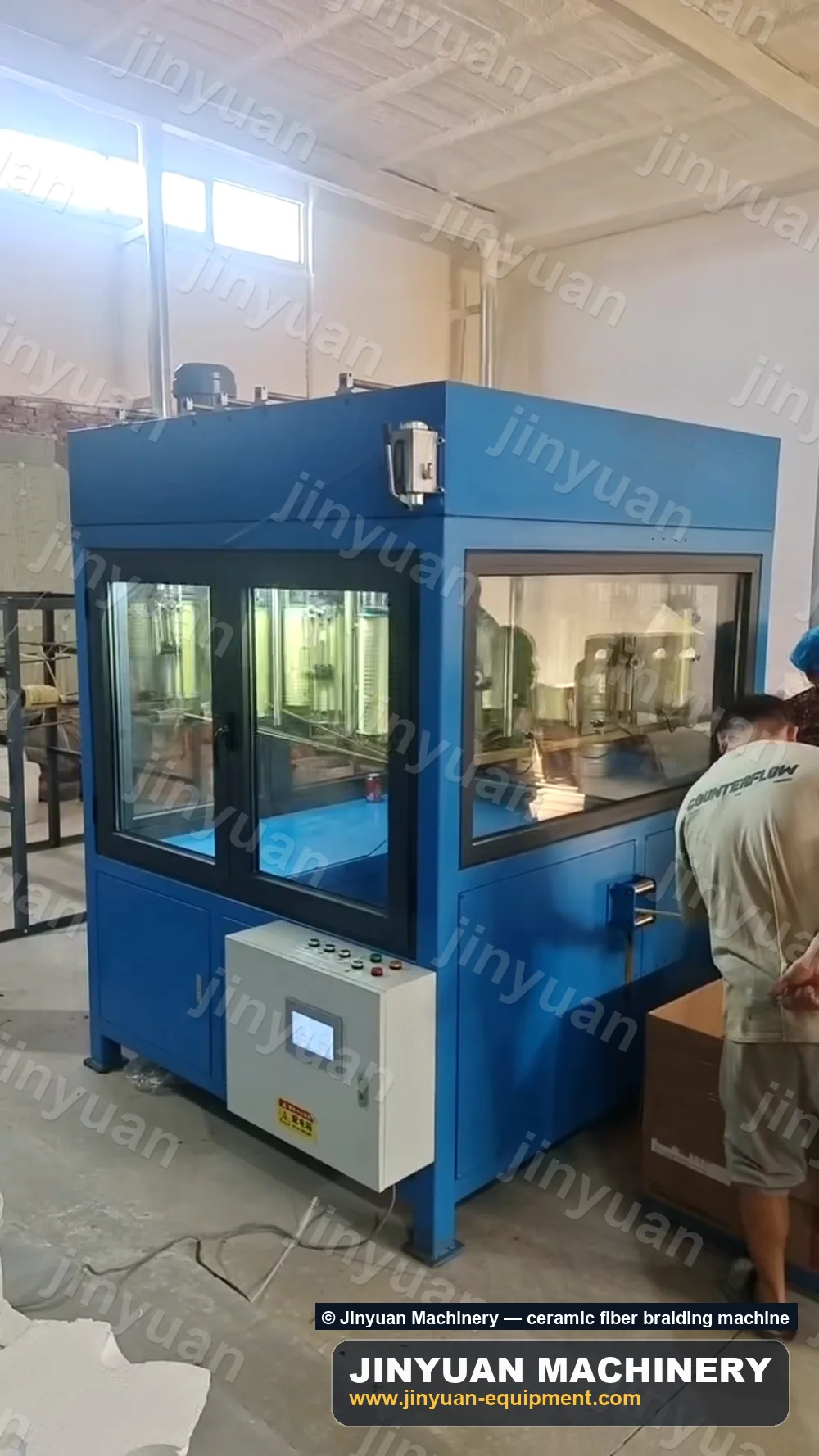
Representative configuration: 32-carrier inverted packing braider, four-track, enclosed.
| Machine Type | Maypole braider, packing and rope |
|---|---|
| Layout | Inverted (hanging carriers) or vertical |
| Carrier Count | 32 (8 / 16 / 24 / 48 / 64 also built) |
| Track Configuration | Four-track interlocking (two-track for tubular and round braid) |
| Bobbin Size | φ70 × 165 mm (larger bobbins on high-speed models) |
| Rotor (Horngear) Diameter | 336 mm class |
| Main Drive | 2.2 kW, constant shaft speed |
| Shaft Speed | 25 r/min, constant (rotor speed — not main-shaft rpm) |
| Take-up | Independent stepless speed control (VFD) |
| Braided Section Range | φ25 – 60 mm round packing on this configuration |
| Typical Output | 200 – 260 m per 8-hour shift, material dependent |
| Overall Dimensions | 1500 × 1500 × 2300 mm (L × W × H) |
| Enclosure | Enclosed frame with toughened glass doors and door-open stop |
| Control | Push-button panel with digital indication; PLC / HMI available |
| Power Supply | 380V/50Hz/3Phase (customizable) |
| Yarn Input | Spun ceramic fiber yarn; optional 316L stainless or E-glass reinforcement |
| Also Runs | Graphite, carbon fiber, aramid, cotton, oil-resistant packing yarns |
Figures above describe one configuration we build, not a fixed catalogue model. Carrier count, track count, bobbin size, drive power and the section range all move together, and every machine is specified against your product list. Treat the table as a starting point for the technical agreement, not as a substitute for it.
Three clips from our own workshop: the machine, the braid forming, and the packing that comes off it
The carrier ring running inside the enclosed cabinet. Spools hang on the carriers; the drive head sits above; the panel at the base carries the speed indication and the door interlock.
Yarn drawn off the packages converging into the cone at the braiding point. Every strand that arrives here has to arrive at the same tension — this is the stage that decides whether the finished packing is even.
Ceramic fiber gland packing straight off the take-up. The interlocked braid structure and the surface finish are what the buyer inspects, and both are decided upstream at the braiding point.
Clips are shot in our own workshop on machines we build. They are muted, run on click, and load only when played — they cost nothing on page load.
What changes between one braiding machine and the next
| Configuration | Options | What It Decides |
|---|---|---|
| Carrier count | 8 / 16 / 24 / 32 / 48 / 64 | The largest and smallest section you can braid compactly |
| Track count | Two-track or four-track | Whether strands interlock through the thickness — four-track for rectangular packing |
| Layout | Vertical or inverted | Yarn path length and tension stability; inverted is the faster layout |
| Braid structure | 2×2 or 3×3 interlace | Surface pattern and how the section holds its shape in service |
| Take-up control | Change gears / mechanical stepless / independent stepless (VFD) | How finely you can trim the pitch, and whether you can trim it while running |
| Enclosure | Open frame or enclosed with toughened glass | Dust containment, noise, and how easily you can watch the braid point |
| Take-off and winding | Level winder / coiler / length counter | How the finished braid is presented for cutting and packing |
| Core and reinforcement feed | Optional | 316L stainless wire or E-glass carrier introduced at the braiding point |
| Options | Impregnation heating plate, auto lubrication, yarn-break stop | Dip finishing, maintenance interval, and unattended running |
One braider, several marketable products — the difference is the yarn and the finishing
Rectangular section from four-track interlocking, with optional core. Sized for rectangular stuffing-box grooves on pumps, valves, agitators and expansion joints. This is the highest-volume product for most customers.
Circular section for round glands and valve stems, and for braided rope used in furnace door sealing, expansion-joint packing and heat-resistant lacing.
Hollow braid with no core, run over cable, pipe and roller to protect against heat and abrasion. A two-track machine with the take-off set for a hollow section.
Square packing sizes follow GB/T 3003–2006, which covers 6×6 mm to 50×50 mm and round 5–50 mm. Some makers advertise square packing up to 100×100 mm; sections above 50 mm sit outside the standard, so tolerances and acceptance criteria have to be agreed with the buyer rather than quoted from the standard.
| Finished Section | Typical Carrier Count | Typical Machine |
|---|---|---|
| Up to 12 mm | 8 | Two-track, small-section, braid or tubular |
| 10 × 10 to 50 × 50 mm | 24 – 32 | Four-track square braider — the standard packing machine |
| Above 50 mm | 48 – 64 and up | Large-section machine; sizes above 50 mm are non-standard |
Note that braiding is not the only way to make a rope. Twisted rope is produced on a twisting machine with no carriers and no track plate, at a fraction of the capital cost. If your market is static sealing rather than braided packing, say so — recommending a braider you do not need helps nobody.
What the operator does, and what the machine does on its own
For the full twelve-station breakdown — including what to check and what goes wrong at each station — see Ceramic Fiber Braiding Process: From Spun Fiber to Finished Packing.
We build the fiber line upstream of it, which changes the conversation
Yarn for braiding has to be spun, and the fiber that goes into it comes off a spinning machine and a cotton line. We supply those. If your braiding problems start upstream in the fiber, we can follow them back — most suppliers of braiders cannot.
Carrier count is the single biggest cost lever on a braider, and it is set by the largest section you intend to sell. We ask for your product list first and size to it. If a smaller machine covers your range, we will quote the smaller machine.
Ceramic fiber is brittle and its usable tension window is narrow, so braid quality is decided by how evenly the carriers pay out, not by nominal speed. Per-carrier tensioning, ceramic eyelets and a documented re-calibration routine come as standard.
“Speed” on a braider means two different things: the rotor or carrier motion, and the take-up in metres per minute. The numbers differ by more than an order of magnitude. We state which one we mean, every time — ask any supplier to do the same before you compare quotations.
The clips on this page were shot in our workshop on machines we build. Ask for video of the specific configuration you are being quoted, running your yarn, before you place a deposit.
Eyelets, friction plates, springs and bobbins are consumables on any braider. We commission on site, train your operators on threading and tension setting, and quote a wear-part kit with the machine so the first year is not spent chasing spares.
What buyers ask before ordering a braiding machine
Upstream machines that feed a braiding line, and other lines we build
Technical guides on the fiberising and braiding stages
Send us your section range, the yarns you intend to run and your target output. We will come back with the carrier count, the layout and the take-up specification that covers it — and say so if a smaller machine would do.
Get a Free Quote